Axiom x Husher Did Not Invent Bundling. It Made It Ordinary.
Axiom's Husher integration brings private multi-wallet funding, consolidation, and aged-wallet sales into one Solana terminal. Here is why traders revolted.


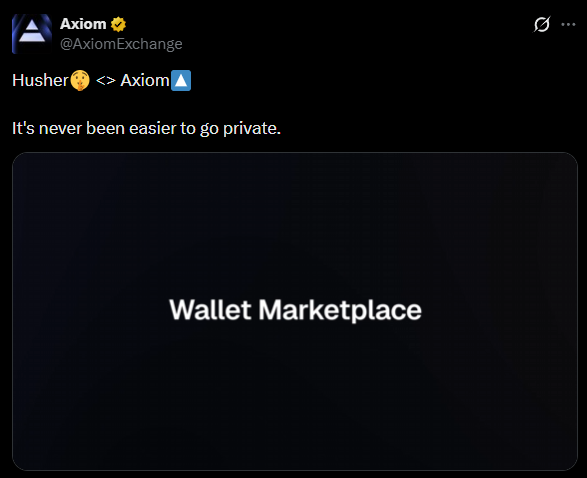
On 15 August, Axiom announced its Husher integration in seven words: "It's never been easier to go private."
The sentence was vague. The product list was not.
Husher said Axiom users could reach its infrastructure without leaving the terminal: normal, private and multiswap orders, a private batch-consolidation mode, and a newly added marketplace for aged wallets with existing onchain activity. Axiom's own interface described that marketplace as a place to discover and purchase pre-funded, aged and active wallets.
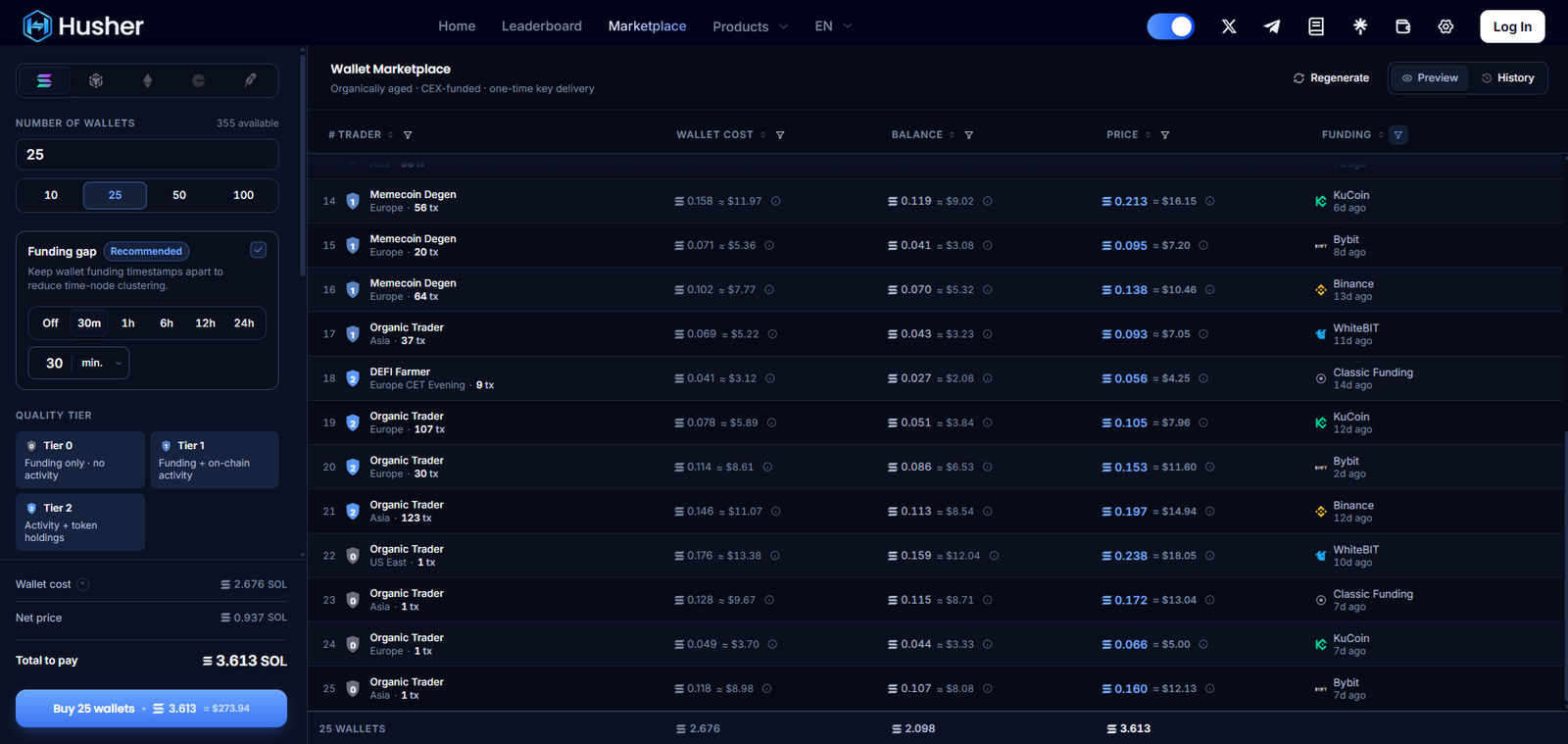
The marketplace sums up its stock in one line across the top of the page: "organically aged, CEX-funded, one-time key delivery."
That phrase is most of the backlash. Husher is not only routing transfers privately. It is selling wallets whose past behaviour can be carried into the hands of somebody new.
The visible reaction was fast and heavily hostile. Critics said the integration would let anyone with enough money "mega bundle" a token, make coordinated wallets look natural, and degrade the quality of new Solana pairs. Within days, community members had scraped the listings and published a blocklist of 4,816 addresses, and traders were passing it around with instructions to import the lot into your terminal and watch them. A minority praised the partnership as a real privacy improvement, and were outnumbered in the visible discussion by people treating it as an attack on launch transparency.
The sharpest version of the criticism is not that Axiom invented token bundling, because it did not, and not that Husher switched off Solana's public ledger, because it did not. The change is distribution. A workflow that previously demanded specialist services, sourced wallets, custom scripts and private coordination has been compressed into a consumer interface inside one of the most-used memecoin terminals on the chain.
Bundling did not become new. It became a button.
Why it matters that this landed inside Axiom
Axiom is a Y Combinator-backed trading platform founded in 2024 that puts memecoin trading, perpetual futures, yield products, token discovery, wallet monitoring and fast execution into one terminal. By 2025 it had become one of the most prominent trading interfaces in the Solana memecoin market.
That reach is the story. A standalone privacy service reaches people who go looking for privacy. A Husher panel inside Axiom reaches traders who were already there to find tokens, inspect wallets and place orders, and who now find private multi-wallet routing sitting a tab away from the thing they came for.
There is a sharper version of that awkwardness. Axiom operates a Bundle Checker, a feature built to flag launch purchases that land together in the same Solana slot. It is now offering privacy infrastructure beside its own detection infrastructure for the behaviour that privacy can obscure.
That does not prove contradiction or bad intent. Detection tools and privacy tools can coexist in one product without anybody planning a scandal. It does put an unusually uncomfortable pair of features on the same dashboard, and it is why the announcement read to traders as a policy statement rather than a release note.
The three pieces, and why they only worry people together
Husher presents itself as a privacy-focused, non-custodial swapping service. Three of its capabilities matter for token launches.
Multiswap is the fan-out. One operation distributes funds across many destination wallets through Husher's routing.
Batch Mode is the fan-in. It takes assets from multiple wallets and consolidates them into one destination through the same private routing. This is the one piece that predates the August rollout: Husher and Axiom shipped private consolidation together in June, announced in terms that left nothing to interpretation. Funds would be "privately routed through Husher to break the onchain link", any amount, as many times as you want, from anywhere.
The wallet marketplace supplies the identities. Instead of generating fresh addresses, a user can buy wallets that already carry transactions, funding history and age.
The interface makes that harder to read as incidental. Wallets are graded in tiers, from funding only, to funding plus onchain activity, to activity plus token holdings, and each is listed with a trader persona, a region and a transaction count: Organic Trader, Memecoin Degen, DEFI Farmer. Beside the batch size sits a control called Funding gap, marked recommended and set to 30 minutes, which spaces out the funding timestamps of the wallets being bought. The stated purpose of it is to "reduce time-node clustering".
That is not privacy in any ordinary sense. Privacy hides what belongs to you. This is a countermeasure aimed at a named analytical technique, sold by the slider.
Each of the three features has uses with nothing to do with manipulation. A team may want operational wallets kept separate, payments made without publishing its whole treasury graph, or trades that copy bots cannot mirror in real time. Privacy is not the scandal, and it is worth saying that before the rest of this.
The concern is the combination.
- Buy wallets that already look aged
- Fan funds out to them privately
- Buy the launch from many separate-looking addresses
- Fan the proceeds back in privately
None of those four steps proves manipulation. Together they supply most of the surrounding infrastructure needed to make common control harder to establish, which is a different claim and a much more defensible one.
"Bundling" is two different words
Part of the argument is people talking past each other.
In Solana's transaction infrastructure, a Jito bundle is a group of up to five transactions that execute sequentially and atomically inside the same slot: either all of them land or none do. Bundles have entirely legitimate uses, including atomic arbitrage, execution guarantees and protection against certain kinds of transaction reordering.
Memecoin traders use the word more loosely. A "bundled launch" usually means a coordinated group of wallets bought supply in the same block or the same early window. A cluster is a different idea again: wallets tied together by shared funding, repeated transfers, recycled addresses or common behaviour over time. As Bubblemaps puts it, a bundle is about when wallets bought, while a cluster is about how they behave.
Husher's published feature list does not include a Jito launch-bundle generator. What it offers is the adjacent layer: wallets with existing history, private distribution to many addresses, private consolidation back from them, all inside the terminal where the trading happens anyway.
That is enough to weaken some of the clues analysts use to decide whether apparently separate buyers are actually separate. It is not enough to erase the act itself. An aged wallet cannot un-buy a token in the same block as nineteen others. If twenty addresses buy inside one launch window, a timing detector may still flag the synchronisation.
What age and private funding weaken is the supporting evidence around that timestamp. The addresses no longer look freshly created, and their first visible funding transactions may not all point back at one obvious organiser.
Why traders hate it anyway
Wallet history became a product
A wallet's history stays attached to its address after control of the private key changes hands. So an address can be genuinely old while its current operator is completely new, carrying months of transfers and swaps that belong to somebody else entirely.
Husher calls these wallets "organically aged." The history may well be organic. The continuity of ownership is the part nobody can see.
Solana's launch infrastructure has spent the year finding new things to put a price on, including a launchpad built to sell one trader's attention. Wallet history is the stranger product, because what is being sold was manufactured by somebody who is no longer involved.
Age is a property of the address, not of the person holding it, and the chain records no event when a private key is sold. "One-time key delivery" describes how Husher says the key reaches the buyer. It is not, by itself, evidence that no previous owner, supplier or intermediary kept a copy, and the public rollout material reviewed for this article did not describe a verifiable method for proving exclusive key ownership. That cuts both ways: it is a reason to distrust an aged wallet's apparent independence, and a reason for the buyer to distrust the wallet.
The funding graph got less legible
One of the simplest ways to connect Solana wallets is to look at the first incoming SOL transfer. Helius runs an entire attribution endpoint on that signal, returning a readable label when the funder is a known entity, and it lists identifying bot farms funded from a common source as one of the things the endpoint is for. The people selling attribution tools are quite clear about what the first hop is worth.
The pattern those tools are built to catch is easy to picture. One wallet funds twenty new ones, the twenty buy the same token, and later they send assets back toward a common destination. Private routing changes the middle of that picture.
Exchange funding does not make a wallet invisible: analysts may still identify the exchange. But an exchange label names the service that processed a withdrawal, not the person who requested it. When many addresses have separate histories and exchange-funded origins, the first-hop graph says much less about whether they share an owner.
The result is ambiguity, not disappearance. That distinction matters, and it is also cold comfort, because ambiguity is all a launch operator needs.
It lowers the operational barrier
Sophisticated launch operators already had multi-wallet software, funding services, private swaps and secondary wallet markets. Nothing here was previously prohibited and is now permitted.
The better analogy is factory installation. A capability that used to require assembling your own setup is being fitted to the dashboard.
That matters because cheaper tools do not only serve the people who already had expensive ones. They change who attempts the behaviour, how often it happens, and how quickly one tactic becomes the market's default assumption.
This is the strongest reading of the backlash, and it is not really a complaint about privacy at all.
Traders are not angry that private transfers became possible. They are angry that plausible independence became something you can buy in a batch of 25.
It can manufacture the appearance of a crowd
Memecoin markets treat holder count, early-buyer diversity and visible wallet activity as social evidence. Fifty early wallets look broader than three. Older buyers look less manufactured than a wall of fresh addresses. A holder map with no direct links between its nodes looks more distributed than one arranged around a single funding wallet.
None of those signals ever proved that fifty independent people showed up. They were always proxies, and this is what happens to a proxy once somebody starts selling it.
A 2026 Georgia Tech preprint examining more than 41,000 Solana memecoin launches found that bundled account traces could reveal hidden multi-account coordination, and treated holding concentration, coordinated addresses and bundled behaviour as important features for identifying high-risk launches. The study does not evaluate Husher. It does support the underlying worry: apparent wallet diversity can conceal common organisation, and researchers have to work to see through it.
Husher did not create that problem. It sells tools that can make parts of it easier to stage.
Privacy was already a loaded word at Axiom
The rollout also arrived after an earlier trust episode. In February 2026, after allegations published by the onchain investigator ZachXBT, Axiom acknowledged that someone on its team had abused internal customer-support tools to look up user wallets. The company said it had been "shocked and disappointed that someone on the team abused internal customer support tools", removed access to them, and promised to hold the offending parties responsible.
The Husher integration is a separate event and there is no public evidence connecting the two. What the earlier episode changes is the audience. Axiom's privacy promises are now heard by users who already have an open question about who inside the company can see their activity, which is why "it's never been easier to go private" landed as a claim to be tested rather than a benefit to be enjoyed.
What actually changes onchain
Solana does not forget the last transaction. A purchase appears. A sale appears. Supply sits in observable addresses. Timing exists and cannot be renegotiated afterwards. Husher changes the route and the available attribution clues, not the existence of the destination transaction.
Four things follow for anyone reading launches.
- Wallet age is weaker evidence of participant age, because an old address may have a new controller.
- Exchange funding is more ambiguous, because it identifies a service rather than a beneficial owner.
- Behaviour outranks provenance: timing, order sizing, repeated patterns, common destinations, recurrence across launches, eventual consolidation.
- Offchain records become evidence in their own right, because a marketplace listing can show that a wallet was offered for sale even when the chain cannot show the moment its key changed hands.
The community response is already that adjustment happening in public. Compiling thousands of listed addresses into a warning list within days is exactly the right instinct and a bad final answer: inclusion in that list is not proof of bundling, fraud, or current ownership. A wallet may be listed and never sold. It may change hands again after the list was built. Terminals that treat the list as a verdict will flag innocent addresses, and operators who read the list will simply source wallets somewhere else.
The next arms race is not privacy against transparency. It is one set of tools producing plausible separation while another set hunts the behavioural residue that separation leaves behind.
The strongest case for Husher
Public blockchains expose salaries, treasury payments, personal holdings, business relationships and every transaction attached to a pseudonymous identity. There are real reasons to stop one payment from revealing an organisation's entire financial graph, and "criminals want privacy" has never been a serious argument against privacy as such.
Jito bundles are neutral infrastructure. Multi-wallet management is not automatically manipulation. Buying an old wallet is not evidence of a planned exit.
Supporters of the integration made a specific argument worth taking seriously: wealthy teams already had privacy infrastructure, so putting it in a mainstream terminal narrows an information advantage rather than creating one. Everything above about lowered barriers is the same fact read from the other side.
That defence is strongest for private transfers and weakest for the marketplace, because the two products do different things. Privacy lets a current owner reveal less about themselves. Selling wallet history lets a buyer inherit a signal they did not earn. The first withholds information; the second supplies a misleading one.
Not established: that Axiom or Husher deploys a token, reserves supply, executes an atomic launch bundle, or coordinates an exit.
Unverified: Husher markets its routing as private. No independent audit of that claim was found.
Inferred, not proven: that bought history plus private routing makes common control harder to establish. It follows from the listed features, not from any observed campaign.
Calling this a one-click rug machine would be satisfying and unsupported. Calling it bundling-adjacent infrastructure is closer to what the evidence carries.
Six questions with public answers, or six questions without them
The announcement offered a slogan. A market this sensitive needs operating rules, and the rollout material reviewed here did not supply them.
- Where do marketplace wallets come from? Created for sale, bought from former users, or supplied by third parties?
- How is exclusive key ownership verified? What stops a supplier keeping a copy after the advertised one-time delivery?
- Will marketplace addresses be labelled? Will Axiom's own wallet analytics show that an address was listed or passed through Husher?
- How does the Bundle Checker treat Husher activity? Can Axiom's detection recognise coordination involving marketplace wallets or Husher-routed funds?
- What use violates platform policy? Are deceptive launches, manufactured activity, wash trading and coordinated exits prohibited, and what happens when they are detected?
- What will be published in aggregate? Scale, safeguards and observed misuse can be described without exposing a single private user.
Those are proposed right-of-reply questions, not questions already put to either company. No outreach to Axiom or Husher is represented in this article. As of 18 August, Axiom's account had added nothing to the one-line privacy pitch, and every piece of follow-up detail had come from Husher.
What traders can safely assume now
Axiom did not invent bundling. Husher did not switch off Solana's public ledger. They packaged wallet age, private multi-wallet routing and private consolidation into a mainstream memecoin trading interface, which is a smaller act with larger consequences.
That does not make every Husher user a manipulator. It does change the assumptions a reader of launches can safely make.
- Fifty wallets are not necessarily fifty participants.
- An old wallet is not necessarily an old holder.
- A CEX-funded address is not necessarily independent.
- A clean-looking holder graph is not necessarily a clean launch.
Solana can record every transaction and still be uncertain about who controlled the addresses making them. The chain sees the act. Husher sells a better costume.
The next thing worth watching is not another privacy announcement. It is whether Axiom's own Bundle Checker starts flagging wallets Axiom's own marketplace sold, because that is the point at which the company has to decide which half of its product it believes.

How $TOAD Turned an Argentine Cartoon Into Solana Lore
A 1988 Argentine children's toad really does predate Pepe the Frog. What a Solana crowd built on top of that in a fortnight is the better story.

fomo Built the Feed for the Memecoin Machine
fomo turns public wallets, leaderboards and referrals into a single scroll. Its rise shows the next memecoin fight is over discovery, not creation.

InfoFi Paid Crypto to Talk. Then X Changed the Rules.
InfoFi promised to reward useful crypto voices. Then X revoked the API underneath the whole model, and four businesses had to become something else.