fomo Built the Feed for the Memecoin Machine
fomo turns public wallets, leaderboards and referrals into a single scroll. Its rise shows the next memecoin fight is over discovery, not creation.

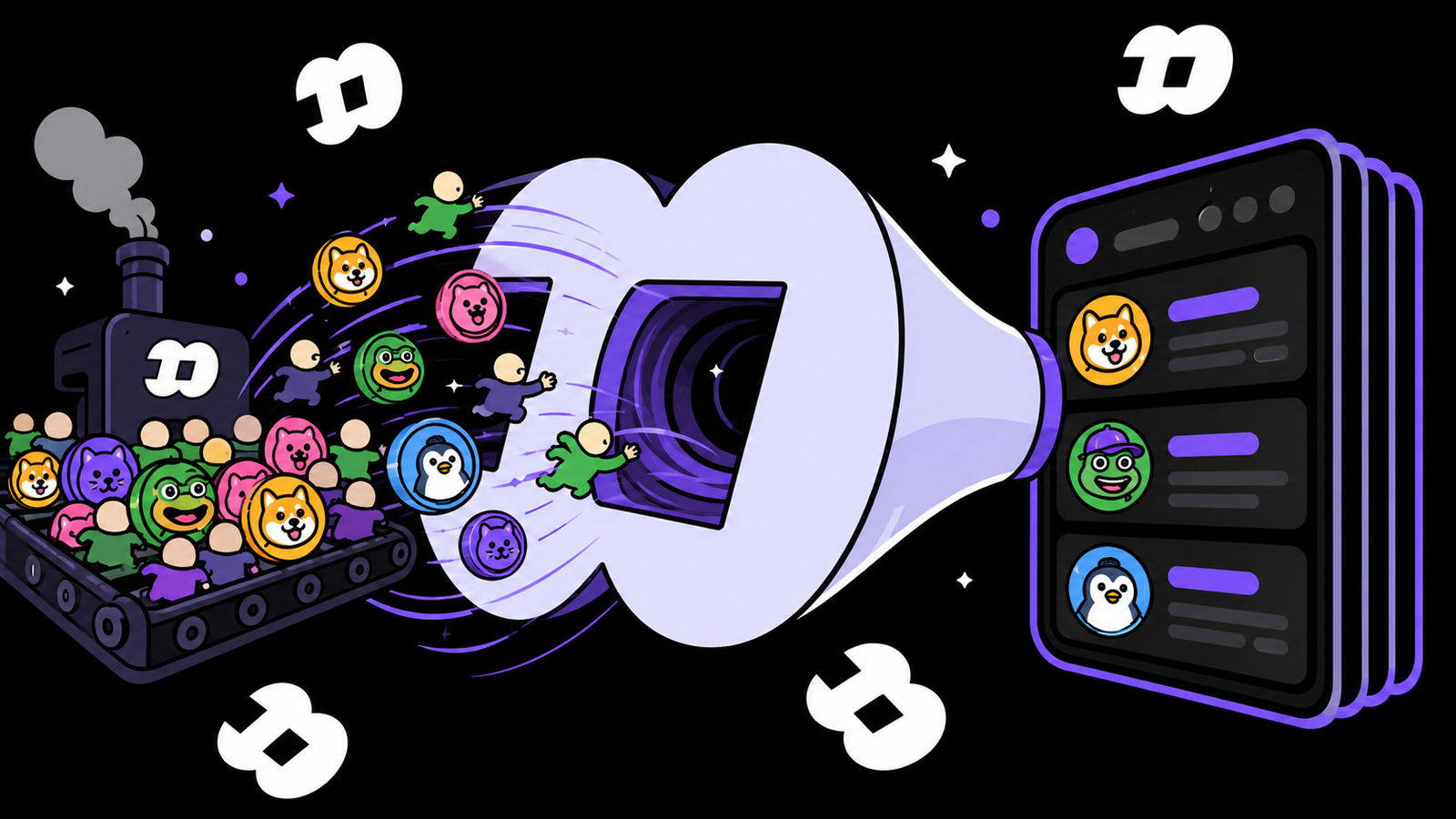
- A trade executes
- It lands in the feed as identity
- Followers act on the signal
- Fees and referral commissions accrue
In mid-August, fomo posted higher 24-hour revenue than Hyperliquid, according to DefiLlama. It made a perfect crypto screenshot: one number, one window, one instant winner.
It did not make fomo the bigger business. Hyperliquid's daily revenue regularly clears $3 million, while fomo's has been moving between roughly $150,000 and $400,000, peaking near the top of that range. Pump.fun had already pulled off the same trick. A single-day flip against a protocol that measures its revenue in billions cumulatively is a milestone about momentum, not about size.
The useful signal was never that fomo won. It was that a social app had grown large enough to enter the comparison at all.
Pump.fun lowered the barrier to creating a memecoin. fomo has lowered the barrier to noticing one, following the person trading it, and placing a trade without leaving the feed.
Pump.fun built the factory. fomo is going after the crowd outside it.
Those first three are the company's own numbers, published with its June funding announcement, and the revenue peak is DefiLlama's reading for the week to 8 August 2026. None of them are audited user cohorts. They are useful anyway, because they describe the funnel the company is deliberately building.
It is not a launchpad, and the difference is the whole business
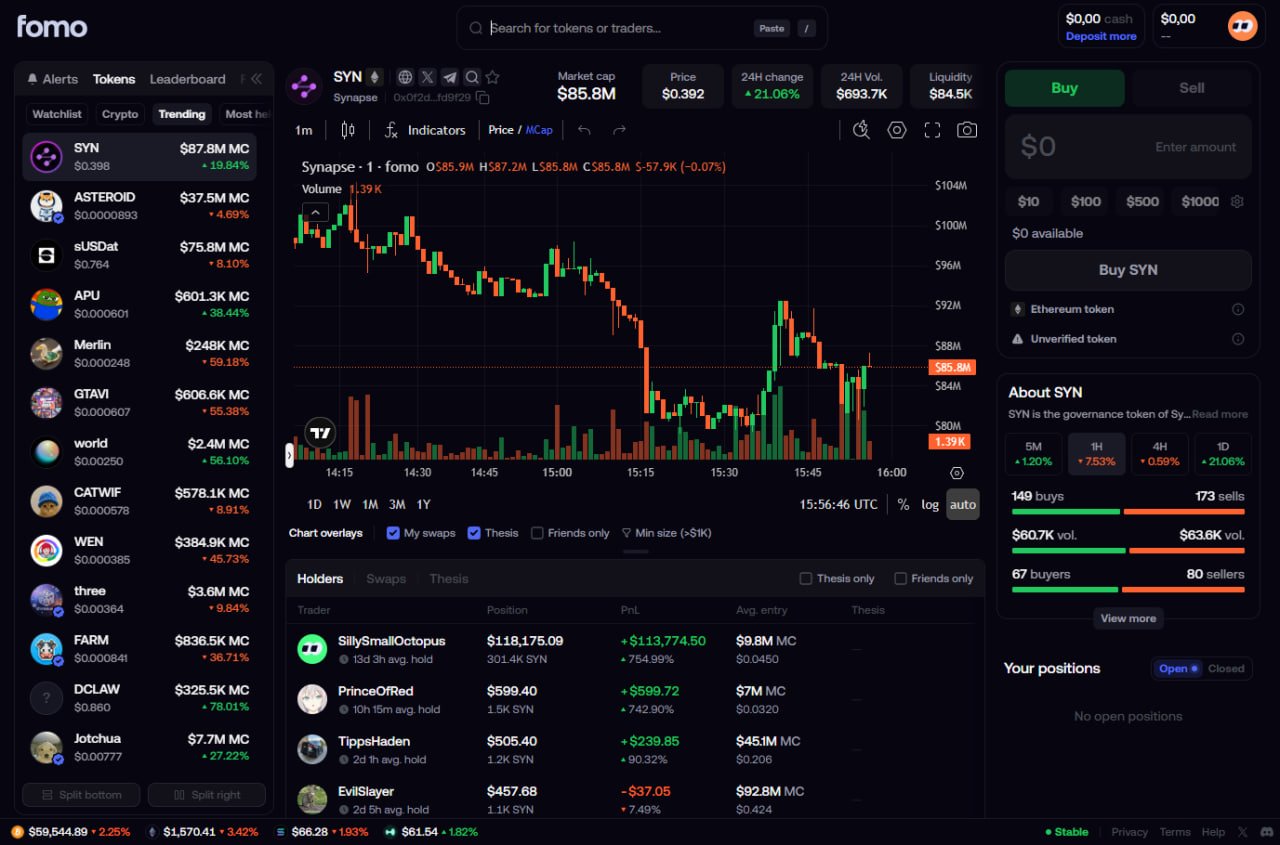
fomo opened its public beta in May 2025 as a mobile, social-first trading app. Profiles, a feed, public trading activity, leaderboards, alerts and token pages sit on top of an execution layer. Sign-in works through an Apple ID or an email address, Apple Pay handles funding, and "gasless" routing removes the native-token juggling that used to sit between a curious person and their first onchain trade.
Calling it a launchpad is tempting, because most of what moves through it is recently launched tokens. It is also wrong, and the company's own terms say so: fomo states it is not a decentralised exchange, an exchange or a broker.
A launchpad manufactures the asset and its first market. fomo sits one link further down the attention chain, helping people find assets created elsewhere and routing their orders through third-party infrastructure.
That distinction is the reason the product matters. The memecoin market has no shortage of places to mint a token. Its scarce resource is attention, and deciding which of those tokens anyone ever sees. That is the problem fomo is built around, and it is the same problem that made a launchpad out of one trader's audience when Ansem.io started selling one trader's attention.
Who built it, and what they optimised for
fomo was co-founded by Paul Erlanger and Se Yong Park, both alumni of the derivatives exchange dYdX. That lineage shows in the product: people who had already built a professional trading venue chose, for their second act, to build the least professional-feeling one they could.
The money arrived in two steps. Benchmark led a $17 million Series A in November 2025, as the only institutional investor in the round. Then in June 2026 came a $75 million Series B led by Index Ventures, with Union Square Ventures, Benchmark again, and a list of angels including the Zynga co-founder Mark Pincus. The Block reported the round at a $550 million valuation.
The company describes itself in that announcement as "the first on-chain trading app built for the rest of us", which is an unusually honest statement of strategy. The target is not the trader who already has a terminal, a wallet tracker and a bot. It is the person who has none of those and was never going to acquire them.
The mechanism that made it work was mundane. Apple Pay support arrived in June 2025 and, in Erlanger's words to TechCrunch, "We saw a massive influx of users and revenue". By the Series A the founders reported over 120,000 users. Seven months later the figure they published was more than five times that.
The sequence, not the viral weekend
- May 2025. Public beta opens as a mobile social trading app.
- June 2025. Apple Pay funding lands and growth accelerates sharply.
- November 2025. Benchmark leads a $17 million Series A. Founders report more than 120,000 users.
- June 2026. Perpetual futures arrive through Hyperliquid's infrastructure, the web version ships, and the $75 million Series B closes.
- 7 August 2026. Pump.fun ships its own social trading features: alerts for followers, zero-fee trading and cross-chain USDC transfers.
- Around 8 August 2026. Leaked agreements surface describing Pump.fun offers to fomo's most visible traders.
- Week to 8 August 2026. fomo's weekly revenue peaks at $2.64 million.
- Mid-August 2026. fomo out-earns Hyperliquid over a single 24-hour window.
Read as a whole, the trajectory is not a viral moment. It is eighteen months of removing steps, followed by a funding round that paid for removing more of them.
The public trade is the product
On fomo a trade does two things. It changes a balance, and it becomes content attached to an identity.
Profiles can display positions and performance. Leaderboards rank the visible. Followers can be notified when someone they track trades. Buy and sell activity connects to charts and posts. The company reports more than 110 million social interactions since launch, which is a strange metric for a trading venue and exactly the right one for what this actually is.
This gets called copy trading, and mostly it is not. The standard flow is not automatic mirroring: a follower receives information about somebody else's trade and then decides whether to place their own.
That gap is where the asymmetry lives.
It can establish that a specific wallet executed a specific transaction at a specific time. That is more than a cropped profit screenshot ever proved.
It cannot establish that the wallet is the trader's only one, that the visible entry was the first, that no hedge exists elsewhere, or that an unrealised gain was ever sold.
fomo's own terms concede the point by prohibiting attempts to game rankings through wash trading or selective transfers, and reserving the company's right to recalculate or reset performance metrics. A leaderboard that can be gamed is a constructed product, not a map of skill.
By the time a visible trader becomes a signal, that trader may have entered lower, accumulated through another address, or already reduced risk. The follower sees an action. The follower does not see the position around it.
So social transparency closes one information gap and opens another. The most visible trader acts first, and then becomes the reason other people act.
The feed pays for its own distribution
Growth here is not only a matter of people enjoying the interface. Money is attached to distribution.
fomo's affiliate programme lets approved participants earn commission when referred users join and trade, processed in real time and with no stated ceiling. Set that beside the feed and the loop closes on itself: a position becomes a post, the post attracts followers, followers convert to referrals, referrals generate trades, trades generate fees and commissions, and the resulting visibility earns the account more followers.
The content does not describe market activity. It manufactures the next transaction.
That does not make every enthusiastic fomo post paid promotion. It means four different things wear the same clothes, and a reader should keep them apart:
- Someone who genuinely likes the product.
- A trader showing real performance.
- An affiliate being paid for generated activity.
- A platform that earns whenever a transaction happens.
Those interests overlap. They are not the same interest.
fomo does not need to know which memecoin survives. It needs people to keep trading them.
That is the asymmetry underneath everything else. A trader profits only if an asset moves their way, after costs. A visible account gains reputation and rank. An affiliate earns on referred activity. fomo collects a fee on the qualifying transaction either way. Of all the participants, the platform has the most predictable outcome, which is why the feed is a commercial instrument and not a courtesy: it gives people a reason to reopen the app when they arrived with no particular token in mind.
"Gasless" is not costless
Removing the need to hold a native gas token for every route is genuinely good design. It is not the same as free.
Under fomo's terms the platform takes 0.50 per cent on a buy or a sell. On Solana that carries a minimum charge of $0.95 per transaction, and on cheaper chains such as Base and BNB Chain there is no minimum. There is also a one-off "token rent" cost the first time a given token is bought.
The minimum is where the headline percentage stops describing reality. On a $10 order, $0.95 is not half a per cent, it is 9.5 per cent, and a small position bought and later sold pays it twice before slippage, spread or third-party costs are counted.
None of that is hidden, and none of it is unusual for a consumer app. The point is narrower: a fee quoted as a percentage behaves like a much larger percentage once the floor takes over, and the users most likely to meet that floor are precisely the first-timers the Apple Pay funnel is built to attract.
What the interface cannot simplify
For an ordinary spot purchase the downside is bounded: a token can go to zero and the loss stops at what was committed.
That stopped being the full description in June, when perpetual futures arrived. fomo's terms warn that losses on leveraged derivatives can exceed the initial margin and that positions may be liquidated without notice. They also list risks from liquidity, network congestion, oracle failure and problems at the third-party protocols that actually execute the trade.
The interface is unified. The infrastructure is not.
The perps that let fomo enter the revenue rankings run on Hyperliquid's infrastructure, and fomo's cut arrives as builder fees.
In the record week to 8 August, those builder fees were roughly $39,000 of a $2.64 million total.
So the headline comparison flatters both sides of one relationship: the challenger's newest revenue line depends on the incumbent it was measured against, and most of what fomo earns still comes from somewhere else entirely.
Access has legal edges too. Users must be at least 18 or otherwise legally able to enter the agreement, and the perpetual futures product is not offered to US persons. A cleaner button does not make a safer token, and it does not make a derivative appropriate for whoever happens to be holding the phone.
The crowd turns out to have a price
If the thesis is that discovery is now the contested layer, the clearest evidence is what a rival was reportedly willing to pay for it.
Pump.fun shipped its own social trading features on 7 August. Days later, leaked agreements surfaced describing what it was offering fomo's most visible traders to change sides. As reported by Crypto Briefing, the terms ran to:
- $20,000 as a signing bonus, and $30,000 a month after that.
- Full migration of existing funds and positions, with the fomo account closed entirely.
- Exclusive trading through a new Pump.fun wallet.
- A linked public X account, tying the trader's online identity to the platform.
- A $25,000 minimum in monthly trading volume.
Treat those figures as a reported claim rather than confirmed policy. They come from leaked documents published in mid-August, and neither company has confirmed, denied or commented on them. What can be said without the documents is that Pump.fun shipped follower features and moved on the same traders in the same week, which is a coherent strategy whatever the contracts say.
If the terms are accurate, the interesting clause is not the money. It is the demand for a linked X account and a closed rival account. That is not a company buying trading volume, which it could get more cheaply through fee rebates. It is a company buying an audience, and insisting the audience can only be reached in one place.
Which tells you what both firms think the asset is.
What to check before believing the feed
- What the P&L measures. Dollar profit, percentage return, realised and unrealised gains are four different claims.
- What the wallet leaves out. A verified address can be real without being the only one.
- When the signal appeared. The account you are following may have entered earlier, and cheaper.
- Who is paid for the post. Affiliate commissions and partnerships shape which platform and which asset an account promotes.
- The whole cost. Platform fee, the minimum charge, token rent, price impact, spread and third-party costs.
- The exit, not the quoted price. Thin liquidity can price a position it will not let you leave.
The most consequential button
fomo's real innovation was never that traders can watch each other. They were doing that on X and in Telegram long before the app existed, just across five products instead of one.
The innovation is that public financial behaviour has been turned into a social object. A wallet becomes a profile, a transaction becomes a post, profit becomes status, followers become distribution, distribution becomes volume, and volume becomes fees. Every step in that chain is legible, and the whole chain is the business model.
It can genuinely make onchain activity easier to understand. It can also make risk contagious, because the distance between seeing a trade and entering one has collapsed to a thumb movement.
Both readings are true at once, and the next thing worth watching is which of them the numbers support after the funding stops subsidising the friction. Pump.fun made creating a token feel effortless. fomo has made joining in feel effortless.
The button that matters in the next cycle may not be Create.
It may be Follow.

From 400 UNI to Endless Points: How Airdrops Changed Crypto
Airdrops once surprised early users. Then came the roles, the snapshots, the seasons and the points. The history is a fight over who deserves the tokens.

The $65 Million Blokyz NFT Raffle That Took Over X
More than 25,000 ETH queued for 7,500 Blokyz NFTs worth 225 ETH. Most of it was refundable, and the queue itself became the product everyone could see.

What Are Quotrons? Inside $QUOTRON's Stock-Reward NFTs
Quotrons turns retro stock terminals into collectible, fee-linked NFTs. Its next test is whether the rewards can outgrow trading in Quotrons itself.