Ansem.io Is Not Just a Launchpad. It Is a Market for Ansem's Attention
Ansem's new Solana platform borrows pump.fun for the launch, then sells the thing it actually owns: his audience, priced in burns, airdrops and a leaderboard.

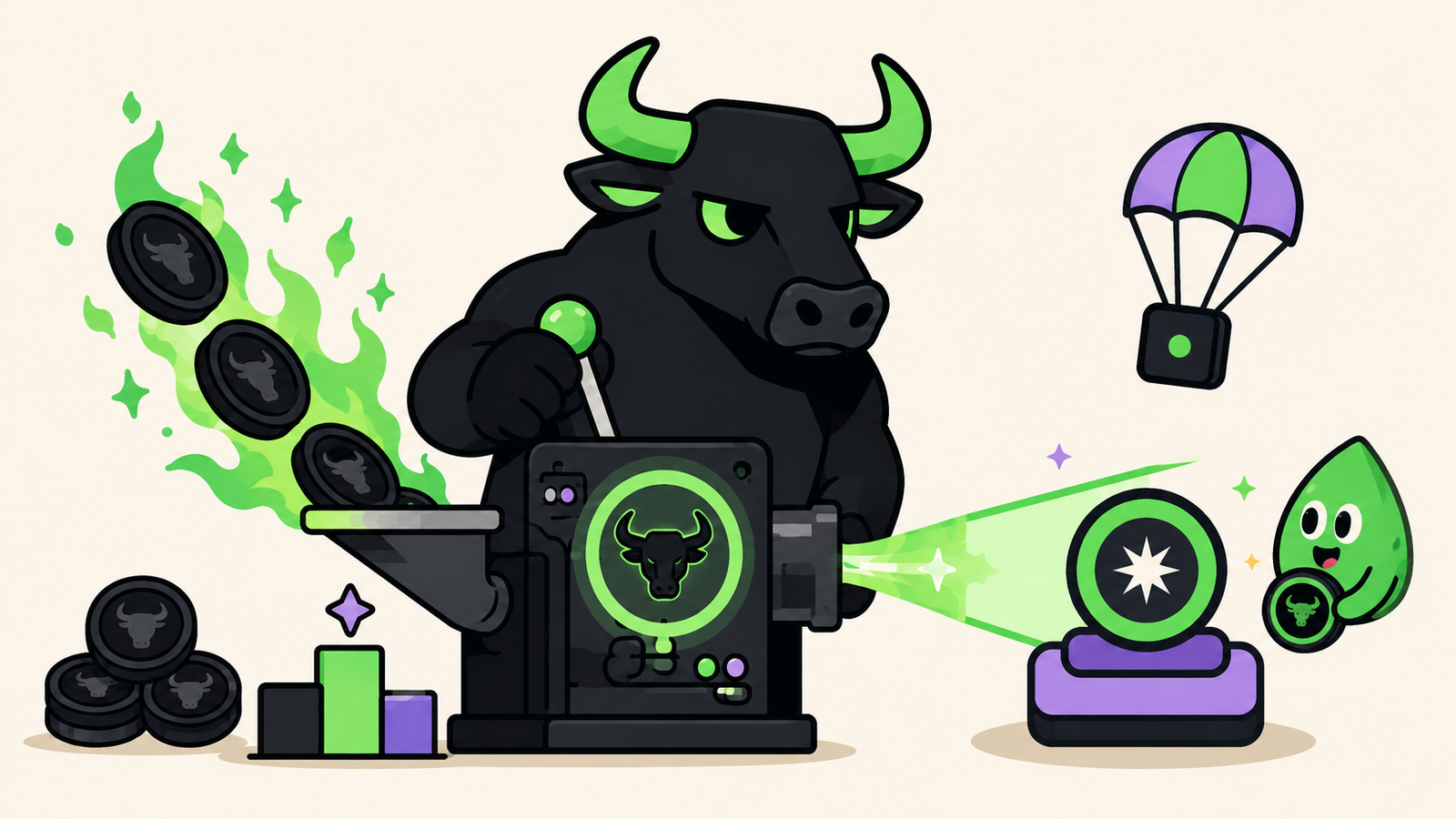
On August 17, the crypto trader Ansem put a new site online carrying a five-word promise: "Every launch, on the record."
The obvious product is a Solana token launchpad. The more revealing product is the audience bolted to it.
Ansem.io does not replace the machinery that already creates and trades new tokens. Launches are routed through pump.fun using dedicated launch wallets. What the site adds sits on top: supply distributed to $ANSEM holders, publicly verifiable token burns, paid profile upgrades, status tiers, a leaderboard called the z500, and promotion for the projects that climb it.
The launch button is borrowed. The audience is proprietary.
That makes ansem.io far less interesting as another place to mint a token, and considerably more interesting as an attempt to turn one trader's social graph into an explicit, priced, measurable distribution market.

The trader behind the launchpad
Ansem, also known as Zion Thomas, is a trader and market commentator closely tied to Solana. He came to crypto from computer science, moved out of software engineering into full-time trading, and became most visible through his advocacy for Solana and his early attention to memecoins including BONK and dogwifhat. By mid-2026 his following on X was around one million accounts.
That is not an audience in the ordinary media sense. An Ansem post can be a market event on its own, particularly when the subject is a small token with thin liquidity and no settled identity yet.
The argument about what that means is not new. In 2024 the blockchain investigator ZachXBT accused him of promoting too many low-cap tokens to a following large enough to move them. Ansem answered that those tokens had already captured retail attention, and pointed to dogwifhat as evidence that discussing a small memecoin is not automatically a grift.
The disagreement was never really about which coins performed. It was about whether someone can discuss a market that reacts to the discussion without becoming part of the mechanism.
Ansem.io gives that argument a website, a leaderboard and a fee schedule. Rather than treat influence as an accident, the platform tries to put it onchain.

How $ANSEM stopped being a nickname and became infrastructure
The token did not start as an official product.
A wallet nobody has identified launched The Black Bull on pump.fun around June 17, bought most of what it had just created, and sent 650 million tokens straight to Ansem's public wallet. He began distributing tokens and creator-fee proceeds onward from there. By a June 29 snapshot, Bubblemaps data cited by The Defiant still put about 60 percent of the supply in his hands.
Treat that share as history rather than as a current balance: it would need another wallet review to stand as a present-tense claim. What it establishes is how strange the origin was. An anonymous launch handed the majority of a token to the one person whose name and reputation were the only thing giving it meaning, and he became its economic centre without having created it.
Those are CoinGecko's figures at 19:15 UTC on August 17, a few hours into the launch. The distance between the last two is the part worth holding onto: most of the supply is not circulating yet, so the market is pricing a fraction of what exists. All four will have moved by the time you read this.
What ansem.io adds is a job description for the token.
Holding $ANSEM determines eligibility for launch airdrops. Burning it buys a project higher status and, potentially, more visibility. Every team that buys in order to burn creates demand, and every burn permanently removes supply. The launchpad and the token now sit inside the same loop.
None of which means holders own or govern the platform. From the public material available during this first-day review, there is no visible token-holder governance system and no stated legal relationship between the token and the company. The token has utility inside the system. Utility is not ownership, and the two get conflated often enough to be worth separating early.
What the machine actually does
Five moving parts, and they are a loop rather than a list.
- Team buys
$ANSEM - Burns it for a badge
- Holders get supply
- Project climbs the z500
- Channels promote it
A pump.fun launch underneath. A team creates its token through ansem.io, but the token launches on pump.fun. A dedicated launch wallet is funded for the initial transaction costs and the distribution process. Ansem.io is building above an existing issuance and trading venue, not replacing one.
Supply goes to holders. The standard flow allocates tokens to eligible $ANSEM holders, described as an on-record airdrop with claims displayed through the site. Ansem has said the system is not limited to tokens created through the new launcher: existing projects can use it to distribute supply and market themselves to holders. That widens the product from a launchpad into a distribution network.
The project page is upgradeable. Projects start with a standard listing. An enhanced page currently costs 0.5 SOL and adds a banner, a project story, official links, a roadmap, tokenomics and updates. One odd detail is that the unlock fee can reportedly be paid by someone other than the original creator, with the information then attached to the launch wallet and project page. That could let a committed community rescue an abandoned listing. It could also use clearer documentation about who can edit what, and what happens when two parties disagree.
Teams burn for status. Two paid commitment tiers were on the launch page during this review.
Gold: a verified burn of 92,627 $ANSEM.
Diamond: a verified burn of 370,508, plus a submission the platform team reviews before launch.
Enhanced page: a separate 0.5 SOL, on top of either.
The token thresholds are fixed, but the dollar cost of clearing them moves with the token, so what a badge costs a team this month is not what it will cost the next one. The burns are permanent and read directly from the chain.
The z500 ranks and promotes. Projects climb through their burns, the market value of the supply they distribute to holders, and paid boosting. Higher-ranked projects may be promoted through Ansem's channels.
The project calls the z500 an onchain index. On day one it is more accurately an onchain leaderboard with paid curation attached. The public description is not a passive portfolio, a neutral benchmark or a mechanically selected basket. It is a competition for attention whose inputs happen to be visible onchain. That is not a criticism so much as a naming problem, and names on a leaderboard matter because readers act on them.
Crypto does not have a launch problem
There is no shortage of ways to create a token.
Pump.fun's whole model is that anyone can make a coin and trade it from the first block. Raydium's LaunchLab goes further and offers itself as shared infrastructure, letting third-party platforms run branded launch environments with their own fees, curve restrictions and post-graduation liquidity settings. Others compete on creator economics: Bags advertises a one percent royalty on every trade, splittable across as many as 100 creators, applications or wallets, which makes its real product a configurable fee stream for whoever is attached to a launch.
Ansem.io is betting on a different scarcity. Deployment is a commodity. Credible attention is not.
A team does not need another form that produces a mint address. It needs initial holders, social distribution, a page that explains what the thing is, and some way to signal that it intends to be around longer than an afternoon.
That is a real problem, and the scale of it is documented. A 2026 research project studying high-risk Solana launches assembled more than 40,000 tokens that had successfully migrated beyond their original launchpads. Even inside that group, which had already cleared a survival threshold most tokens never reach, there was enough manipulation and concentration to build a dedicated risk-detection dataset from.
The launchpad era solved issuance. It did not solve trust, attention or survival. Ansem.io's answer is to make teams pay the audience directly, and to leave receipts.
A burn proves commitment, not character
A permanent burn is a genuinely stronger signal than a promise. It costs something real, anyone can verify it, and it cannot be undone by deleting a post.
But it proves exactly one narrow fact: a wallet destroyed a stated quantity of $ANSEM.
It does not prove the project controls no hidden wallets. It does not prove the distribution is fair, that the team has any right to the character it is using, that the roadmap is achievable, or that anyone will still be running the account next month. A dishonest team can comfortably afford a costly signal when it expects to extract more than the signal costs, and the more legible the badge, the better that trade looks.
Ansem.io can make a commitment visible. It cannot make the person behind it honest.
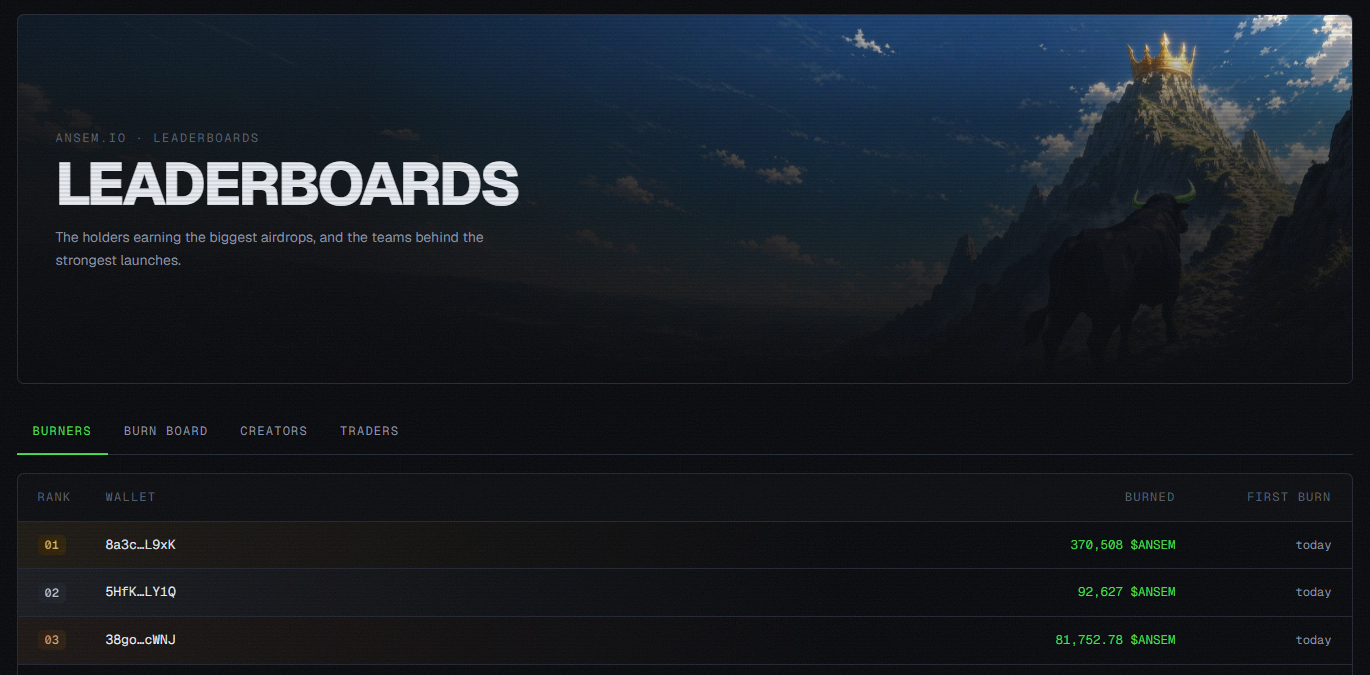
The z500 is a leaderboard, and leaderboards get bought
The ranking mixes real market activity with visibility that is explicitly for sale. Projects can burn for badges, pay for an enhanced page, pay for boosting, distribute supply to an existing holder base, and possibly be promoted through Ansem's social channels.
Every one of those is a reasonable product for a marketing platform. They get complicated the moment the resulting leaderboard is read as a quality ranking, because capital and quality are not interchangeable. A well-funded project can buy a stronger signal than a small but real community. A coordinated team can manufacture attention around its own airdrop. A project planning a short extraction can book the burn as customer acquisition.
So the badges need precise language. Gold and Diamond can reliably mean this much was burned. They must not quietly drift into meaning this project was checked and is safe.
The Diamond review makes that sharper, not softer. Human review will catch obvious spam and impersonation, which is worth having, but it also installs a centralised gate. Readers need to know who sits at it, what evidence they weigh, what conflicts they have to declare, and whether a rejected team can appeal.
That gate is also where the flywheel becomes a conflict map. The alignment is real: teams buy and burn, holders receive pieces of new launches, projects get an audience, ranked launches get visibility, and the channel becomes more valuable as a distribution network the more projects compete for placement. But Ansem has historically held a substantial position in the asset those teams are buying and destroying, while competing for attention he controls or heavily influences. Holders benefit when new teams bid for their token, and then receive tokens from projects they may be motivated to talk about.
None of that is automatically improper. It does make disclosure unusually load-bearing. A public ledger of burns is useful. The public also needs a ledger of incentives: wallet exposure, fee destinations, paid promotion, review relationships and sponsored placement, all impossible to miss rather than technically available.
An airdrop is not a community
Sending tokens to thousands of wallets creates broad ownership quickly. It can just as easily create thousands of indifferent recipients.
Some will never notice. Some will sell on sight. Some will belong to the same operator. Others will promote every distribution they receive, because the next airdrop depends on how visible they made the last one.
Holder count cannot distinguish between those cases, which is why it is the number most likely to be quoted.
The measurements that will actually mean something arrive later: how many recipients claim, how many are still there after seven and 30 days, how many turn up in project spaces, how concentrated each distribution becomes once trading starts, and whether a single launch develops contributors who were not already inside the $ANSEM network.
Distribution can create the conditions for a community. It cannot supply one.
What day one cannot tell you
Better records make some actions easier to inspect. They do not change what sits underneath. The launches still run on pump.fun, where open creation is the design, so copycat tokens, disputed ownership, volatile bonding-curve markets, concentrated wallets and short-lived projects all remain exactly as possible as they were.
This was reported from the public site and indexed material a few hours after launch, at about 19:15 UTC on August 17. Not verifiable in that window: a published security audit, an open code repository, the weight each input carries in the z500, the full platform fee flow, who performs the Diamond review, and whether a conflict-of-interest or sponsored-placement policy exists. None of this establishes that those things are absent. It means they were not yet findable, on a platform whose product is transparency.
The first-day numbers will be the least useful test anyone runs. The real one is what the platform publishes, and what its launches look like once the first wave of Ansem's attention has moved somewhere else. Specifically:
- The exact z500 formula, and what burns, airdrops, market capitalisation, boosts and human review each contribute to it.
- Labels that separate paid placement, algorithmic rank and editorial promotion, on the page, not in a FAQ.
- Published fee destinations and platform-controlled wallets.
- The criteria and the decision makers behind Diamond approval.
- Airdrop retention and active-recipient counts, rather than wallet totals.
- Thirty-day and 90-day survival data for the highest-ranked launches.
- Evidence that rank predicts durable activity rather than the largest marketing budget.
- A clear line between token utility and any claim on ownership or governance.
The strongest idea here is not that teams can launch another token. It is that a private influencer deal can be replaced with a public commitment to the audience. A project distributes supply before it asks for attention. The burn can be inspected. The paid status is visible. Holders receive something directly instead of watching an allocation change hands privately.
That is cleaner than the arrangement it replaces. It is not independent of incentives; it is an attempt to make them legible.
Ansem's influence was already part of this market. Ansem.io gives it a price, a token gate and a leaderboard. Best case, it becomes a more accountable route for projects to reach an audience without secret allocations. Worst case, it becomes a pay-to-play homepage where teams buy social proof and holders quietly become the distribution department.
On day one it is neither. It is a machine for making commitments visible, which is a real thing to have built.
Trust starts 30 days later, when the receipts have an afterlife.

Before the GTA 6 Leak, $CYBERLEEK Was Already Trading
The Solana token traded for nearly three quiet days before QR-coded GTA 6 footage handed it an audience. The bots got there before the crowd did.


Axiom x Husher Did Not Invent Bundling. It Made It Ordinary.
Axiom's Husher integration brings private multi-wallet funding, consolidation, and aged-wallet sales into one Solana terminal. Here is why traders revolted.

How $microduck Turned a $399 Robot Into an NVIDIA Narrative
A real robot supplied the character. Reports of an NVIDIA deal supplied the storyline. An unofficial token on Robinhood Chain brought the two together.