Hyperliquid Built the Market Washington Could No Longer Ignore
US regulators spent years telling onchain derivatives venues to register or leave. Hyperliquid became too important to ignore.

- September 2023: the CFTC fines three DeFi venues and says smart contracts do not make an unregistered exchange legal
- April 2025: it asks how perpetual futures might work inside regulated markets
- May 2026: it signs off on a bitcoin perpetual itself for the first time
- August 2026: the president says Hyperliquid out loud
On 19 August 2026, a crypto exchange with no announced US launch became a White House talking point.
President Donald Trump, speaking with technology executives in the Roosevelt Room, said Commodity Futures Trading Commission chairman Michael Selig was working to bring Hyperliquid into the United States "in a fully compliant and legal fashion." Within minutes, crypto timelines had compressed the sentence into something much larger: Hyperliquid was coming to America, the CFTC wanted it, and the offshore era was almost over.
The market moved on the sentence alone. Hyperliquid Strategies, the Nasdaq-listed company that holds $HYPE as a treasury asset, closed that day up 30.4%, its largest single-day gain on record. The token set an all-time high three days later. None of it followed a rule, an order or an application. It followed a president saying a name.
The public record does not go that far.
Trump's comment was a political signal, not an approval order, and the transcript shows how lightly it was offered: "I understand that Mike is also working to bring hyper liquid into the United States." He moved on to interest rates in the next breath. The following day Selig described a possible route for both registered firms and unregistered crypto exchanges, and directed staff to engage with onchain protocol developers. He also said the views were his own and did not necessarily represent the full Commission.
That distinction matters. But so does the fact that the conversation is happening at all.
Three years ago the CFTC's message to decentralised derivatives projects was simple: smart contracts do not make an unregistered exchange legal. Today its chairman is considering whether exchanges built outside the traditional system could be brought into a version of it built for the purpose.
Hyperliquid did not earn that attention because Washington suddenly took an interest in another crypto app. It earned it because the app had become a market.
Confirmed. Trump said Selig was working on a legal and compliant US route. Selig has directed staff to explore rules under which registered firms and unregistered crypto exchanges could be designated as a type of designated contract market he calls a "crypto asset market", trading on a leveraged or margined basis under "purpose-fit rules".
Not confirmed. No trading date, supported regions, market pair, market maker or operating entity. No approval order, no registration application, no proposed rule. Hyperliquid has not been designated anything.
Worth knowing. Selig never says the word Hyperliquid, in either set of remarks. And the rulemaking is conditional on Congress: "If CLARITY continues to stall," he said, the CFTC will use its existing authorities. Until then, "we're going to give CLARITY its breathing room for a vote."
What is Hyperliquid?
Hyperliquid is two closely connected things.
The first is an onchain exchange. Its best-known product is a market for perpetual futures, usually called perps: derivative contracts that track an asset's price but never expire, kept near spot by a recurring funding payment, and generally taken with leverage that magnifies both gains and losses. It also runs spot markets. Hyperliquid did not invent perps. It changed where they could live.
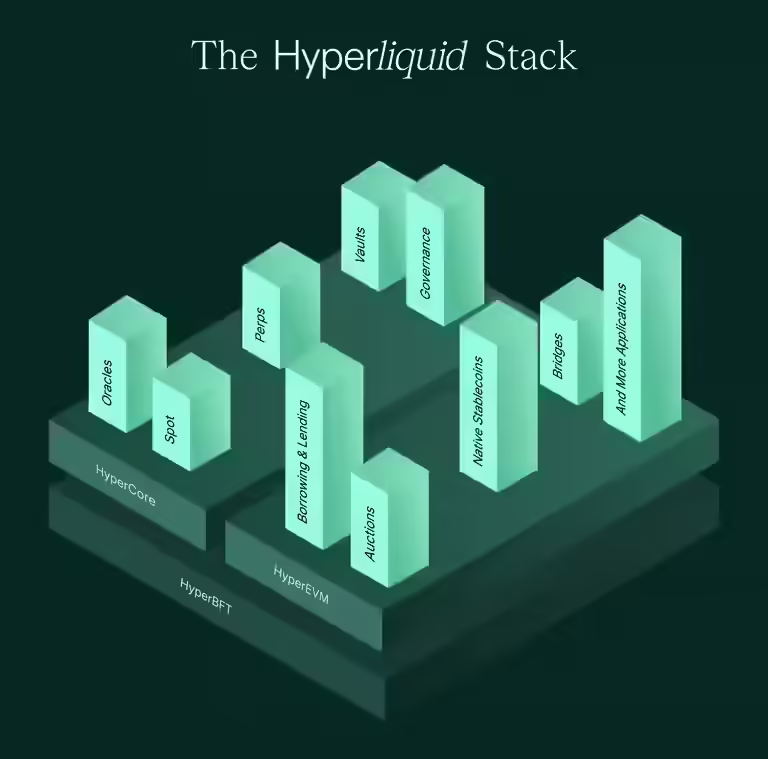
The second is a blockchain built around that exchange. The documentation splits execution in two: HyperCore runs the order books, the margin system, the trades and the liquidations, while HyperEVM gives developers an Ethereum-compatible environment connected to the same liquidity. Both are secured by HyperBFT, the network's own proof-of-stake consensus.
In plainer terms, Hyperliquid tried to put the machinery of a major exchange onto a public blockchain without making it feel like a blockchain application.
The protocol says every order, cancellation, trade and liquidation happens onchain "with one-block finality", and that it is non-custodial rather than holding user funds the way a centralised exchange does. It claims HyperCore "currently supports 200k orders / second", and its site adds a 0.07-second block time, a figure that does not appear in the technical documentation. Every one of those numbers is the protocol's own and none has been independently reproduced. The more revealing figure is the one the docs bury: median end-to-end latency of 0.2 seconds for a well-connected client, which is what a trader actually experiences.

It began with the failure of the centralised exchange
Hyperliquid's origin story runs directly through the collapse of FTX.
Jeff Yan and a pseudonymous co-founder known as iliensinc had been running Chameleon Trading, an independent crypto trading operation. In 2022 Yan stopped trading for the firm and turned its small team toward building market infrastructure. FTX's collapse that November gave the decision a sharper purpose: crypto's largest products were still running through companies that held user assets and operated mostly invisible internal systems.
The problem was technical. A serious order book takes a constant stream of new orders, amendments and cancellations, and general-purpose blockchains were too slow and too expensive to carry that traffic at the speed active traders expect. So rather than put the exchange on an existing chain, the team built a chain around the exchange.
Hyperliquid launched at the end of February 2023 to a small audience and, initially, without the liquidity that makes an order book worth using. A protocol vault called HLP, the Hyperliquidity Provider, helped fill the gap: it market-makes, performs liquidations and collects a share of trading fees, funded by ordinary depositors who share its profit and loss. By September 2023 larger professional market makers had begun connecting.
Then it grew into something wider. Spot trading arrived. The team stopped treating Hyperliquid as an exchange on a blockchain and started treating it as a blockchain with an exchange at its centre, a shift that produced HyperEVM in February 2025 and, with it, general-purpose applications built around the network's liquidity.
- 2022. Yan and iliensinc redirect the Chameleon Trading team toward building an onchain exchange.
- February 2023. Hyperliquid launches with a custom chain and a perpetual order book.
- 29 November 2024. $HYPE launches, with 31% of maximum supply allocated to early users.
- 18 February 2025. HyperEVM goes live.
- March 2025. The $JELLY incident forces validators to intervene, raising hard questions about emergency authority.
- October 2025. HIP-3 opens market deployment to outside builders.
- August 2026. Trump names Hyperliquid; Selig describes a possible regulatory category the following day.

The airdrop changed who appeared to own the exchange
On 29 November 2024, Hyperliquid launched $HYPE, the network's native token.
Roughly 31% of maximum supply went to the people who had already traded there, with a further 23.8% locked up for core contributors. The project said there were no allocations for private investors, centralised exchanges or market makers, and its documentation still states that Hyperliquid Labs "is self-funded and has not taken any external capital." Around 94,000 addresses received the genesis distribution.
That allocation became one of Hyperliquid's most consequential cultural decisions.
Most exchanges build early ownership around founders, employees and private investors, then invite users into the finished product. Hyperliquid reversed part of that sequence. Its early users had already produced the volume, the liquidity and the attention before a token existed, and then received a large share of the network their activity had helped make valuable.
That does not make the distribution automatically fair. A points system still decided which activity counted, larger users earned larger allocations, and the core team retains significant ownership. The spread was steep: across those 94,000 addresses the mean allocation was roughly 2,900 tokens and the median was 65, so the typical recipient got a rounding error while a few hundred got life-changing sums.
But the expectation had shifted. Users were no longer only customers generating fees. They were being presented as part of the network's capital structure, and for much of the crypto crowd that mattered nearly as much as the technology.
Hyperliquid showed that an exchange could attract liquidity without first building a conventional venture-capital ownership stack, then use token ownership to turn its earliest users into long-term participants.
What Hyperliquid actually changed
Onchain stopped being an excuse for bad execution. For years decentralised exchange design came with an accepted trade-off: automated market makers were open and easy to deploy but behaved nothing like a professional order book, while onchain order books were slower, thinner or costlier than their centralised rivals. Hyperliquid attacked the compromise directly by optimising the chain around the exchange instead of asking a general-purpose chain to accommodate one. The result was not merely a faster venue. It was evidence that an order book, a margin system and a liquidation engine could live in a blockchain's native state and still attract serious volume.
The exchange became the chain. Most exchanges are applications. Hyperliquid made the exchange the central primitive of its blockchain, which changed what developers had to do: instead of finding liquidity independently and persuading users to visit another isolated application, they could build interfaces, lending systems and other tools around an execution layer that already worked. The protocol's own ambition for this is stated plainly. It wants, in its words, to "house all of finance on one open, transparent, credibly neutral system."
Transparency became a competitive feature, and a reputational risk. On a centralised exchange, outsiders see what the company publishes. Hyperliquid makes far more of its activity observable, which provides evidence without guaranteeing safety. The distinction became obvious in March 2025, during the $JELLY incident.
A trader opened a large short in an illiquid memecoin perp, withdrew margin until the position liquidated itself, and pushed the spot price upward. The order book could not absorb the liquidation, so the losing side passed to HLP, the community-funded vault, which now held a rapidly appreciating position it had never chosen. Unrealised losses reached about $12m. Hyperliquid's validators reached consensus in roughly two minutes, delisted the market and settled positions valuing $JELLY at $0.0095 against a manipulated price above $0.50, wiping out the attacker's profit and protecting the vault.
Two readings followed, and both are partly true. Supporters saw a public system identify and contain a market failure in real time. Critics saw proof that "fully onchain" does not make governance automatic, neutral or broadly decentralised. Hyperliquid made the intervention visible. It did not make it apolitical.
Market creation became a product. HIP-3 turned Hyperliquid from a venue that selects markets into infrastructure other teams use to create them. An approved deployer stakes 500,000 $HYPE and can define markets, price sources and contract specifications while using HyperCore's order books and margin system, with validators able to slash the stake of a deployer who threatens the protocol. Since it reached mainnet in October 2025, outside builders have created markets tied to equities, commodities, foreign exchange, indices and pre-IPO companies; the largest deployer accounts for over 90% of HIP-3 open interest, running continuous leveraged markets on names like Tesla and Apple.
That last development also explains Washington's interest. A single venue can be blocked, prosecuted or told to register. A public system on which many independent teams create markets is a more complicated object, and the regulator has to decide which actors are exchanges, which are developers, which are intermediaries, and who is responsible when something fails. Hyperliquid turned that theoretical problem into a live one.
The CFTC moved from enforcement to invitation
In September 2023 the CFTC settled charges against three DeFi operators, Opyn, ZeroEx and Deridex, over leveraged and margined retail crypto trading. The penalties were modest. The language was not. "Somewhere along the way, DeFi operators got the idea that unlawful transactions become lawful when facilitated by smart contracts," said enforcement director Ian McGinley. "They do not." Two of the three were also charged with failing to register and with failing to run a customer-identification programme, and the order found that blocking American internet addresses had not been enough to keep American users out.
Then the market kept growing offshore, and the question changed from whether to how.
On 21 April 2025 CFTC staff asked for public input on bringing perpetual-style derivatives and 24/7 trading into regulated US markets. Hyperliquid Labs responded a month later, and the substance of its filing is more interesting than the summary suggests: it does not ask to be licensed, and does not propose registering as an exchange or a broker. It argues that "continuous, on-chain markets like Hyperliquid already meet, and in several respects exceed, the Commission's policy objectives," and that what needs updating is the rulebook. That is advocacy from an interested party, but it shows the current conversation did not begin with Trump's remark.
On 29 May 2026 the Commission approved BTCPERP, a bitcoin perpetual filed by KalshiEX the day before. The order was narrow, and the Commission said in writing that "the perpetual contract design may not be suitable for all asset classes." It is often described as the moment perpetuals became legal in America, which is not quite right: perpetual-style futures had already been listed by US exchanges through self-certification. What was new was the Commission itself signing one off, alongside a policy statement closing the self-certification route for perpetuals on other asset classes.
On 15 July 2026 the Innovation Task Force meeting log recorded a single line: Hyperliquid Strategic Inc. and Hyperliquid Labs. The log has two columns, date and participants, and no topic. Anyone describing what was discussed is guessing. One month later, Trump said the quiet part out loud.
Those are Hyperliquid's own API figures at 12:42 UTC on 22 August 2026, and they are most of the answer to why the regulator is interested. Washington is not deciding whether crypto perpetual markets should exist. They exist, at scale, and much of that activity developed outside the United States. Notional volume counts leveraged contract activity, not money sitting on the platform. And the leverage is tiered rather than uniform: most of those markets cap out far below the 40x that bitcoin gets.
Three other motives sit behind the first. Selig has framed the issue as competition, arguing that "without clear rules of the road, builders, visionaries, and entrepreneurs always leave for brighter shores," which is partly industrial policy and partly an attempt to convert influence into oversight: a venue beyond the perimeter can restrict American access while remaining globally important, while a registered one has enforceable obligations. There is also the possibility that a public ledger makes trades, liquidations and interventions easier for a regulator to reconstruct than a private exchange database, though that still leaves identities, accountability and price sources to solve. And Hyperliquid is a useful test case, because it combines nearly every hard question in one place: leveraged derivatives, spot markets, public settlement, a native token, validators, outside market deployers and developers building on shared infrastructure.
The regulator is not only negotiating with one company. It is testing whether its exchange laws can recognise a new kind of machine.
What a compliant Hyperliquid would have to change
This is where the easy celebration ends.
A designated contract market carries continuing obligations across manipulation, market disruption, position accountability, emergency authority, trade records, financial integrity, participant protection, disciplinary procedures, conflicts, system safeguards and financial resources, and the CFTC reviews audit trails, surveillance and enforcement programmes as a matter of routine.
Identity and screening. Customer identification and sanctions compliance.
Surveillance. Market monitoring and a reportable audit trail, plus procedures for manipulation and abusive trading.
Accountability for listings. Clear responsibility for which markets exist and where their prices come from.
Documented risk rules. Leverage, margin and liquidation policy, and emergency powers written down before they are used.
A legally answerable entity. Customer-asset protections, dispute and disciplinary processes, and regulatory access to records and responsible personnel.
How those duties would be allocated is unknown, and some could sit with a US interface, a registered exchange or an intermediary rather than the base protocol. But the tension is real. Hyperliquid's appeal comes partly from continuous markets, wallet-based access and a system that does not resemble a broker account. US compliance normally depends on knowing the customer, supervising the market and identifying somebody legally responsible. The product that enters the United States may not be the product crypto users know today.
The strongest counterargument goes further. Perpetual futures are not spot trading with a different interface: they are leveraged derivatives with no expiry, where funding accumulates, sharp moves force liquidations, and round-the-clock operation leaves no closing bell for risk teams, support desks or surveillance. The Commission's own policy statement concedes the design may not suit every asset class, and Better Markets, a financial-reform group, argued in its response that always-on leveraged products raise customer-protection, market-integrity and systemic risks, particularly for retail participants.
Hyperliquid's own history sharpens the point. Its ledger shows what happened, but a small validator set can coordinate emergency decisions that would draw intense scrutiny at a regulated exchange. The $JELLY intervention may well have prevented a larger loss. A US regulator would still ask who held the authority, what rule governed its use, and whether every participant could have read that rule in advance.
There is a political limit too. Selig's roadmap is prospective, he said the views were his own, and he described legislation from Congress as the more important step, calling a bipartisan bill "the most important step towards future-proofing this industry." A chairman's roadmap can move policy. It is not the same thing as enacted law.
What to watch next
The next meaningful development will not be another friendly sentence from Washington. It will be paperwork.
Watch for a formal rule proposal defining a "crypto asset market", an application or registration involving a Hyperliquid entity, an agreement with an existing designated contract market, a published CFTC order, or a clearly described US product.
Then look at the details. Who identifies customers. Who monitors manipulation. Who controls listings. Which markets are allowed. What happens to leverage. Which entity holds emergency authority. Whether an outside deployer can create a market for US users. And who answers when the protocol, the interface and the deployer disagree.
Those answers will tell us whether Washington is importing Hyperliquid or only importing its technology.
Hyperliquid has already won the first argument. Onchain markets are no longer a slow side attraction waiting for centralised finance to validate them. The next argument is harder: whether the United States can bring the machine inside its legal perimeter without rebuilding it into the kind of exchange it was designed to replace.

What Is $QENIS? Inside the Solana Meme's First Five Days
Qenis existed as an AI character before the contract. Five days later, $QENIS had thousands of traders, creator-linked economics, and an unfinished control story.

From 400 UNI to Endless Points: How Airdrops Changed Crypto
Airdrops once surprised early users. Then came the roles, the snapshots, the seasons and the points. The history is a fight over who deserves the tokens.

Ansem.io Is Not Just a Launchpad. It Is a Market for Ansem's Attention
Ansem's new Solana platform borrows pump.fun for the launch, then sells the thing it actually owns: his audience, priced in burns, airdrops and a leaderboard.
