$TRUMP 2 Years Later: Who Won, Who Paid, and What Remains
The chart collapsed. The project did not. Official Trump evolved from a launch spectacle into a holder-ranked access club, while affiliated entities remained central to supply, royalties, trading revenue and the token's next phase.

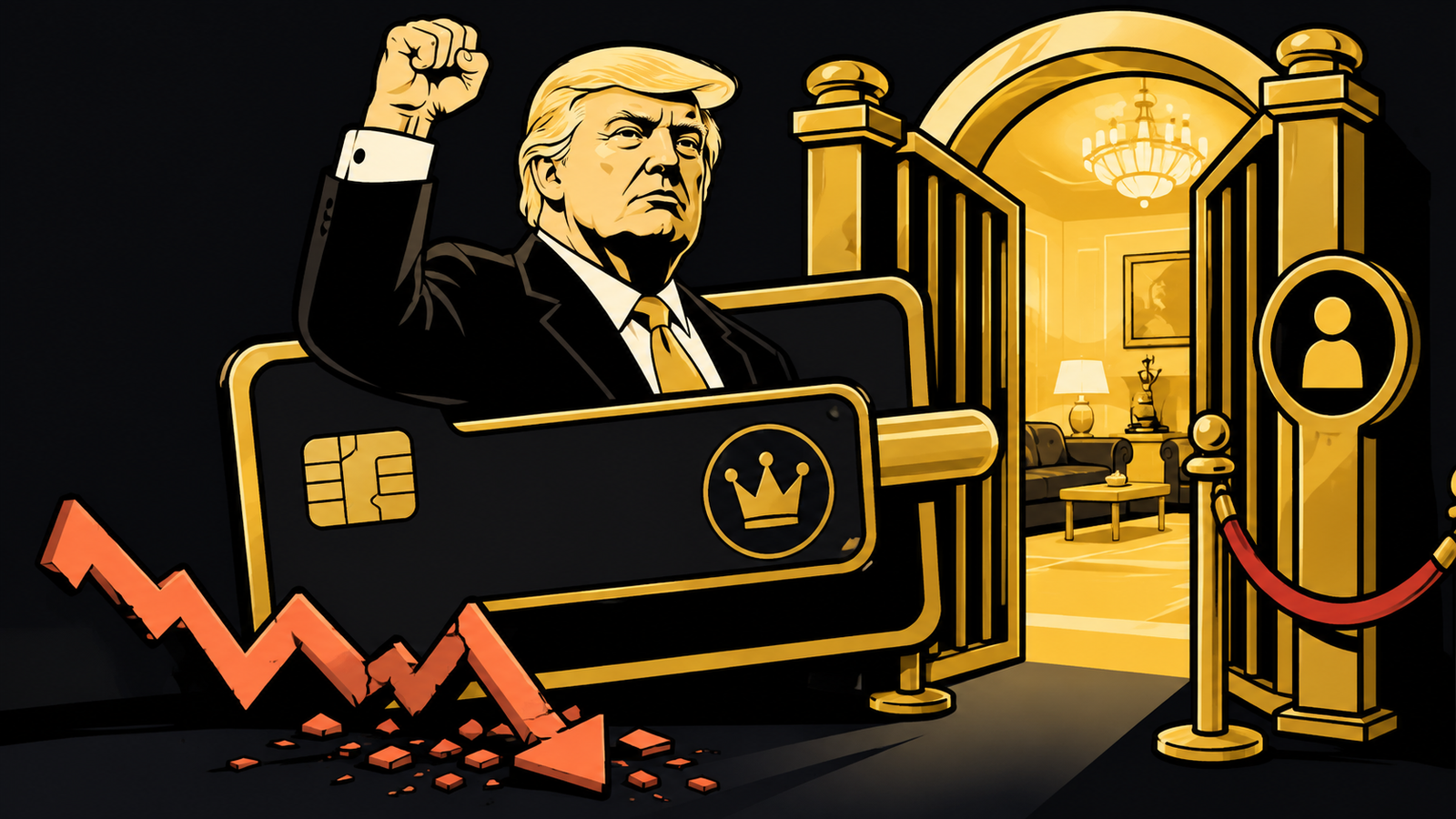
Today, the cleanest description of $TRUMP is not memecoin.
It is a scoreboard.
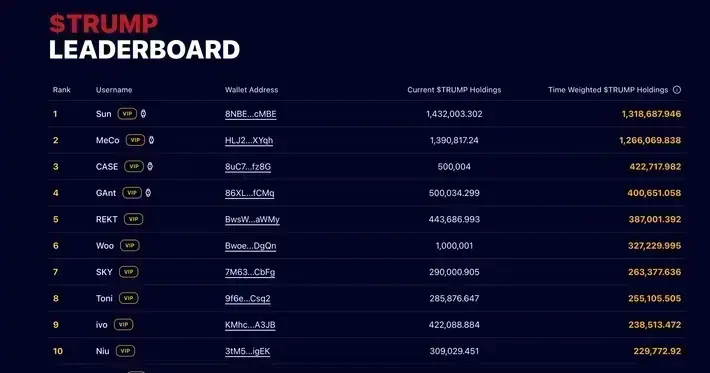
The active Coin Club tells holders that the more tokens they hold, and the longer they hold them, the higher they climb. Sell everything, and they disappear from the leaderboard. The current grand prize is a three-day Formula 1 Singapore experience for the top 23, complete with a luxury hotel, chauffeured transport, private events and an 18-carat Trump watch for the top three. Lower tiers offer merchandise discounts, collectible gifts and early access to future experiences.
This is not the forgotten landing page of a dead celebrity coin. It is an active retention system.
But scroll to the legal copy and the project says something very different. The token has no payment functionality, no transactional utility, no commercial integration, and cannot be redeemed for goods, services or cash. Eligibility decisions are discretionary, and benefits can change.
That tension, between a product that rewards holding and legal language that denies utility, is not a footnote.
It is the entire second act.
- The chart: a scarce initial float, traded hard
- The club: hold longer, rank higher, get in the room
- The inventory: affiliated entities still deciding what to do with the rest of the supply
Reporting snapshot: 28 August 2026. Prices, circulating supply and volume move continuously, and the figures below were read at a stated moment rather than audited.
The launch sold identity before it sold utility
When Donald Trump announced the token on 17 January 2025, the message was not about decentralised infrastructure, governance or financial technology.
It was about identity.
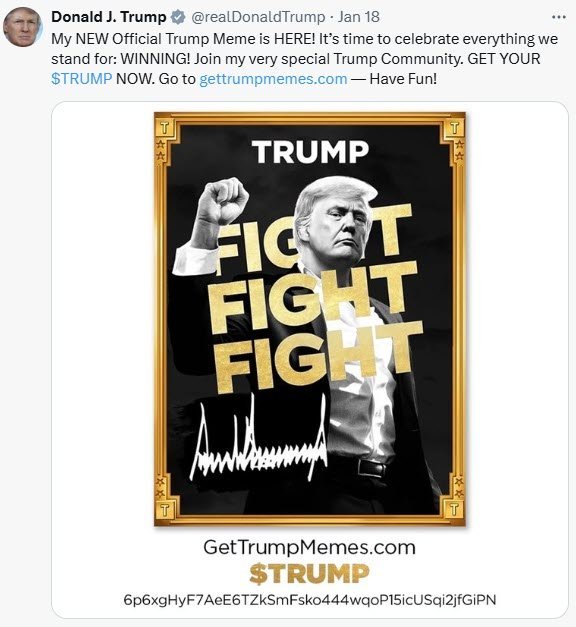
His launch post told supporters to celebrate "everything we stand for: WINNING!" The official website called the token a piece of history, the ultimate digital card for "true Patriots and Trump fans," and part of a community celebrating Trump's courage and strength. On the very same page, the disclaimer insisted that the project was "not political" and had nothing to do with a political campaign, governmental office or agency.
Those statements can be separated in legal copy. They are much harder to separate in the market.
Political identity was not an incidental theme applied to an ordinary token. It was the demand engine. The official status answered the authenticity question immediately. The photograph, slogan, presidential endorsement and timing supplied a story that thousands of anonymous memecoins spend their entire lives trying, and usually failing, to manufacture.
The initial market structure was equally important. Two hundred million tokens were made available at launch, with total supply scheduled to grow to one billion over three years. CIC Digital LLC and Fight Fight Fight LLC collectively owned 80% of the original supply, and the site disclosed that CIC Digital and Celebration Cards LLC would receive trading revenue generated by the token. That disclosure is still on the front page today, alongside a TRON version of the token added since launch.
So the package was established from day one:
- Political identity for the believer.
- Volatility for the trader.
- Official access for the ambitious.
- Supply and fee economics for the affiliated entities.
Official Trump did not need a conventional roadmap. The brand was the roadmap.

The chart was the first product
The launch worked. For a moment, it worked spectacularly.
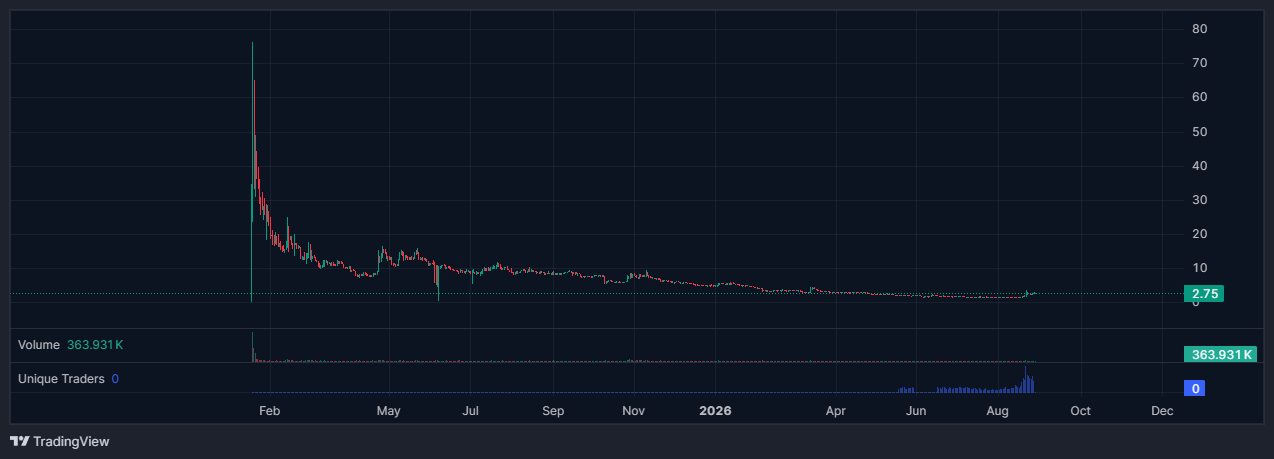
The token reached an all-time high of $73.43 on 19 January 2025, two days after launch. It has not been close since.
Those are CoinGecko's figures at 08:24 UTC on 28 August 2026, and they were moving while they were being read: the token had risen more than 22% over the preceding day.
Fully diluted, it still values in the billions, because only about a quarter of the total supply is counted as circulating.
That produces one of the stranger facts in the aftermath. A token can lose almost all of its peak price while remaining extremely tradable. $TRUMP is severely impaired as a store of value for anyone who bought near the top. It also turned over more than a billion dollars in a single day, nineteen months later, while sitting 96% below its high.
The distinction matters.
Survival is not recovery.
A market can remain busy because people believe in the asset. It can also remain busy because people are speculating on attention, trading volatility, providing liquidity, hedging inventory or trying to qualify for something outside the chart.
In this case, all of those incentives now overlap.
The chart was the first product. It is no longer the only one.
Access became the retention product
The first access experiment was blunt: hold enough of the token, rank among the winners, and attend a dinner with the president.
In May 2025, 220 qualifying holders attended the black-tie event. Inca Digital estimated that securing those seats had taken roughly $148 million in held or committed tokens between them, and that the top 25 accounted for more than three quarters of it. More than half of the attendees were believed to be based outside the United States.
It was a remarkable conversion of token ownership into social status. Not governance. Not cash flow. Not protocol rights.
A seat.
The model returned in April 2026, when 297 qualifying holders attended a conference at Mar-a-Lago, and a smaller top tier received a separate VIP reception. More people qualified than the year before, but for far less money. Nansen estimated the 2026 group held roughly a fifth of what the first dinner's winners had.
The price of entry had collapsed alongside the token. The access model had survived it.
The project then expanded it from isolated events into a broader club. Its public materials now advertise World Cup experiences, Trump Tower gatherings, merchandise discounts, memorabilia, early access to a mobile game, and the ongoing Formula 1 leaderboard. Some membership benefits require only one token to apply; the highest-status experiences depend on time-weighted holdings and rankings.
That scoring system is more important than the watches and gift bags.
The published terms for the current event are specific. The Singapore weekend, on 9 to 11 October 2026, is open to the top 23 holders on the leaderboard as of 1 October 2026.
Eligibility is determined on time-weighted holdings across a fixed window, from 18 July 2026 to the snapshot date, and the terms say plainly that this is "not merely the quantity of $TRUMP coins held at a single point in time."
Holders who competed in the earlier World Cup event and kept their tokens carry a 10% boost of their final score from that snapshot.
A normal holder campaign rewards owning the token at one moment. This one rewards duration, rewards returning, and drops you off the board entirely if you sell.
That is a retention mechanic built directly around market behaviour. It does not guarantee that anyone will keep holding. It does make selling feel like abandoning accumulated status rather than merely closing a position.
In 2025, access looked like a stunt. By 2026, access had become a system.
| Date | What happened | Why it mattered |
|---|---|---|
| 17 Jan 2025 | Trump publicly launched the official token. | Presidential identity instantly separated it from unofficial celebrity coins. |
| 19 Jan 2025 | The token reached its $73.43 all-time high. | The launch moment became the overwhelming source of historical valuation. |
| 27 Feb 2025 | SEC corporation-finance staff published its general meme-coin statement. | Typical meme coins received a relatively permissive reading of federal securities law, with important caveats. |
| 22 May 2025 | The top 220 registered holders attended the first dinner. | Token balance became a visible route to presidential access. |
| 25 Apr 2026 | A second event brought 297 qualifying holders to Mar-a-Lago. | The access model repeated even after the price had deteriorated. |
| 15 Jul 2026 | The project disclosed expanded liquidity, club, game and inventory plans. | The token formally entered a broader ecosystem and monetisation phase. |
| 28 Aug 2026 | The token traded near $2.83 while a time-weighted leaderboard ran toward its October snapshot. | The chart remained deeply damaged, and the access machine was still running. |
Who benefited? Follow the structure, not the slogans
The broad public ownership map is visible. The exact internal economics are not.
| Party | Publicly disclosed role | What remains unclear |
|---|---|---|
| Donald J. Trump Revocable Trust | Listed as the 100% owner of CIC Digital LLC in Trump's 2025 annual financial disclosure. | The filing does not provide a token-specific profit-and-loss statement. |
| CIC Digital LLC | Affiliate named in the 80% collective supply allocation, and listed as a recipient of trading revenue. | Its precise share of the 80%, current inventory and complete fee formula are not disclosed. |
| Fight Fight Fight LLC | Co-owner of the original 80% allocation, and operator associated with the site and services. | Its exact ownership and economic split are not laid out in the public materials reviewed. |
| Celebration Cards LLC | Described as the owner of Fight Fight Fight and a recipient of trading revenue. It also licenses Trump's name, image and likeness. | The full licence economics are not disclosed. |
| DTTM Operations LLC | Owns the registered Trump trademark the project uses. | The trademark payment structure is not detailed. |
| Token holders | Receive transferable market exposure and possible eligibility for project-operated benefits. | They receive no guaranteed benefit, no project ownership, and no described control over a treasury or protocol. |
Then there is the largest official income number.
Trump's annual public financial disclosure for 2025 lists CIC Digital as a business associated with licensing fees for NFTs and meme coins. Under it, the filing records $635,068,835 in royalties from a licence agreement with an entity named Celebration Coins. The same disclosure lists the Donald J. Trump Revocable Trust as CIC Digital's sole owner.
It is not labelled as pure trading fees from this token, and it is not a complete token revenue statement. The filing does not separate primary token sales, secondary-market trading revenue, licensing income or other related activity.
There is also a naming discrepancy. The financial disclosure says Celebration Coins, while the official site repeatedly names Celebration Cards LLC. The public materials reviewed do not explain whether that difference is clerical, corporate or substantive.
A separate blockchain estimate gives another view: by the May 2025 dinner, Chainalysis put fees generated by the affiliated entities at roughly $320 million. That figure and the royalty figure cannot be added together. They cover different periods, different revenue categories and different measurement methods.
For holders, the distribution was also highly uneven. Nansen data reported by CoinDesk found that 1.48 million wallets had bought the token since launch, and split them like this:
- Roughly two thirds lost money. About 988,905 wallets were down a combined $3.81 billion.
- Roughly one third gained. About 492,285 wallets showed $4.04 billion in gains.
- Net, the population was barely ahead, by something like $236 million, with the profitable side heavily concentrated among buyers who entered in the earliest hours.
Those figures need their own caveats. A wallet is not necessarily one person, one participant can control many wallets, and onchain profit calculations can include open positions and depend on cost-basis assumptions.
But the direction is hard to miss. Not everyone lost. The upside was simply distributed very differently from the downside. Early entrants obtained the most favourable prices. Large wallets could compete for premium access. Affiliated entities could receive trading-linked revenue as activity continued. Later buyers mostly arrived after the token had already become globally visible.
For a holder, success depended heavily on timing. For the project-side economics, continued turnover could remain valuable whether the next trader won or lost.
The fee engine did not require every holder to become wealthier. It required the market to keep moving.
The 80% allocation never stopped mattering
At launch, critics focused on the headline number: entities affiliated with the project collectively controlled 80% of the original one billion tokens.
Nineteen months later, that allocation still shapes nearly every part of the story.
In its 15 July market update, the project said approximately 67% of total supply had unlocked under the published schedule, and that around 5% of previously unlocked tokens had been deployed, sold, distributed or otherwise monetised since its February update.
It then disclosed that less than 9.6% of total supply could be selectively deployed, sold, distributed or otherwise monetised over the following months, naming partnerships, acquisitions, opportunistic dispositions, club activities, the mobile game and other ecosystem initiatives.
A ceiling just below 9.6% is just under 96 million tokens. At the snapshot price, that inventory carries a rough screen value approaching $272 million. That is not a forecast of proceeds: selling or distributing a large quantity could move the market, some tokens may be used as incentives rather than sold, and the project made the plan explicitly dependent on market conditions.
The project reported roughly 67% of supply unlocked, which is about 670 million tokens. CoinGecko listed about 250.9 million as circulating at the snapshot.
An unlocked token may be eligible for use or disposition without already appearing in the tradable float. The gap between those two numbers is not proof that every unlocked token will be sold.
It is evidence that the publicly circulating supply does not tell the whole inventory story.
The current terms are unusually direct about this. They say Fight Fight Fight, CIC Digital or their affiliates may dispose of tokens under pre-announced plans "or otherwise." They also tell users that dispositions may occur at the same time as marketing, promotional, community-building and club activity.
The terms further disclose that project parties may hold financial interests that conflict with those of token buyers, and that promotional activity may positively or negatively affect the price while a disposition programme is active.
That language matters because it changes the criticism. The inventory risk is not hidden in an unknown deployer wallet. It is publicly acknowledged.
But disclosure does not make the market structure disappear. It tells holders exactly what kind of market structure they are entering: one in which access campaigns, liquidity programmes and project-side inventory management may operate at the same time.
Transparency may improve the information available to participants. It does not remove the overhang.
The token has utility, except where it legally does not
In ordinary crypto conversation, something has utility when holding or using it unlocks an experience, feature, right or service.
By that standard, the token plainly does things. Holding it can affect club eligibility and leaderboard rank. One token can qualify someone to apply for basic membership. The America First Challenge lets holders with at least one token submit or vote for businesses competing for non-equity grants. The mobile-game programme distributed tokens to its waitlist and allocated more for in-game prizes. The project also used token incentives in a Kamino liquidity campaign and opened additional pools.
Yet the official club disclaimer says the token has no transactional utility, no commercial integration and no redemption rights.
Both descriptions can be true, because they use different meanings of utility.
The token is not presented as a claim on project revenue. It does not grant an enforceable share of the affiliated businesses. The public materials reviewed do not describe holder control over the contract, the treasury, supply policy or the corporate entities. The America First vote is participation in a project-operated competition, not governance over the token itself. The discounts and experiences are benefits offered through a separate, centrally administered club, where the project determines balances, eligibility and awards, and reserves broad discretion over the services.
So what the token has become is something narrower and more revealing.
It is a credential, not a claim. The wallet proves the holder meets a project-defined condition. The project decides what that condition unlocks.
The blockchain is decentralised. The value proposition is not.
Political identity shaped participation, but did not explain every participant
It would be too simple to describe every buyer as a political supporter. The token attracted at least three overlapping groups.
There were believers who saw an official collectible and an expression of support. There were traders who saw one of the largest attention events in memecoin history. And there were access-seekers who treated the leaderboard as a market for rooms, introductions, status and proximity.
The 2025 dinner showed how international that third group could become. More than half of its 220 attendees were believed to be outside the United States, and some participants publicly discussed networking with other large holders as part of the appeal.
That does not erase the political core. It shows how valuable that core became to people who might not share the same motivation.
A political supporter could buy identity. A crypto fund could buy volatility. A founder could buy entry to a room. A market maker could buy a position in one of the most visible token markets on earth.
All of them used the same contract.
Political identity was therefore not a filter that admitted only ideological believers. It was the gravity well that attracted several different kinds of demand.
That is one reason this was structurally different from a normal campaign souvenir. A hat has a purchase price and a margin. A freely traded token can produce continuous volume, new price discovery, leaderboard rankings and project-linked trading revenue long after the first sale.
The community could keep changing while the symbol stayed the same.
The legal context contains scrutiny, not a final verdict
The regulatory picture is much less settled than either side's strongest talking points suggest.
In February 2025, staff in the SEC's Division of Corporation Finance said that the offer and sale of a typical meme coin, as described in its statement, generally would not involve a security. It portrayed typical meme coins as speculative, entertainment-oriented collectibles without rights to business income or assets.
The same document set limits. It was a staff statement, not a Commission rule or decision, and carried no independent legal force. It said the specific facts and the manner of sale still mattered. And it warned that fraud connected to meme-coin sales could be pursued under other federal or state laws even where securities law did not apply.
Commissioner Caroline Crenshaw dissented, arguing that calling something a meme coin, and surrounding it with disclaimers, should not replace examining its economic reality, promoter activity and buyers' expectations. That was her own view, not a Commission ruling.
Political scrutiny has continued. On 3 August 2026, Senators Elizabeth Warren and Richard Blumenthal asked the SEC to investigate the token, citing the disparity between reported project-side income and losses among later buyers. Their letter alleged that the pattern warranted examination for possible fraud or unjust enrichment, and raised the possibility of a gradual rug pull.
That is a request and an allegation. It is not a charge, not an SEC finding, and not a determination that anything was a rug pull.
The White House has rejected the conflict-of-interest criticism, telling Reuters that Trump's assets were held in a trust managed by his children and that there were no conflicts of interest.
The project's own position is also explicit: the token is not an investment or a security, is unrelated to a political campaign or governmental office, and is offered as an expression of support and engagement with the symbol and artwork.
The sources reviewed for this article show congressional inquiries, a request for investigation, an SEC staff position and a dissenting commissioner's response. They do not show a public criminal charge, conviction, settlement or final judicial ruling against the issuer through this snapshot.
So the legally accurate conclusion is neither cleared nor proven unlawful. The token sits inside a fact-sensitive gap between a permissive general meme-coin interpretation, broader fraud law, and an unresolved political fight over whether public officials should be able to sponsor crypto products while in office.
What actually remains?
The original mania is gone. The original market structure is not.
| Layer | What survived | What did not |
|---|---|---|
| Market | A market capitalisation around $710 million, a billion dollars of daily turnover and broad tradability. | The peak valuation and the price expectations formed during launch week. |
| Community | A project-operated club, leaderboards, events, discounts and game initiatives. | Any convincing idea that the community governs the token or its economics. |
| Access | Repeated real-world experiences, from Mar-a-Lago and Trump Tower to the World Cup and Formula 1. | The scarcity of the first dinner, and the capital once required to qualify. |
| Ownership | Affiliated entities remain central to supply, trading revenue, licensing and inventory management. | The launch-era illusion that the tradable 20% was the whole economic picture. |
| Holder outcomes | A minority of wallets, especially early entrants, retained very large aggregate gains. | Broadly distributed profitability among the much larger group that entered later. |
| Policy debate | Continuing questions about conflicts, disclosure, securities treatment and fraud jurisdiction. | Any simple final legal answer. |
The token did not evolve into a currency. It did not become a decentralised protocol. It did not give holders control over a treasury, a company or a political movement.
It became a branded access economy with a liquid market attached.
That distinction explains why the project can look dead from one angle and active from another. A holder who bought at $60 sees a collapsed chart. A trader sees a billion dollars of daily volume. A club participant sees a leaderboard. An affiliated entity sees inventory, licensing and activity. A regulator sees a product whose legal language, promotional system and economic reality may not fit neatly inside the same category.
$TRUMP did not die. It changed products.
The chart was the launch product. Access became the retention product. Inventory is still the long game.

fomo Built the Feed for the Memecoin Machine
fomo turns public wallets, leaderboards and referrals into a single scroll. Its rise shows the next memecoin fight is over discovery, not creation.

How $TOAD Turned an Argentine Cartoon Into Solana Lore
A 1988 Argentine children's toad really does predate Pepe the Frog. What a Solana crowd built on top of that in a fortnight is the better story.

How $SUE Turned a Rescued Construction Cat Into BNB Chain's New Builder Meme
Sue was rescued from a Komatsu excavator in Ohio weeks before traders gave her a ticker. One enormous repost, a yellow hardhat, and BNB Chain's "Build and Build" identity did the rest.