How $SUE Turned a Rescued Construction Cat Into BNB Chain's New Builder Meme
Sue was rescued from a Komatsu excavator in Ohio weeks before traders gave her a ticker. One enormous repost, a yellow hardhat, and BNB Chain's "Build and Build" identity did the rest.
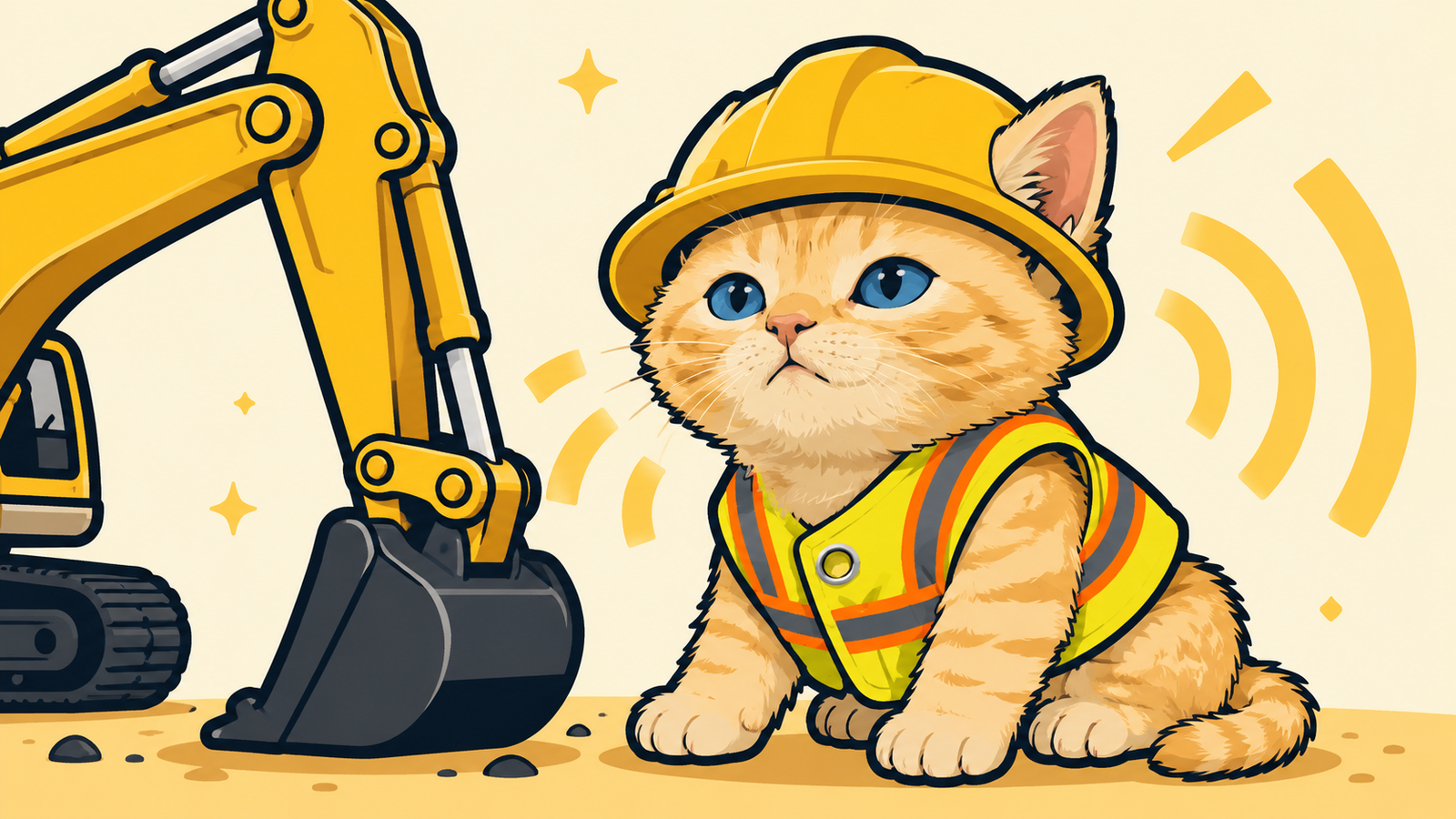
Before Sue had a contract address, she had a skid plate problem.
On 14 July 2026, Chase Guello, an operating supervisor at River Reach Construction in Barberton, Ohio, heard a kitten crying inside a Komatsu excavator. Guello knocked the machine's skid plate loose and let the kitten drop out through the bottom, then carried her into the office trailer. He suspected she may have spent a day or two trapped inside the machinery during the summer heat.
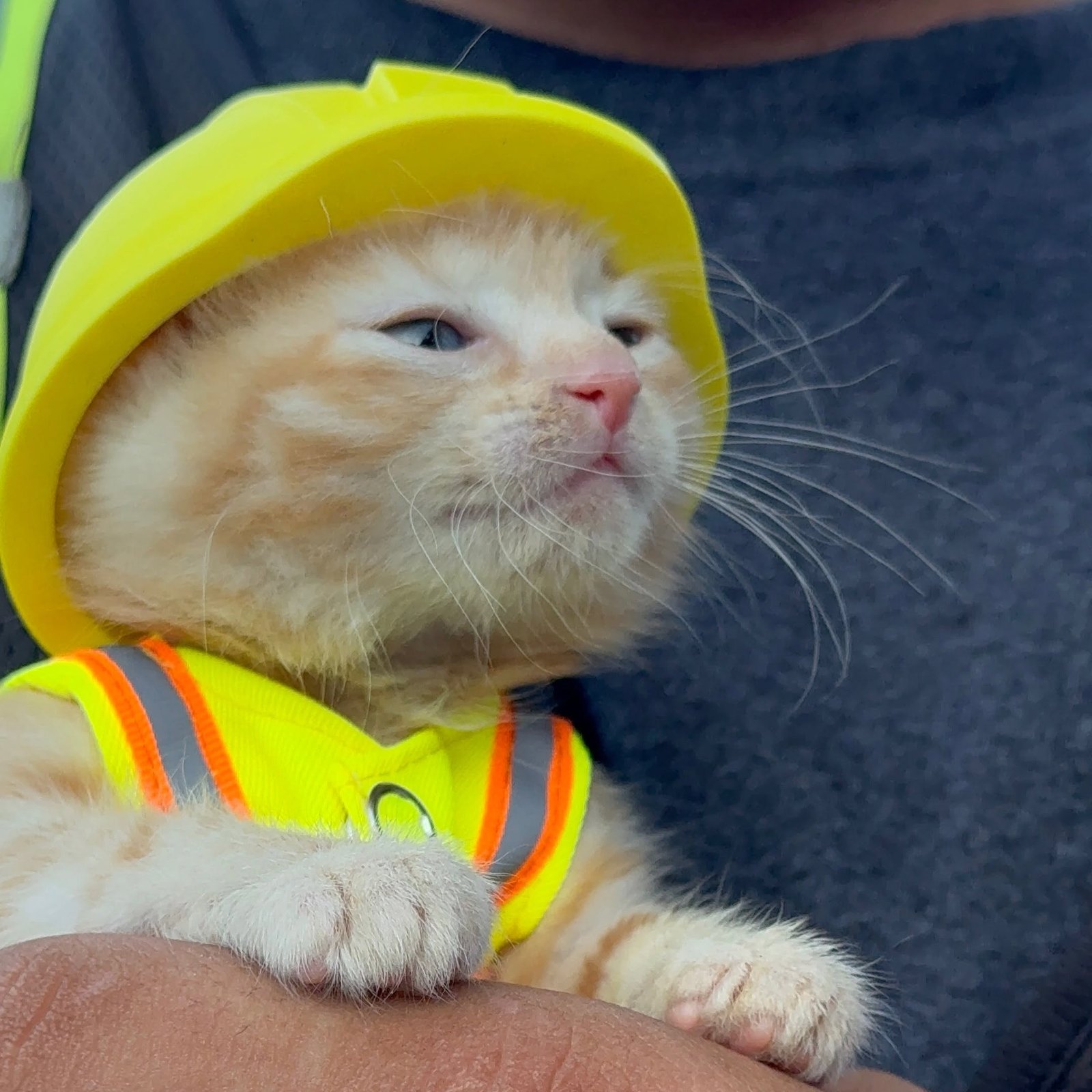
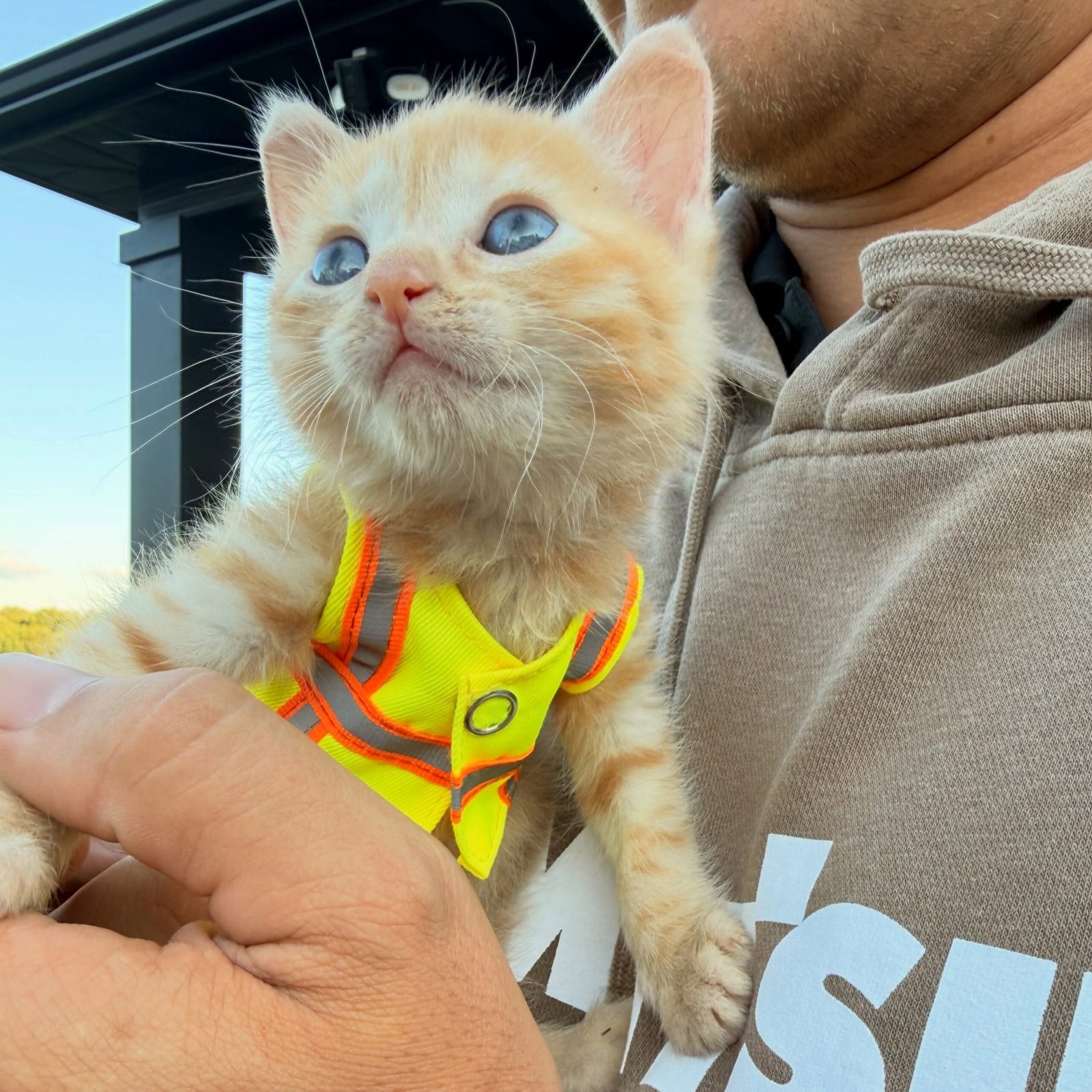
The crew held an online naming poll and chose Komatsu, after the excavator brand, announcing the result on 21 July. Sue became the nickname that stuck. By 16 July, updates showed her healthy, playful and eating. Komatsu later sent the crew a miniature safety vest and hardhat, which Sue modelled in a 30 July post. The plan was for her to become the company's shop cat once she was old enough, with the shop mechanic driving her between the yard and his house until then. The Akron Beacon Journal reported all of it on 31 July, three and a half weeks before any token existed.
That sequence is the most important fact in the $SUE story.
The token did not invent a mascot and then manufacture an origin around it. The rescue, the name, the photographs, the hardhat and the tiny-construction-supervisor joke all existed before the market arrived. The token found a complete character waiting on the internet.
- 14 July: the kitten is pulled out of the excavator
- 21 July: a crew poll names her Komatsu, Sue for short
- 30 July: she models a hardhat sent by Komatsu
- 24 August: a token appears on BNB Smart Chain
It also found the character at exactly the right moment.
The token came after the story
A token called $SUE surfaced on BNB Smart Chain on 24 August. Its principal PancakeSwap pair uses the contract 0x2Ab8A4Dd2191989aC2898006Df350B236D2B7777, and pair records put its first liquid trading activity at 12:48 UTC that day. The project says the token launched through Flap, an onchain launch protocol used for tax and non-tax tokens.
The official website presents $SUE as a deliberately simple memecoin. It claims a fixed supply of one billion tokens, no team allocation, no remaining owner control, a zero percent buy tax, and a one percent sell tax distributed to holders in BNB. It openly says there is no roadmap, business model or promised product, and describes the contract as renounced with "no owner keys, no switches".
Those figures are the project's account of itself, not conclusions from an independent contract audit.
Flap's documentation does describe support for tax-token and dividend-style mechanics, so the structure is plausible on its face. The exact implementation, control state, allocations and connected wallets still need dedicated onchain verification.
Four things would settle it: the real supply and allocations, the actual control state, holder concentration once pools and related wallets are excluded, and whether the BNB distribution operates as described.
The website is equally direct about something more important culturally: this is not an official Sue token.
The project says it is not endorsed by or affiliated with River Reach Construction, the rescuers, the photographer, Komatsu, Flap, PancakeSwap or BNB Chain. It describes itself as a fan-made community token using a real story and photographs that remain the property of their original owner. Its wording is unusually plain: "$SUE is an unaffiliated community memecoin. It is not endorsed by, connected to, or operated by the construction crew, the photographer, Komatsu Ltd., or the person who first posted about Sue."
That makes $SUE a token based on a real cat, not a token belonging to the people responsible for the real cat.

The post that changed the scale
Sue's original story had already received regional reporting and a growing animal-content audience. The market did not form around that gradual attention alone.
The acceleration came when a large Puppies and Positivity account resurfaced the story on X, in a retelling that ran to hundreds of thousands of likes and thousands of comments. By 25 August, third-party mirrors were displaying more than 14 million views on the post. The exact counter continued changing, but the direction was unmistakable: a local construction company's rescue had escaped into the general internet feed.
Then the crypto distribution layer attached itself.
Trader accounts began posting the $SUE contract alongside the viral animal post. A Telegram channel with almost 28,000 subscribers linked directly to the same X post, published the contract several times, and compared Sue to earlier cat and dog memes. The channel's own posts make the sequence unusually visible: first the viral cat, then the contract, then the familiar language of bags, entries and potential.
This distinction matters. The first audience was reacting to a rescued kitten. The second audience was reacting to the possibility that millions of people were reacting to a rescued kitten.
That is how attention becomes an asset.
The viral source did not need the token. The token urgently needed the viral source.
Why Sue fit BNB Chain so neatly
Every chain develops a vocabulary that helps its communities decide which memes feel native.
BNB Chain's vocabulary was almost custom-made for a construction cat. BNB officially describes Build and Build as the philosophy behind its name. Sue already had a yellow hardhat, a reflective vest, heavy machinery and a job-site origin story. The token's copywriters only had to make the connection explicit: born to build, and hardhat stays on.
The yellow visual language helped. It matched both construction equipment and the colours already associated with the Binance and BNB ecosystem. The result was a character that looked BNB-native without having been designed for BNB at all.
This is an inference about cultural fit, not evidence of coordination or endorsement. The project's own disclaimer says no such affiliation exists.
The timing supplied another advantage. Flap was running a 100,000 USDT campaign from 19 to 28 August, one half of a wider BNB "Trenching Szn" promotion, with daily rewards drawn among traders clearing $500 of eligible volume on Flap-launched tokens. $SUE appeared inside that campaign window.
The campaign did not create Sue's meme, and there is no evidence that BNB Chain or Flap selected or promoted $SUE specifically. It did, however, mean the token entered an environment where Flap launches were already being watched and trading activity was already being incentivised.
The meme supplied the story. The campaign supplied a particularly receptive market.
One quiet mismatch is worth noting, since the slogan leans on it. River Reach is an environmental restoration contractor, working on streams and wetlands. Sue's crew does not really build things. It puts them back.
From Sue to 施工猫
The next transformation happened through translation, and it started earlier than most of the audience realises: the token's registered onchain name is not Sue at all. It is 施工猫, construction cat, with SUE carried as the ticker.
Chinese-language crypto accounts took up the same phrase. Posts emphasised the combination of a real rescue story, a yellow hardhat, cat imagery and BNB's builder culture. Some turned her into a broader worker-cat archetype, less a specific Ohio shop cat and more a small creature reporting for another day on the job.
That reinterpretation gives the meme more room to travel.
Komatsu, River Reach Construction and Barberton are specific references. 施工猫 is a role. Anyone can draw a construction cat. Anyone can add a hardhat to an avatar. Anyone can post about continuing to build through a bad market.
The token's website reinforced this behaviour by releasing a browser-based tool that places a yellow hardhat on a user's profile picture. It is a simple feature, but it gives the community something to do besides repeat the ticker.
It also illustrates what tokenisation changed. Sue began as one rescued cat with one documented story. The token is turning her into a reusable costume.
That can expand the culture, but it can also detach the meme from the actual animal and the people who rescued her. Some Chinese-language posts described the construction cat as though it emerged from Chinese internet culture, even though the documented origin is a construction company in Ohio. The localisation is real. The rewritten origin is not.
The first market was fast, large, and unstable
At 12:02 UTC on 25 August, roughly 23 hours after the pair opened, DexScreener showed the principal $SUE pool with about $175,000 of liquidity behind a market capitalisation near $2.46 million, on $9.9 million of reported 24-hour volume across 82,583 transactions.
The same reading showed the price up about 49 percent over the previous hour and down 9 percent across the five minutes around the snapshot, which is the texture of a market still being discovered rather than one that has settled.
The reported volume was roughly 57 times the pool's available liquidity. High turnover can come from genuine demand, trading bots, repeated activity by the same participants, arbitrage, campaign incentives, or some mixture of all four. Volume alone cannot establish that $SUE had millions of independent buyers, or even that its market attention matched the reach of the original cat post.
The market was also fragmented almost immediately, and more thoroughly than a single copycat. A search of the token's onchain name at that same moment returned at least 26 distinct contracts using it, across four chains: two more on BNB Smart Chain, seventeen on Robinhood Chain, five on Solana and one on Ethereum. The Robinhood Chain group arrived at roughly hourly intervals through the first night, each seeded with a nearly identical $39,000 to $46,000 of liquidity. The largest reported turnover of any of them was on Solana, not on BNB Chain.
Almost all of that activity is tiny beside the main pair, and none of it is evidence of who deployed what. A shared name is not a shared operator, and a copy is not automatically an impersonation attempt.
What it does establish is that the ticker identifies nothing on its own. For $SUE, the exact contract is part of the identity story rather than a detail that can be inferred from the symbol.
Why the meme has real potential
The strongest thing about $SUE is not its first chart. It is the amount of cultural information packed into one image.
- The story predates the market. A documented rescue gives Sue an emotional arc that cannot be produced by a token launch form.
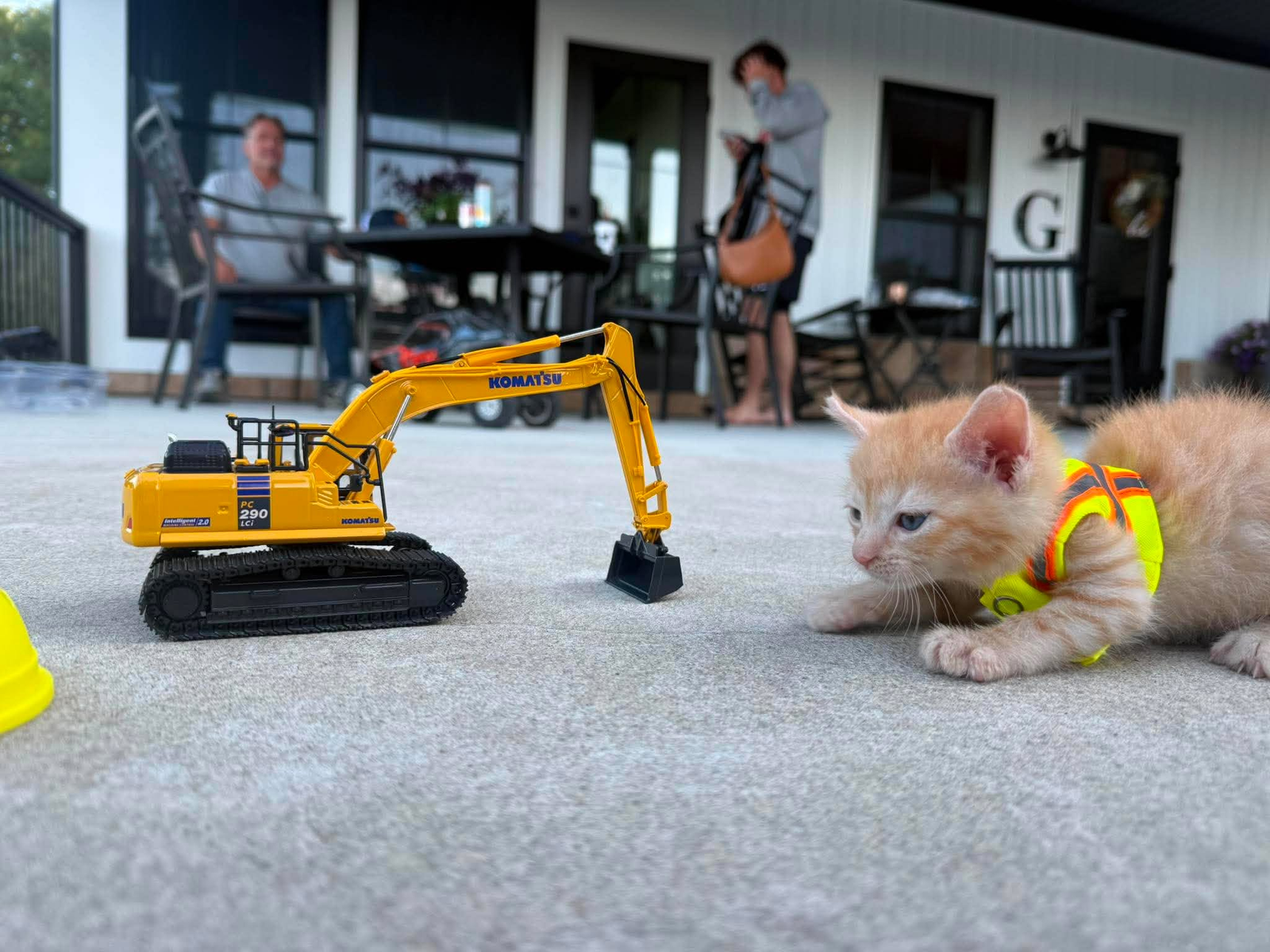
- The character is instantly readable. Orange kitten, yellow hardhat, reflective vest, excavator. The entire joke survives at thumbnail size.
- The name contains its own caption. Komatsu becomes Komat-Sue. The wordplay connects the animal to the machine without requiring a paragraph of lore.
- The character has a role. Crypto already has thousands of cats. Sue is not merely another cat. She is the foreman, the supervisor, the shop cat, the tired construction worker.
- The meme translates. 施工猫 turns a specific American rescue into a portable worker-cat archetype.
- The community has a costume. "Hardhat stays on" and the profile-picture generator provide a repeatable ritual, which is more useful to a meme community than a complicated roadmap nobody intends to read.
Together, these qualities give $SUE a better cultural starting point than most tokens created around an invented animal and an empty Telegram room.
They do not guarantee that a durable community will form.
What $SUE still has to prove
The first unresolved question is authorisation. The project clearly says it is unaffiliated with the crew, the photographer and Komatsu. There is no public evidence in the reviewed material that Sue's rescuers approved the token, participated in it, or receive any benefit from it. There is also no evidence that they objected. Their position is simply unknown.
The second question is control. The public materials do not identify who launched the token, who controls the website and social accounts, whether several independent contributors have access, or whether the project could continue if its current operator disappeared. "Community memecoin" describes the branding. It does not, by itself, describe the operating structure.
The third question is whether the crowd exists beyond the distribution channels that discovered it. A hardhat generator and a group chat are early cultural tools. Most of the visible activity, however, still consists of trading posts, contract repetition, market-cap commentary and variations of the original photograph. The test is whether artists, translators, moderators, archivists and recurring contributors remain after the viral animal post leaves the feed.
The fourth question is whether the token mechanics match the website. The one-billion supply, the sell tax, the BNB distributions, the renounced control and the absent team allocation should be verified from the contract and the holder structure rather than accepted from marketing copy. Until then they remain claims made by the project.
Finally, $SUE has to decide what relationship it wants with the real story.
The fact that Sue is real is the project's greatest cultural advantage. It is also its most obvious responsibility.
A token can call itself a fan project, but sustained use of a real animal, real workers and somebody else's photographs creates questions that invented mascots never face. There is no public evidence that any proceeds reach Sue, the crew, or an animal-rescue organisation.
The thirty-day test
By 23 September, the useful signals will not be whether $SUE revisits its first high.
They will be whether original art replaces repeated photographs, whether the hardhat profile picture becomes a recognisable social object, whether the Chinese and English communities develop shared jokes, whether contributors appear outside the original operator, and whether the project becomes more transparent about its control and token mechanics.
It will also matter whether the real crew responds. Approval, objection, collaboration or continued silence would each change the story differently.
Sue the cat already survived the difficult part. She escaped the excavator, found a home and became the smallest member of a construction crew.
$SUE received the easier assignment: a viral post, a ready-made costume, and a market that already knew how to turn attention into a ticker.
The cat was born to build. The token has not yet proved what it can build.
Ansem.io Is Not Just a Launchpad. It Is a Market for Ansem's Attention
Ansem's new Solana platform borrows pump.fun for the launch, then sells the thing it actually owns: his audience, priced in burns, airdrops and a leaderboard.

fomo Built the Feed for the Memecoin Machine
fomo turns public wallets, leaderboards and referrals into a single scroll. Its rise shows the next memecoin fight is over discovery, not creation.
Robinhood Built a Chain for Stocks. The Internet Gave It a Cat.
Robinhood Chain launched to put equities onchain. Memecoins arrived first and supplied its mascot, its launchpads and most of its early liquidity.
