BitMart's "Orderly" Shutdown Has Become a Fight Over User Funds
BitMart calls its closure an orderly wind-down. Users want withdrawals, liabilities, and usable reserves disclosed. Here is what the evidence actually shows.
Eleven days before BitMart announced it was closing, the exchange published a report describing a company preparing for another eight years of trading.
Nathan Chow, then identified by BitMart as its chief executive, said the platform was building through a difficult market so it could lead when the cycle turned. The report counted hundreds of new listings, expanding products, better app ratings, growth in asset management. It read like a company settling in.
Chow says that on 24 July he was told his employment was being terminated. Two days later BitMart announced the wind-down of its exchange. He says he was "not involved in the decision announced today, not consulted on it, and not informed of it."
- 15 July: another eight years
- 24 July: the global CEO is told he is leaving
- 26 July: the exchange announces it is closing
That sequence is the cleanest way into this story, because it establishes the shape of the problem before anyone reaches for a motive. Before you can work out whether money was stolen, lost, locked, lent, mismanaged or merely delayed, you have to sit with something more basic: BitMart's public account of who was running it fell apart before its balance sheet ever became visible.
Since 26 July the "orderly wind-down" has collected blocked-withdrawal reports, project funds said to be stuck on the platform, claims of unpaid staff, an executive resignation, an official account that may or may not have been hacked, and an open demand that the exchange disclose what it holds and what it owes.
The viral version is shorter: BitMart's CEO stole the money.
The public evidence reviewed for this piece does not prove that. What it does establish is a custody crisis inside a transparency vacuum, and those are not the same accusation.
Not quite a "CEO stole the funds" story
The person at the centre of the allegations is BitMart's founder, Sheldon Xia, and not the executive BitMart had most recently presented as its global chief.
In April 2025 the company announced that Xia would move from CEO to group president while Chow became global CEO with day-to-day control. Xia stayed close to strategy, product and security, according to that announcement.
Chow's account of being dismissed days before the wind-down suggests authority over the closure sat somewhere other than the CEO's office. That does not identify who made which decision, and it is not evidence of wrongdoing. It does make the online shorthand about "the CEO" wrong on the facts.
A more careful description: BitMart's founder and senior management face questions about customer funds, after the executive who publicly held the CEO title said he was removed from the decision entirely.
The separation continued into August, when chief product officer Terence Lee announced his resignation while stressing that he had held no authority over user assets, exchange accounts or financial operations. That was read online as another insolvency signal. Leaving a company and disclaiming financial control are not proof of a shortfall.
What they do show is an organisation whose senior figures were publicly stepping back from responsibility while customers were still asking who held it.

What BitMart was, and why the long tail cared
BitMart launched in 2017 and grew into a significant venue for assets that sat well below the listing thresholds of the largest exchanges.
Its importance was never really its reported volume. BitMart was part of the machinery that converted small token communities into exchange-listed markets. A project could move from an onchain liquidity pool to a global order book, pick up a market maker, and put its ticker in front of people who would never visit its home chain.
The company said it supported more than 1,900 spot assets by the middle of 2026, having added 495 in the first half of the year across memecoins, AI tokens, real-world assets, gaming and infrastructure.
That appetite is what made BitMart useful to emerging projects, and it is also what tied the exchange to the thinnest end of the market, where liquidity is shallow, valuations are unreliable, and a project's tradeable inventory can depend on a single market-making arrangement.
BitMart had already survived one trust event. In December 2021 attackers took up to $196 million from two of its hot wallets. The exchange suspended withdrawals and said it would compensate affected users.
None of that history proves anything about the present allegations. It does explain why a second episode of restricted withdrawals reactivated old fear so quickly.
From orderly closure to accusation
The trouble did not start with the shutdown notice. On 23 May, responding to earlier withdrawal complaints, BitMart said its risk controls had caught 239 linked accounts running a scheme against platform subsidies. Legitimate users were unaffected, it said, and a proof-of-reserves report would follow at an appropriate time.
By 18 August no complete public report reconciling the exchange's assets against what it owes its users had settled the dispute.
- 23 May. BitMart attributes prominent withdrawal and account-restriction complaints mainly to a network of linked accounts abusing platform rewards, and says a proof-of-reserves report is being prepared.
- 15 July. The upbeat first-half report is published. Chow says the exchange intends to operate for another eight years.
- 24 July. Chow says he is informed his employment as global CEO is being terminated.
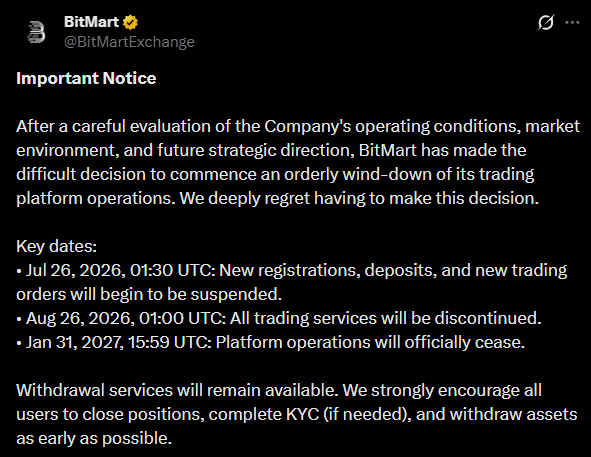
- 26 July. BitMart stops new registrations, deposits and new trading orders, and announces that trading ends on 26 August, with formal cessation of platform operations on 31 January 2027.
$BMX, the exchange's own token, falls 58 percent on the news, according to CoinDesk. - 27 July. Lookonchain reports that 58 wallets withdrew roughly $805,000 over the preceding day, and that no withdrawals were processed in the final eight hours it watched. A point-in-time snapshot of attributed addresses, not an audit of every BitMart withdrawal.
- 6 August. The Cayman Islands Monetary Authority states that BitMart and several named related entities have never been registered, licensed or authorised by CIMA to conduct virtual-asset business from the Cayman Islands, following multiple complaints to the authority.
- 8 August. Xia denies taking user assets, saying the team is inventorying and consolidating assets, maintaining systems, and weighing courts and independent auditors as part of a transparent process. He publishes no figures and no withdrawal timetable.
- 17 August. A long open letter appears on BitMart's official Chinese-language account, demanding wallets, assets, liabilities, usable reserves, staff compensation and a repayment plan by 19 August. Xia says the account was hacked and its claims are fabricated.
Each event added suspicion. None of them, on its own, proves theft. Together they describe a company winding down while basic questions about authority and custody stay unanswered.
The account that accused its own founder
The 17 August letter produced the most explosive version of the story, and it arrived through BitMart's own Chinese-language account.
It addressed Xia and his partner Nancy (Yi) Li, claimed that many users still could not withdraw, and claimed that employees had not received final salary or compensation. It demanded disclosure of the exchange's wallets, assets, liabilities and the reserves actually usable for withdrawals. It asked who authorised the withdrawal restrictions, when management learned of the problem, whether related accounts had received BitMart-linked funds, and what customers could expect to recover. It set 19 August as the deadline for a verifiable disclosure, an executable repayment plan, and an answer on whether the company would accept independent scrutiny. If that deadline passed without one, it said, it would keep submitting evidence to regulators, law enforcement, lawyers and the media.
The most important thing about that letter is the caveat inside it. Whoever wrote it framed the account information it referenced as grounds for an investigation rather than the result of one, said explicitly that it was not proof of wrongdoing, and warned against reaching a criminal conclusion before wallet ownership and fund origins had been verified.
Even BitMart's apparent internal accusers, in other words, did not claim to have established that anyone stole customer money.
Xia's response was that the account had been compromised and the allegations fabricated. He said he had collected evidence of the posts, and would file a police report and send a lawyer's letter to X seeking technical and data forensics. That challenges the source of the accusation. It does not answer the questions the letter asked about total liabilities, usable reserves, outstanding withdrawals or a repayment schedule.
So there are two incompatible readings of the same post, and the whole scandal changes shape depending on which is true:
- Insiders. Employees used an official channel to force management into disclosing a shortfall, because nothing else had worked.
- An attacker. Someone seized the account and used the exchange's genuine withdrawal problems to publish a convincing accusation.
The available evidence does not settle which, and the difference matters: one version makes the letter testimony, the other makes it forgery.
The chain is not a confession
Onchain data has fed the anxiety without resolving it.
Around the shutdown announcement, wallets attributed to BitMart by Arkham held roughly $71 million, down from about $102 million earlier in July. More than half of that attributed balance was reportedly held in WFI tokens, with a comparatively small tracked balance in USDT.
That composition raises a fair question about liquidity rather than about honesty. An exchange can hold millions at dashboard prices and still hold far less that could be sold quickly without collapsing the price of the thing it is selling.
Every onchain figure here is one provider's attribution at one moment, and later estimates from different trackers diverged sharply, which tells you how much these totals depend on whose wallet list you use.
Attribution can miss cold wallets, third-party custodians, unlabelled addresses, fiat accounts and assets held through other legal entities. More importantly, it shows only one side of the ledger: it cannot show what the exchange owes customers, staff, lenders, market makers or token projects.
A block explorer proves an address moved an asset. It does not prove who controlled the address, why it moved, whether the asset was a customer's, or whether the company was solvent afterwards.
Even the proof-of-reserves report BitMart promised in May would only be part of an answer. A reserve snapshot can show assets in identified wallets and set them against certain customer balances. It does not necessarily reveal offchain debt, borrowed assets, legal claims, unpaid bills, or obligations parked in another company.
What is missing is not a wallet screenshot. It is a reconciliation: which assets exist and are available, what the exchange owes, which withdrawals are disputed, and how whatever remains will be distributed.
What is confirmed, what is claimed, what is unknown
Separating those three is most of the work in a story like this, so here they are separated.
Confirmed
BitMart is winding down. New deposits and new trading have stopped, trading is scheduled to end on 26 August, and the company recommends submitting withdrawal requests by 05:00 UTC that day, warning that later requests may enter a separate review process. Formal platform cessation is set for 31 January 2027.
Chow says he was dismissed before the announcement and not consulted about the closure. The former product chief has publicly separated himself from control over user assets. Users and projects have publicly reported delayed or blocked withdrawals, in claims ranging from thousands to millions of dollars, though those amounts have not all been independently verified. BitMart promised a proof-of-reserves report in May, and no complete public asset-and-liability reconciliation has answered the current questions.
Claimed, but not established
- That Xia or other insiders misappropriated customer assets.
- That BitMart is insolvent.
- That accounts connected to management received or withdrew customer funds.
- That employees have gone unpaid.
- That the Chinese-language account was controlled by employees or internal whistleblowers.
- That the same account was hacked by an outsider.
Some of these may later prove true. As of 18 August none had been demonstrated through a complete financial audit, a court finding, verified wallet attribution or a regulator's report. The first two are the ones circulating hardest, and they are the two carrying the least public evidence.
Unknown
- The total value of outstanding withdrawals.
- BitMart's complete assets and liabilities.
- How much of its reported balance is liquid and usable today.
- Who made the final closure decision, and why the global CEO was removed immediately before it.
- Who controlled the Chinese-language account when the letter went out.
- Whether customers will be repaid in full, repaid slowly, or asked to accept less.
Five explanations competing for the same silence
The absence of an accounting is what lets several theories survive at once. That is the real cost of the transparency failure: it makes the worst reading unfalsifiable.
The founder took or redirected funds. The most serious allegation, and the fastest spreading. Establishing it would require evidence tying management-controlled accounts to custody assets, followed by transfers inconsistent with running an exchange. Screenshots and wallet clusters can point somewhere; they do not establish ownership or intent by themselves. The open letter raised related-account questions while conceding they were unproven. Xia denies misappropriating anything. For now it remains an allegation.
There are assets, but not liquid ones. A company does not have to lose every token to stop being able to pay out. It might hold project tokens, locked assets, thinly traded inventory, debts owed by counterparties, or an exchange token that cannot be sold anywhere near its displayed valuation. If customers ask for stablecoins and the reserves are mostly illiquid, the withdrawal screen looks identical to insolvency. An OpenGradient co-founder said his project's market maker could not withdraw its BitMart balance and called the exchange insolvent, without disclosing the size or composition of that balance. Plausible theory, not a finished diagnosis.
An internal power struggle took over the wind-down. The CEO's removal, the product chief's resignation and the disputed use of an official account all point at a governance rupture. The account may have been used by insiders who thought public pressure was the only route to an audit; it may have been compromised, as Xia says; or someone may have had access to it without authority to speak for the company. This explains why BitMart appears to be arguing with itself in public. It does not explain where the assets are.
The business was already in retreat. The official explanation points to operating conditions and strategy, and mid-tier exchanges genuinely are squeezed by falling fees, concentrated liquidity, onchain competition and rising compliance costs.
The Cayman authority said BitMart and the named entities were never registered, licensed or authorised by CIMA for virtual-asset business from the Cayman Islands.
That is a statement about Cayman authorisation, not a finding that the exchange held no licence anywhere: BitMart separately promoted an Australian licensed entity in its own first-half report.
Treat it as one regulator confirming an absence in one jurisdiction, which is meaningful, and not as a global verdict, which it is not.
Creditors are pushing for a formal restructuring. Echo Base, a distressed investment firm, said it offered BitMart a funded restructuring package and got no response, and its chief executive argued that a dispersed creditor base may eventually require a court process. That adds another motive to the public argument. Creditors, projects, employees and restructuring firms all have reasons to force information into the open. It does not make their complaints false. It does mean the conversation includes parties trying to shape the outcome, not only observers describing it.

Another one bites the dust, and who actually pays for it
Several camps have formed, and they are not really arguing about the same thing.
One sees another FTX, and the pattern is familiar enough to justify the fear: withdrawal friction, vague explanations, executives distancing themselves, a company asking for patience without publishing what it owes. Another thinks there may still be an operational explanation, noting that BitMart warned a flood of requests, identity checks, source-of-funds reviews, sanctions screening and address verification could all slow withdrawals.
A third camp is not waiting for either argument to win. The onchain investigator ZachXBT put the test in one sentence: "If you actually have the liquidity, then simply return the funds to everyone instead of posting vague statements."
Then there is the crowd enjoying it. A good deal of the reaction has been variations on "another one bites the dust", treating the closure as a weak venue being cleared out of the market. Some of that is earned, given the withdrawal complaints, the 2021 hack and the industrial listing of speculative assets.
But an exchange can deserve to fail without its failure being good for the people trapped inside it. Users do not get their money back because someone posted a victory lap. Employees are not paid because the market cleansed itself. Token communities do not recover market-making inventory because another platform became a cautionary meme.
The scandal is not that theft has been proven. It is that BitMart has not published enough information to rule it out.
Which is also the answer to whether this is a black swan, a phrase being thrown around loosely. It depends entirely on where you are standing.
For anyone with most of their reachable assets stuck on BitMart, the black swan already arrived, and whether the wider market notices does not reduce the damage. For smaller projects the risk is real too: BitMart listed hundreds of assets in months, and if market makers and teams cannot recover inventory, some tokens could lose exchange liquidity, face delisting, or have to replace assets that remain trapped. A problem sealed inside one exchange can spread through many thin markets without moving Bitcoin at all.
A crypto-wide black swan, though, has not been established. The public evidence does not identify large loans between BitMart and other exchanges, major lenders depending on it, or a verified shortfall big enough to force selling across the market. Reported volume says nothing about the size of its liabilities, and attributed wallet totals say nothing about its counterparty network. That would change if a formal process revealed a large asset shortfall, institutional creditors, customer assets pledged elsewhere, or obligations shared with other platforms.
Until then this looks like a potentially severe exchange and long-tail liquidity event rather than an FTX-sized systemic one. That is not reassurance for anyone waiting on a withdrawal. It is just the boundary of what the evidence currently supports.
What would actually settle it
As of 18 August, Xia denies taking user assets and says the latest accusations were published through a compromised account. BitMart says withdrawals remain available, though they may face manual review. Trading is still scheduled to stop on 26 August. The 19 August deadline set by the disputed account had not passed at this research cutoff.
No public reconciliation has yet shown every material BitMart-controlled wallet, the exchange's total customer and creditor liabilities, the reserves that are liquid and usable for withdrawals, the amount and age of outstanding requests, the expected recovery rate, or an independently supervised repayment timetable.
Those six things are the story. If BitMart processes withdrawals and publishes a credible reconciliation, the theft narrative weakens on its own. If it reveals a shortfall, this moves from a messy wind-down into insolvency and recovery. If verified fund tracing shows customer assets moving into accounts controlled by management, the criminal allegations move from rumour towards evidence.
For now the failure that is actually proven is the one nobody is chanting about: a company entrusted with other people's assets has not released enough information for anyone outside it to tell which of these stories is true.

From 400 UNI to Endless Points: How Airdrops Changed Crypto
Airdrops once surprised early users. Then came the roles, the snapshots, the seasons and the points. The history is a fight over who deserves the tokens.

fomo Built the Feed for the Memecoin Machine
fomo turns public wallets, leaderboards and referrals into a single scroll. Its rise shows the next memecoin fight is over discovery, not creation.

How $TOAD Turned an Argentine Cartoon Into Solana Lore
A 1988 Argentine children's toad really does predate Pepe the Frog. What a Solana crowd built on top of that in a fortnight is the better story.