What Are Quotrons? Inside $QUOTRON's Stock-Reward NFTs
Quotrons turns retro stock terminals into collectible, fee-linked NFTs. Its next test is whether the rewards can outgrow trading in Quotrons itself.
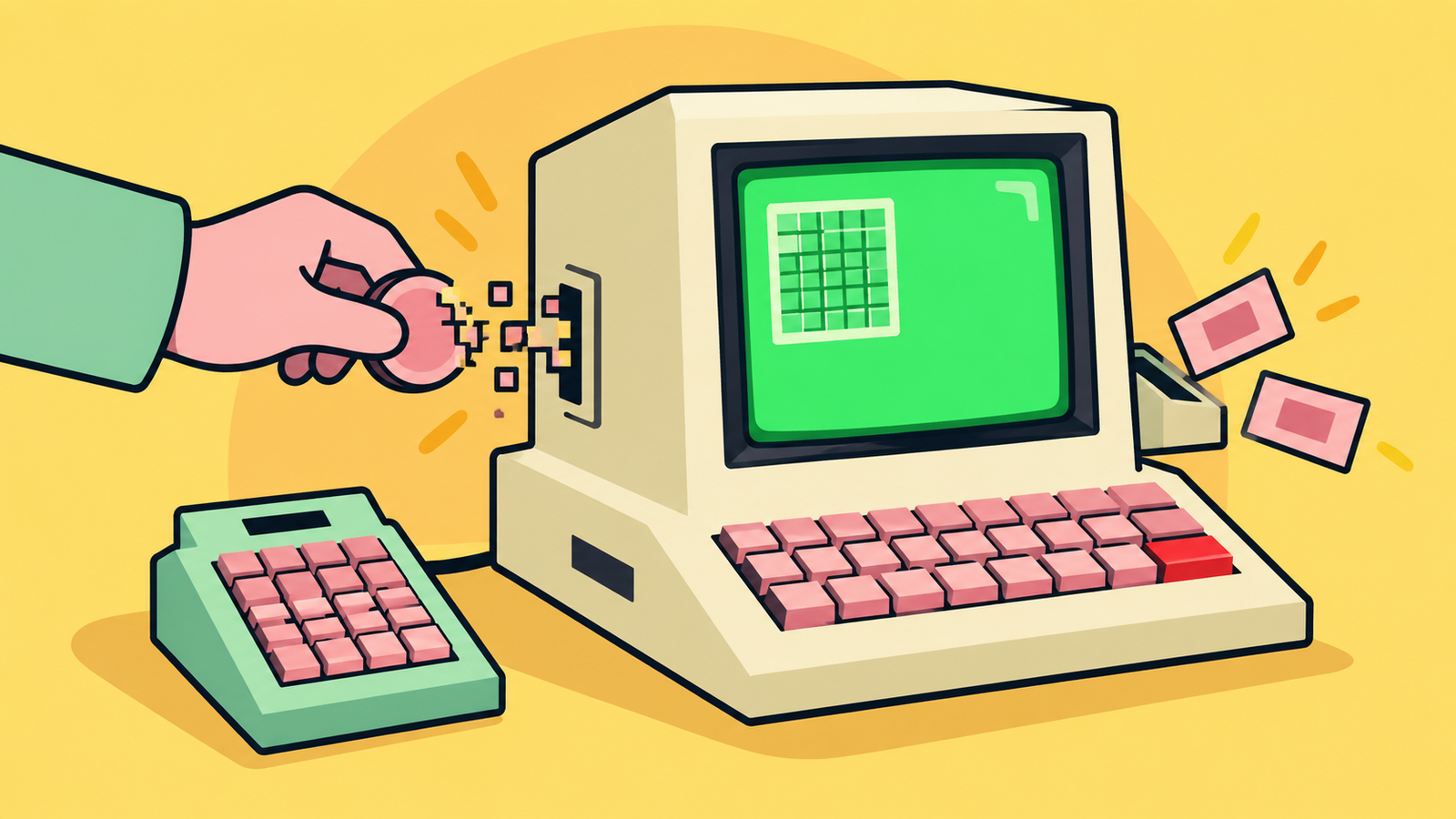
- A Quotron terminal starts dark, backed by a liquid token
- Burning that token hardwires the terminal
- The burn is permanent, the NFT remains
- Hardwired terminals share fee-funded stock-token rewards
A Quotron looks like a stock terminal rescued from a forgotten brokerage. The unusual part is its power switch.
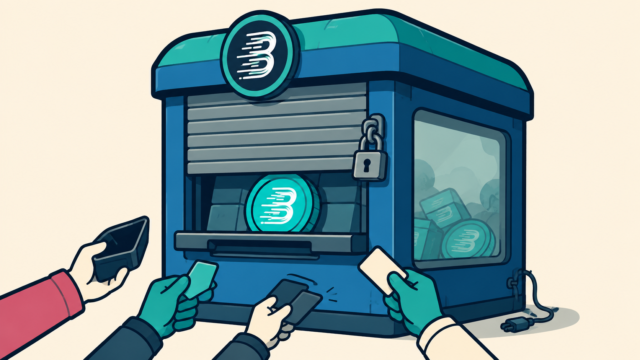
Turning the screen on costs a token. Making a terminal eligible for rewards means permanently destroying the liquid $QUOTRON behind it. The token disappears, the NFT stays, and the project calls the lit result "hardwired." The sacrifice is the mechanism, not a deposit that comes back later.
That is the appeal in miniature: recognisable art wrapped around something that does more than sit in a wallet. It is also where the questions start. What funds the rewards? Why do two Quotrons prices not measure the same thing? And can these little machines attract business beyond people trading the machines themselves?
Those questions matter more than whether the next screenshot shows a higher floor.
What actually is a Quotron?
Quotrons is an experimental project on Robinhood Chain built around a maximum of 4,444 terminals. It uses an ERC-404 design, which fuses a fungible token and an NFT collection into one contract: the liquid side is $QUOTRON, the visual side is a stock-quotation machine, and each whole token corresponds to one terminal.
The marketplace currently indexes 4,224 of them, spread across 923 owners.
Every terminal is in one of two states:
- Dark. Still connected to its liquid token. It trades, it displays, it earns nothing from the hardwired reward system.
- Hardwired. The token behind it has been burned. The screen is lit, the terminal is eligible for stock-token rewards, and there is no way back.
This is not staking with an unlock date. A hardwired terminal can still be sold as an NFT, and the creator has said unclaimed rewards travel with it. The burned token never returns.
The language matters as much as the mechanics. A fraction of $QUOTRON, a dark terminal listing and a hardwired terminal listing are three different assets, and their prices should not be treated as one number. Most of the confusion around this project starts with that shortcut.
The name is real financial history. Quotron terminals put stock quotes on brokers' desks decades before browser tabs became trading floors.
The Computer History Museum documents John Scantlin's use of the CDC 160A in 1962 for the Quotron II system, which delivered the latest New York Stock Exchange prices in roughly 15 seconds.
A trading terminal was always an object about access: who sees the market, who gets the number first, who has a seat at the desk. The NFT borrows that meaning, which is why the screen reads as an explanation of the project's ambition rather than an unrelated mascot.
None of this establishes any relationship with the historical Quotron business. The history explains the reference, not an endorsement.

Where the stock rewards come from
The key word is fees.
The project's site describes a 3% base fee on qualifying $QUOTRON trading volume, split four ways. These are shares of trading volume, not shares of the fee.
| Destination | Share of qualifying volume |
|---|---|
| Hardwired-terminal reward stream | 2.0000% |
| Locked QUOTRON liquidity | 0.6375% |
| $STONKBROKER buyback and burn | 0.2125% |
| Creator | 0.1500% |
| Total | 3.0000% |
On that schedule, $1,000 of qualifying volume produces $30 in fees, of which $20 goes to the reward stream. That stream is shared by every hardwired terminal, it is not a payment to each one, and it is not an annual anything. The project site lists OpenSea royalties as a separate reward source with its own conversion pipeline, which is not the same stream as the swap fee.
Nor do terminals share equally. Per the creator's August update, rewards are processed in batches and divided across ten stock tracks before allocation:
- Standard hardwired terminals share 82.5% by reward weight.
- Three basket relics receive 12.5% between them.
- The Gold Indicator, a single item, receives 5%.
- A 1.25x weight boost applies to holders of the associated STONK BROKER NFT.
So "an NFT that earns stocks" leaves out most of what decides a payment: qualifying activity, allocation rules, reward weight, and how many other terminals are eligible. A rare terminal's payout screenshot is not a forecast for an ordinary one. For scale, the project's own account showcased a collector who claimed $471.10 in tokenised-stock rewards across 91 hardwired terminals. Real money, and also about $5 per machine at that moment.
Two more lines from the project's own fine print belong in any honest description. The site frames distributions as "promotional rewards" under a rewards programme and states in capitals that they are not dividends. And it says stock-token swaps are restricted in the United States region, so the most American-looking mechanism in crypto is not available to Americans.
Being paid in a stock token does not mean the money came from that company's profits.
In this model a trading fee is converted into a different asset. The form of the reward and the source of the reward are separate questions, and that separation is the difference between understanding the product and being impressed by the ticker on the screen.
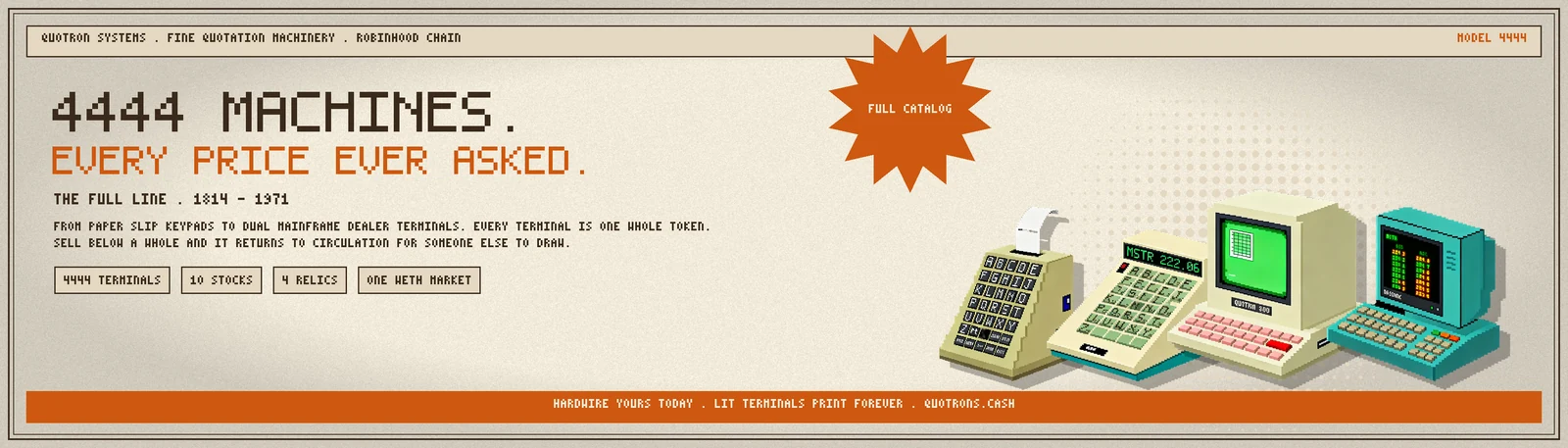
A rebuild is already part of the history
The public builder is Sergio, @cruelhandeth, and the project has already survived its first crisis.
Community accounts describe a V1 exploit involving ERC-404 approvals. Trading was paused, the protocol was rebuilt, and holders were moved over.
Sergio's 13 August update reported the move to V2 as complete across 734 wallets and 4,307 finalised records, including restitution records, with V1 kept as a historical collection he calls Sunset. Those are the creator's own figures. The public record documents that the migration happened; it does not amount to an independent postmortem, and it does not establish that every reported loss was recovered.
The rebuild left traps for anyone researching prices:
- V1 and V2 are different contracts. A cheap listing from the old collection is not evidence that the current collection has collapsed.
- The marketplace description is stale. OpenSea's collection page still explains an older design in which $QUOTRON traded against ten stock pools at once. The creator's current developer guide describes the opposite: one registered Uniswap V4 pool behind one immutable router, because, in his words, the fee engine only works "if settlement cannot be routed around." Do not combine the two descriptions into one system.
- Derivatives are circulating. Quotrons-named spinoffs and tribute projects already exist. None of them is the original collection.
Why Ink changes the question
The most interesting expansion is not a new trait. It is a new source of business.
On 25 August, Sergio published a developer guide announcing eight tokenised-equity markets on Ink, Kraken's Ethereum Layer 2, pairing Backed's wrapped xStocks against the USDG stablecoin: Apple, Amazon, Alphabet, MicroStrategy, Netflix, Nvidia, Tesla and the S&P 500 ETF.
Each pool skips the standard LP fee and instead takes a 0.30% hook fee in USDG on every swap, split exactly in half: one half accrues to hardwired terminals across the venue, the other half pays that pool's liquidity providers. So the terminal side of an Ink swap earns 0.15% of volume, a much thinner slice than the headline 3% structure on the Robinhood side.
A hook is plug-in code that customises how a Uniswap V4 pool behaves, including its fees. Uniswap Labs' own note applies here: hooks are third-party code, and using Uniswap infrastructure does not make a custom hook safe by inheritance.
The design choice is the story. The Robinhood-side token is deliberately closed, one pool behind an unavoidable router, so fees cannot be dodged. The Ink pools are deliberately open: no canonical router, no permission needed, any application that can talk to the V4 PoolManager can route trades through them. A system funded only by its own token turnover lives and dies with interest in the project. A system that earns a sliver of separate stock-token markets could, in principle, be funded by strangers who have never heard of the NFT.
"Could" is doing necessary work in that sentence. Only volume actually routed through those eight pools generates their fees. Quotrons has no claim on xStocks trading in general, on Ink activity in general, or on any of Kraken's business.
Two boundaries to keep in view. First, the migration has not happened: Sergio described the Ink markets as built to receive Quotrons, and the collection's marketplace records still identify it with Robinhood Chain. I could not verify any completed move. Second, the underlying asset is narrower than it looks. Kraken's own xStocks FAQ says the tokens carry "price exposure to the underlying asset" with no shareholder ownership or voting rights, dividends folded in through a rebasing mechanism, and no availability to US persons. That matters when the art makes an NFT look like a miniature brokerage account.
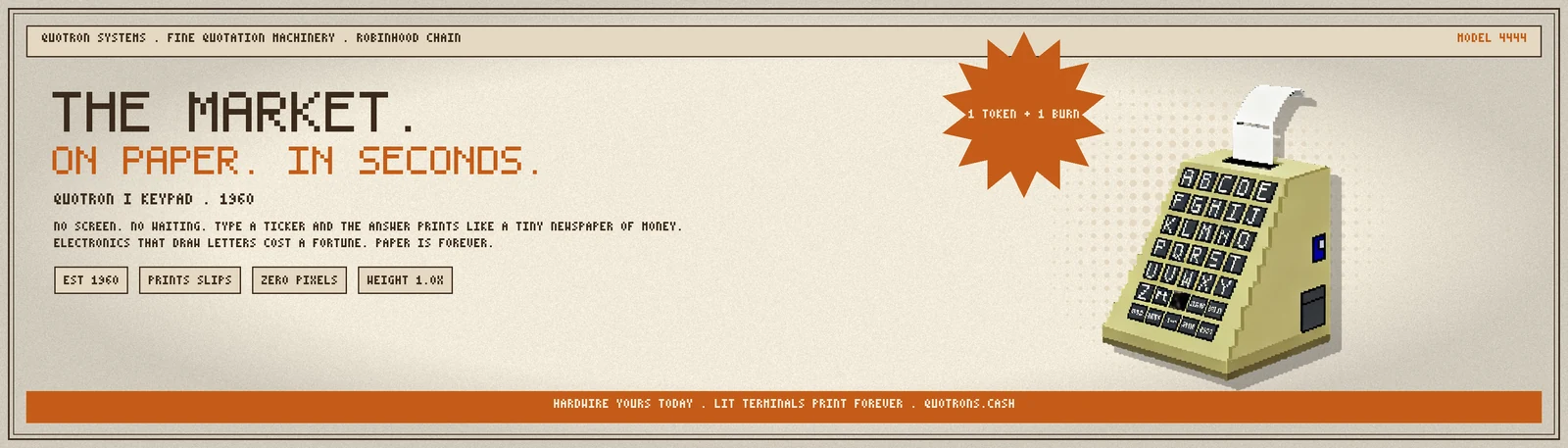
The prices are moving, and there is more than one of them
Snapshots retrieved around 20:15 UTC on 8 September 2026, from OpenSea (collection page) and CoinCodex (token page, coverage listed as Ourbit). The captures are not synchronised, and the two prices are not quotes for the same asset.
The repricing is substantial in both markets. When Foresight News covered the project in late August, the floor sat near 3.15 ETH. It has climbed since, and it has already been higher than it is today.
The token tracker's sampled history is wilder: $4,170 on 4 September, a recorded high of $12,919 on 6 September, and a quote back near $8,600 two days after that. Those are one tracker's observations over days of coverage, not a verified lifetime history, and they describe a market moving too violently to call a trend.
Floor prices carry their usual caveats. One seller can delete the cheapest listing without a single new buyer appearing, so a rising floor can mean stronger demand, thinner supply, or both, and no holder is guaranteed an exit at the displayed number. The liquid token quote is a different asset on a different venue. And multiplying the NFT marketplace's volume by the token-swap fee would manufacture a reward estimate out of two incompatible measurements.
Why the conversation is getting louder
Several stories are overlapping, and the public evidence does not isolate which one is moving the price.
The collectible story is visually clean: old financial hardware becomes an onchain character. The economic story adds an irreversible choice between staying liquid and becoming a reward-bearing machine. The development story reaches into stock-token markets on a second chain. Each gives a different crowd a reason to talk: collectors, token traders and builders are discussing the same project for different reasons, and prominent NFT figures have joined in, with gmoney publicly explaining the mechanics and organising a Quotrons gathering in New York.
Then there is the newest layer: points.
Recent public posts, including from the account Otto Suwen, say Quotron NFTs display associated points and read them as potentially connected to $INK, the token expected from Ink's confirmed points programme. Other accounts have amplified the theory.
No official terms were found for this piece confirming that these points create an $INK entitlement, a specific payment, or any airdrop at all.
"People are speculating about an airdrop" and "holders are receiving an airdrop" are different claims. Anyone pricing the second should know they only have evidence of the first.
What has to work when the novelty fades
The strongest case for Quotrons is that the collectible becomes a recognisable interface to genuinely useful market infrastructure. The strongest objection is that a clever fee structure does not create demand for the thing being traded.
Burning tokens shrinks the supply available to trade. It cannot manufacture buyers. Hardwiring more terminals grows the number of reward claimants without growing the reward pool. An open, routable pool is eligible to win trades, but pricing, liquidity and actual users decide whether it does. Nothing in the mechanism answers those questions; only activity does.
The project says the quiet parts itself. Its site is labelled experimental, warns that hardwiring is irreversible, and states there is "no guarantee of reward drops, reflections, stock-reward conversions" or future distributions, with rewards able to fall sharply, even to zero, at any time. Those are the developer's own risk notes, and they are more candid than most of the posts promoting the project.
Checked directly on 6 September 2026, with the market snapshots refreshed on 8 September: the project site's current fee schedule and risk disclosures, the OpenSea collection state, the CoinCodex token snapshot, the creator's developer guide, the Computer History Museum record, and Kraken's xStocks terms.
Attributed to their authors without independent confirmation: the V1 exploit accounting, the migration counts, batch reward mechanics, the meetup, and all points speculation. The creator's posts were read through public mirrors; the live rewards dashboard and the deployed contracts were not audited for this piece.
No outreach was made, and nothing here verifies cumulative rewards actually claimed versus generated.
The useful next evidence is concrete: how much reward funding arrives from the Ink equity pools versus Quotrons' own turnover, what has actually been converted and allocated to terminals, whether any collection move to Ink preserves holders' claims, and whether the points acquire official terms or evaporate.
Quotrons has found a memorable way to put those questions on a screen.
The screen lights up in one transaction. Building a market that keeps it lit is the longer job.
InfoFi Paid Crypto to Talk. Then X Changed the Rules.
InfoFi promised to reward useful crypto voices. Then X revoked the API underneath the whole model, and four businesses had to become something else.
BitMart's "Orderly" Shutdown Has Become a Fight Over User Funds
BitMart calls its closure an orderly wind-down. Users want withdrawals, liabilities, and usable reserves disclosed. Here is what the evidence actually shows.

From 400 UNI to Endless Points: How Airdrops Changed Crypto
Airdrops once surprised early users. Then came the roles, the snapshots, the seasons and the points. The history is a fight over who deserves the tokens.