How $microduck Turned a $399 Robot Into an NVIDIA Narrative
A real robot supplied the character. Reports of an NVIDIA deal supplied the storyline. An unofficial token on Robinhood Chain brought the two together.
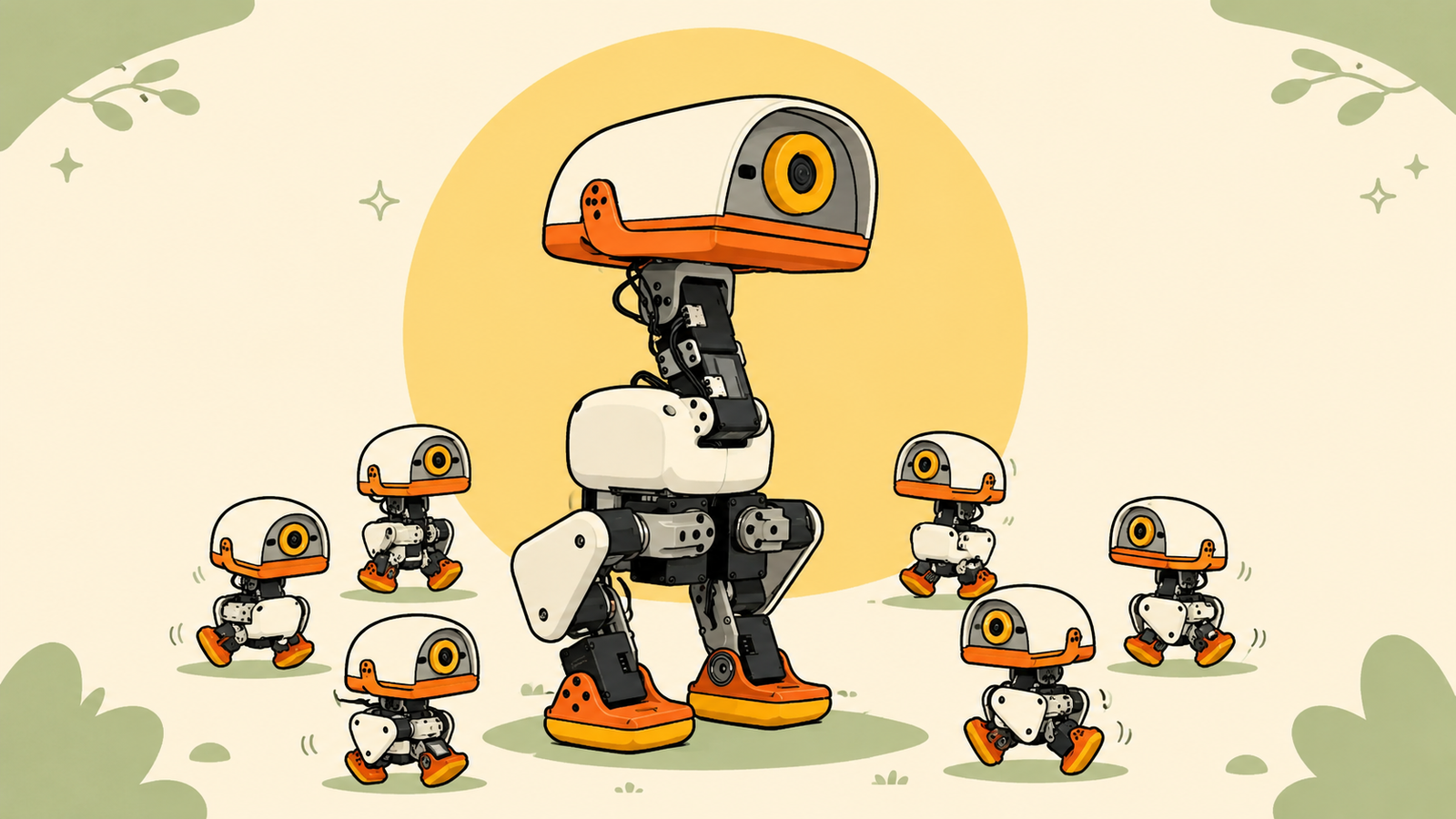
MicroDuck has a useful trick for an internet character. It can fall over and get back up.
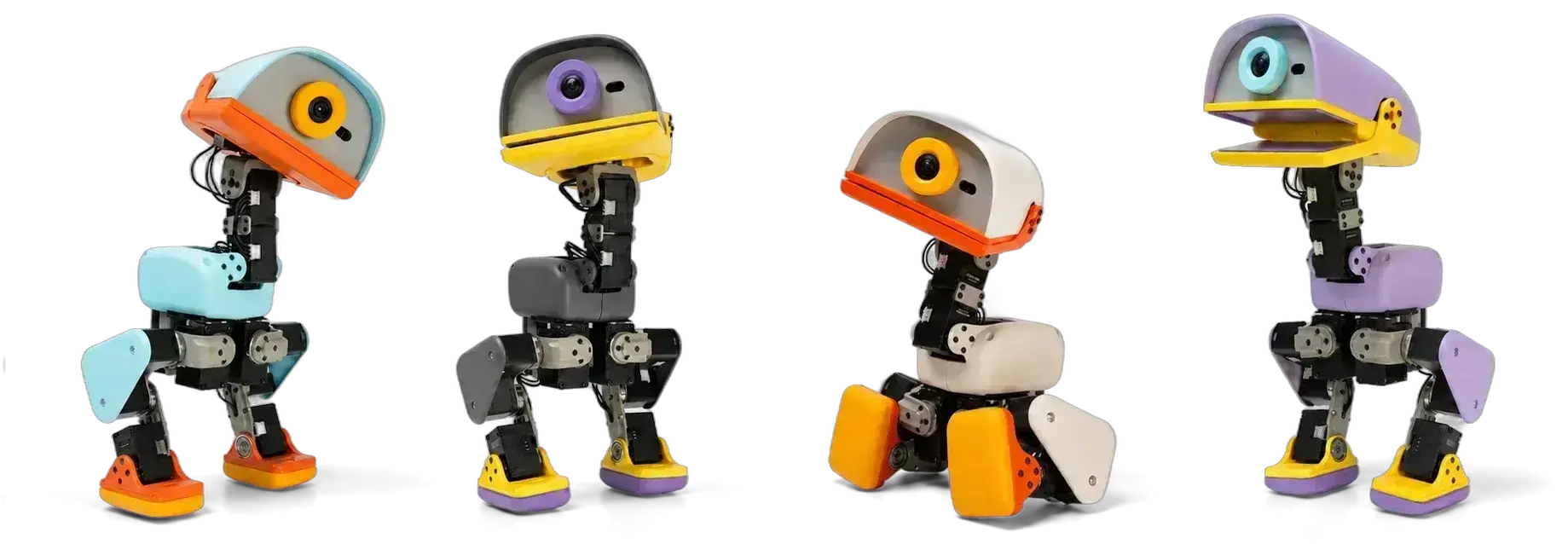
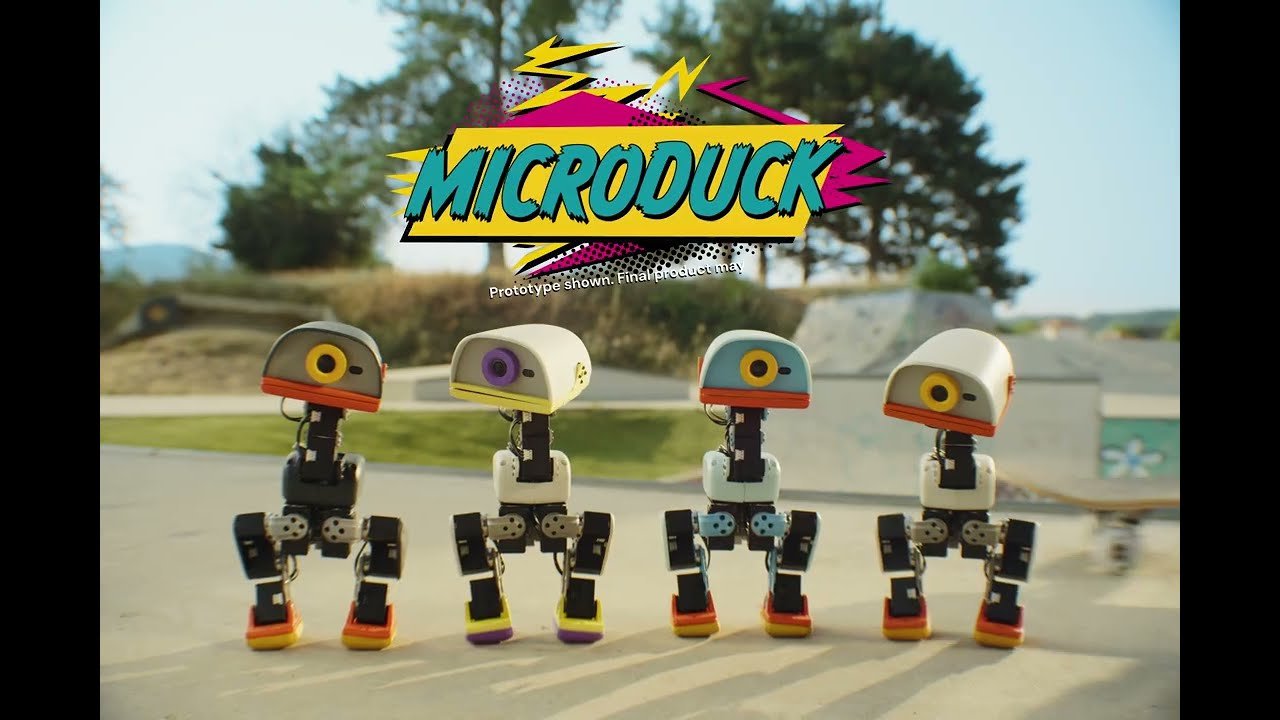
The robot stands 25cm tall, weighs under 800g, waddles on two legs, picks things up with an articulated beak, and will stay upright on roller skates. Pollen Robotics opened preorders on 27 August at $399. The appeal arrives well before anyone explains the engineering: a small mechanical creature trying very hard not to fall down.
The same day, a token called microduck had a market on Robinhood Chain, quoted against an asset labelled NVDA.
- 26 August: reports that NVIDIA is buying Hugging Face
- 27 August: Hugging Face and Pollen open MicroDuck preorders at $399
- 27 August, 11:48 UTC: a microduck/NVDA pool opens on Robinhood Chain
- 28 August: the robot passes $2.6M in reported orders
Nothing in that sequence is a coincidence, and nothing in it is a connection either. A real product launch, a reported corporate megadeal, and crypto's appetite for a recognisable character collapsed into one very compact story.
Reading the contract directly returns a token named microduck, eighteen decimals, and a supply of exactly one billion. That is the whole of what the chain will tell you about it. Everything else attached to the name belongs to somebody else.
Before the token, there was a robotics team
MicroDuck's real history belongs to Pollen Robotics and Hugging Face, and it is considerably longer than the token's.
Pollen was founded in Bordeaux in 2016 and had raised about 2.5 million euros when Hugging Face announced it was buying the company on 14 April 2025. That followed Hugging Face's LeRobot open-source robotics library, started in 2024. Roughly twenty Pollen staff, including cofounders Matthieu Lapeyre and Pierre Rouanet, joined in the deal. The partnership predates this token by well over a year.
The immediate predecessor was Reachy Mini, a desktop robot built for interaction. MicroDuck moves the idea onto the floor. The duck identity came out of the proportions, the beak and the gait, which is the opposite of the usual order: the character followed the machine rather than a meme being wrapped around a product.
That gives the token an unusually concrete source image. This is not another illustrated animal with a ticker attached. The underlying character has physical behaviour, and behaviour is what makes a clip worth reposting: awkward balance, short steps, a grasping mouth, and a recovery routine.
There is real software underneath as well. Pollen published training environments, reward functions and the simulation-to-hardware recipe so developers can teach it new movements. One qualification matters, and the makers state it themselves: the open-source release covers the software, not the mechanical and electronic design files.
None of that makes the token a robotics product. A memecoin borrows a character; it does not acquire whatever the character came from. What the robotics work explains is why this one had something better than a logo to work with.

The few days that compressed the story
The timing put a $399 duck beside one of the largest AI stories of the year.
- 26 August. Business Insider reported that Hugging Face was fielding takeover interest, with talks valuing it above $13 billion. Its report was explicit that no agreement had been signed and that the deal could still collapse. TechCrunch reported the same day that no signed contract existed.
- 27 August. The Information reported that NVIDIA had agreed to buy Hugging Face for $12.9 billion, relayed by CNBC and widely syndicated. Neither company confirmed it publicly.
- 27 August. Pollen and Hugging Face opened MicroDuck preorders.
- 27 August, 11:48:43 UTC. The microduck/NVDA pool was created on Robinhood Chain.
- 28 August. Hugging Face cofounder Thomas Wolf said customers had placed more than $2.6 million of MicroDuck orders in the first 24 hours, having passed $1 million within about six hours of the announcement.
Two of those reports describe the same deal differently on consecutive days. One says talks without a signature. The other says an agreement. Neither describes a completed, officially announced acquisition, and that distinction survives everything built on top of it.
The robot orders are worth the same care. A cofounder saying customers placed $2.6 million of orders is a company-reported preorder figure, not audited revenue, not shipped units, and not money that touched a token. First shipments are expected before Christmas.
The pool timestamp needs one more caveat. It establishes when a market opened, not when the contract was deployed or when the project first announced itself. This is a first-days profile, and the days are genuinely few.
What actually spread on X
There were two conversations, and counting them as one community would be the easiest mistake to make here.
The robotics conversation was about the machine: people posting augmented-reality experiments, simulated movements and, at one point, a headstand. That is creative interest in a robot. It is not evidence that any of those contributors held, endorsed or worked on a token.
The crypto conversation used the robot as an attention source. Accounts circulated the contract address, praised the character's meme potential, and attached it to the acquisition story. A claim also circulated, attributed to the project account @MicroDuckNVDA, that holders would receive NVDA-token rewards. That claim matters more than the rest, because it changes the pitch from owning a robot-themed meme to being paid in something else.
Native X pages could not be retrieved for this article, so the social examples come from indexed copies rather than live timelines. They support cautious attribution of visible claims. They do not establish post ordering, reach, or who caused which trade.
The reward claim was not verified at all. No reward contract, funding source, rules or payout history was located. Treat it as an advertised claim, not a distribution.
Nothing here should be read as evidence that any named account was paid, or that any promotion was coordinated.
What the record does show is a pattern, and the pattern does not need a hidden hand to explain it. A product announcement acquired a contract address, and the contract address travelled on images and headlines that already had an audience.
Why this duck works as a meme
MicroDuck's strongest cultural asset is movement.
A still image establishes a character. A wobble, a fall and a recovery establish a plot. That is a meaningfully different thing to hand a crowd, and it is why the launch footage did most of the work here.
The character is also unusually easy to caption. The same clip reads as determination, confusion, stubbornness, or something very small walking into something very large. Its machine-ness makes the AI association feel earned rather than bolted on, which is not true of most tokens that put a technology label on an unrelated animal.
The size gap supplies the second joke. A tiny duck standing next to a reported thirteen-billion-dollar acquisition is funny on its own, and the disparity does the work without anyone having to write a punchline. The character stays small and silly while the conversation around it becomes enormous.
That is cultural potential, not a forecast. The honest test is whether the crowd can make something that still works once the NVIDIA headline is gone: original drawings, recurring jokes, contributors anyone can name. So far the most repeatable asset is a video that somebody else produced.
The NVDA pair is part of the pitch, not proof of backing
The NVIDIA connection is not invented. It is just not the connection being implied.
NVIDIA and Hugging Face announced a genuine robotics collaboration on 5 January 2026, bringing Isaac and GR00T models into the LeRobot framework as part of a wider physical-AI announcement. A real technical relationship existed months before the acquisition reports and long before this token.
Several very different relationships are then being compressed into one impression.
| What is pointed at | What is established | What it does not establish |
|---|---|---|
| The robot | Pollen Robotics, owned by Hugging Face, opened preorders for a $399 biped on 27 August | That anyone who built it authorised a token |
| NVIDIA and Hugging Face | A robotics collaboration announced 5 January 2026 | Any NVIDIA relationship with this token |
| The acquisition | Two reports on consecutive days, describing the deal's status differently, neither confirmed by either company | A completed acquisition, or one that would reach a memecoin |
| The NVDA pair | A liquidity pool quoting microduck against a Robinhood Stock Token | Ownership of NVIDIA shares, or NVIDIA's involvement |
| Robinhood Chain | A permissionless network anyone can deploy to | Endorsement, partnership, or a listing in the Robinhood app |
The stock-token terminology needs the most care, because it is the part most likely to be misread as ownership.
Robinhood's documentation calls Stock Tokens "tokenised debt securities issued by Robinhood Assets (Jersey) Limited."
They provide economic exposure to a share or fund but, in Robinhood's own words, "do not grant investors any legal or beneficial rights in, or against the issuer of, those underlying securities." A holder of an NVDA Stock Token is not an NVIDIA shareholder.
A memecoin quoted against one of those is another step removed again. It is a price relationship between two tokens, and this publication has been here before with $CASHCAT.
The network label closes none of that gap. Robinhood's own chain documentation calls the network permissionless and developer-friendly and states plainly that inclusion in its ecosystem listings "does not constitute an endorsement, partnership, affiliation, sponsorship, or warranty by Robinhood." Deploying there is a technical act, not a blessing.
There is also the question of where the token says it lives. On DexScreener, where a buyer is most likely to check, the project's listed website is Pollen Robotics' own MicroDuck product page, and its listed social account is @MicroDuckNVDA. GeckoTerminal's profile for the same contract carries no website, no social handles and no verification at all. This article could not locate an independent project site, which means that if a disclaimer of affiliation exists somewhere, it is not reachable from either place a buyer would look.
A token pointing at the manufacturer's page as its home is not a neutral choice. It is the borrowing, made literal.
The market is visible. The operating story is thinner.
The trading is real and easy to measure. The structure behind it is neither.
Those are GeckoTerminal's figures for the contract at 09:36 UTC on 29 August, with the holder count timestamped an hour earlier. The gap in the middle is not an oversight on their part: no circulating supply has been established, so the headline valuation being quoted around this token is a fully diluted figure resting on the full billion.
The pool structure is where it gets interesting, because the NVDA pairing is doing less work than its prominence suggests.
Forty pools now quote microduck, and 28 of them hold under $1,000 of liquidity. The NVDA pool carries about 40% of the token's daily volume, which is more than any other single market. It holds roughly $369,000 of liquidity. The deepest pool on the token is not the NVDA pair at all: it is an ordinary stablecoin pool holding close to three times as much.
That is the whole thesis in one measurement. The NVDA pairing is where the story is told. The money mostly sits somewhere less quotable.
What remains unresolved is the part that would actually matter in a month. Who controls the accounts and the website listing. What privileges, if any, the contract retains. How the supply is distributed among related addresses, as distinct from the pools themselves, which sit near the top of any holder list by design. And what, mechanically, would make an NVDA reward programme work. No contract audit or ownership review is being claimed here, and none was available.
The asymmetry is the story. The robot's makers, product, funding history and software are all documented and named. The token's operators are not. Borrowing a documented origin does not document the people running the market built on top of it.
What the duck has to do next
$microduck is worth writing down because it shows how quickly a physical product becomes an onchain character now. The source material arrived with motion, personality and an audience already assembled. The token added a market and a different set of incentives.
The useful next evidence is not a grander description of NVIDIA's role. It is smaller and harder to fake: original work from the token crowd rather than reposted launch footage, operators anyone can name, and documentation for a reward system that currently exists as a claim.
Those would separate an emerging community from a temporary audience standing around somebody else's launch.
By the thirty-day check on 28 September, the questions are whether the accounts are still posting, whether anyone has drawn this duck rather than reposting it, whether the reward claim was ever honoured, and whether the phrase survives the acquisition news finishing one way or the other.
The robot already has a reason to exist. It has preorders, a shipping date and a team with names.
The token's next act is to show what its crowd adds to it.
From 400 UNI to Endless Points: How Airdrops Changed Crypto
Airdrops once surprised early users. Then came the roles, the snapshots, the seasons and the points. The history is a fight over who deserves the tokens.
Robinhood Built a Chain for Stocks. The Internet Gave It a Cat.
Robinhood Chain launched to put equities onchain. Memecoins arrived first and supplied its mascot, its launchpads and most of its early liquidity.

Almost Five Years After $SQUID: The Fake Game Token Crypto Still Remembers
The unauthorised Squid Game token did not spread because its warnings were hidden. It spread because a famous name and a one-way market made them secondary.