Robinhood Built a Chain for Stocks. The Internet Gave It a Cat.
Robinhood Chain launched to put equities onchain. Memecoins arrived first and supplied its mascot, its launchpads and most of its early liquidity.

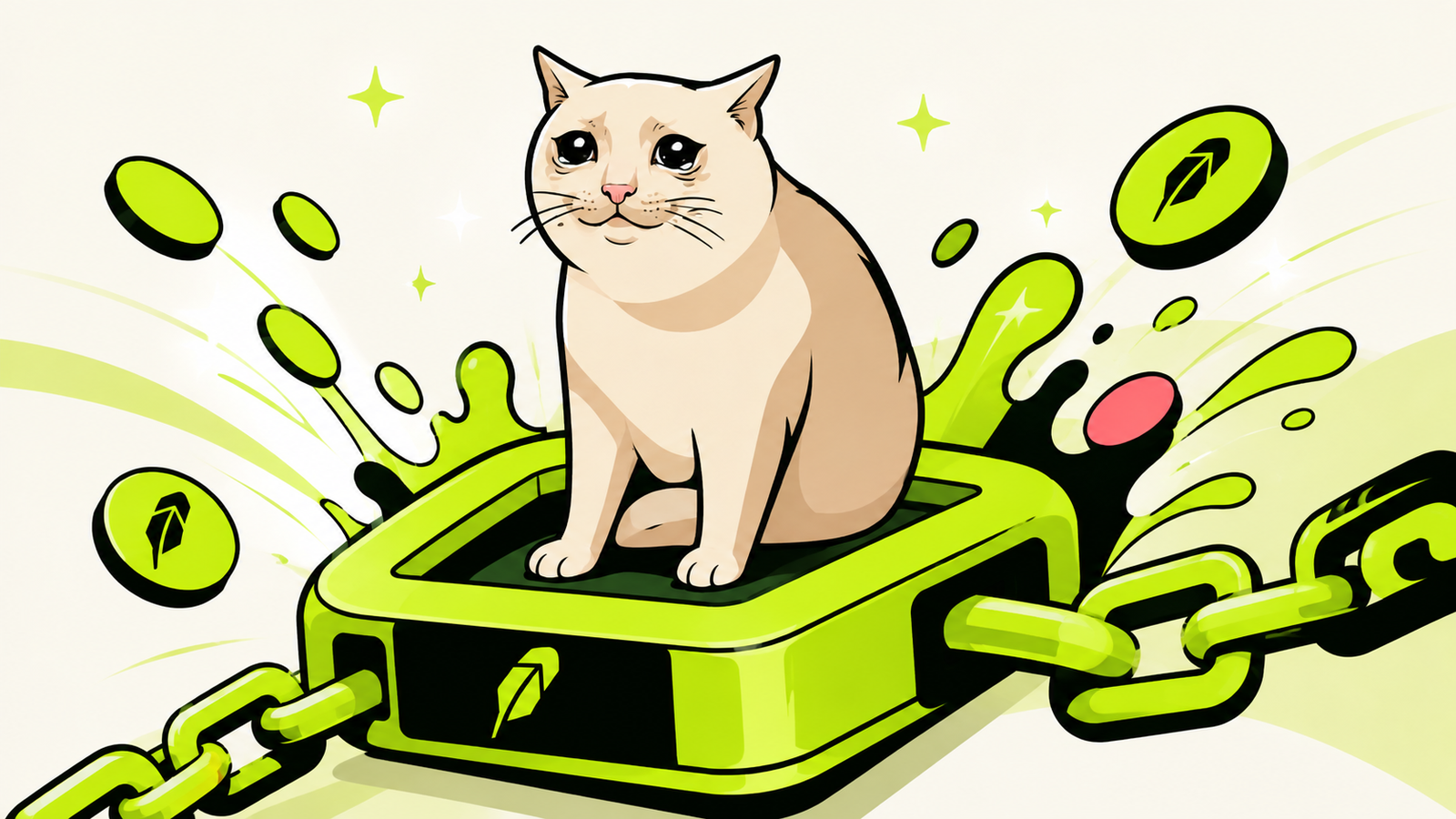
On July 1, Robinhood launched a public blockchain with an institutional pitch attached. Robinhood Chain would bring stocks, exchange-traded funds and other real-world assets onchain, keep them available around the clock, and let eligible users move them through wallets, decentralised exchanges and lending markets. Uniswap arrived as a day-one liquidity partner. Chainlink, Alchemy and BitGo supplied the surrounding infrastructure. The word "permissionless" was in the announcement, but everything else in the presentation pointed at a new financial system.
Then the cat arrived.
In a little over a week, $CASHCAT, a community-launched memecoin with no role in Robinhood's product plan, passed $200 million in market capitalisation. By July 27, CoinGecko estimated that memecoins accounted for 79.2 percent of decentralised exchange volume on Robinhood Chain. Trading tied to real-world assets accounted for 9.69 percent. The chain built to put equities onchain had discovered that its first dominant asset class was internet culture with a ticker.
It is easy to read that as a joke at Robinhood's expense. The company brought the stocks, crypto brought the animals, and a carefully scripted product launch lost control of its own timeline.
The joke misses the more interesting part. Memecoins did not break into Robinhood Chain through a side door. They walked through the front door Robinhood had deliberately left open. Anyone could deploy a contract. Existing Ethereum tooling worked without modification. Assets moved through familiar wallets and exchanges. For eligible Robinhood Wallet activity, the company even covered gas for an initial 90-day promotional period. The meme economy was not an exception to the chain's design. It was one of the first groups to use that design exactly as advertised.
The chain Robinhood actually built
Robinhood Chain was not a reaction to memecoins. It was the next stage of a tokenisation strategy that had already been running on Arbitrum One.
Robinhood launched its first generation of stock tokens for European customers in 2025, opened a public Robinhood Chain testnet on February 10, 2026, and shipped the dedicated mainnet on July 1. Arbitrum described the approach as a "launch-and-migrate" model: introduce the product on an existing network, watch how it gets used, then move to customised infrastructure with more control over performance and operations. What launched in July was configured for low-latency execution, Ethereum compatibility and the requirements of financial applications.
The flagship assets are Robinhood Stock Tokens, and that name does more work than it should.
Robinhood's own documentation describes Stock Tokens as tokenised debt securities issued by Robinhood Assets in Jersey. They provide economic exposure to an underlying stock or ETF. They do not give the holder legal or beneficial rights in the underlying company. The onchain format makes them programmable and composable. It does not make anyone a shareholder of Nvidia, GameStop or anybody else.
The second word the launch materials compressed was "permissionless."
At the application level it is accurate. Anyone can use the network, deploy contracts or build on it. It is EVM-compatible, uses ETH for gas, and speaks to standard tooling. At the infrastructure level, control is considerably more concentrated. The protocol is governed by an eight-member security council, of which Robinhood holds two seats. The fraud-proof system currently relies on two permissioned validators, run by Offchain Labs and Alchemy. L2Beat files the project under "Other" because fewer than five external actors can submit a challenge.
That does not make "anyone can build here" false. It means "anyone can build here" and "no small group holds meaningful infrastructure power" are two different sentences, and only the first one was being made.
For the memecoin crowd, the first sentence was the only one that mattered.

The cat at the gate
$CASHCAT did not start with a randomly generated animal. It started with a piece of unused Robinhood history.
Before Vlad Tenev and Baiju Bhatt settled on Robinhood, "CashCat" had been a working title for their trading product. Tenev discussed the discarded name years before Robinhood Chain existed. One correction worth making early: CashCat was a proposed company name, not a documented former mascot. Crypto supplied the mascot afterwards.
That still gave the token something most chain-native memecoins never have. Lore that predates the contract.
The name tied Robinhood's origin story to its new permissionless network. The cat could be presented as the version of Robinhood that never shipped, revived by users and returned as a market. Corporate archaeology, turned into fan fiction, turned into a ticker.
Robinhood did not create the token, and launching on Robinhood Chain does not make anything an official company project. The separation got more complicated later, when Robinhood made Cash Cat tradable through its own platform. As of August 16, Robinhood's website carries a live Cash Cat page saying users can buy or sell it. A listing is not sponsorship, ownership or endorsement, but it closed the loop: Robinhood dropped the name, the crowd revived it, and Robinhood brought the result back inside the product.

Then $CASHCAT became a template.
The cast that followed included $DOGO, $PIPEDOG, $HMM, $MOW, $TENDIES and $FRONG, alongside the usual supporting animals and retail-trading references. Checked at 06:24 UTC on August 16, CoinGecko put the combined market capitalisation of its Robinhood Chain memecoin category at roughly $360 million, with $CASHCAT and $DOGO the two largest entries. Those figures move continuously, and they measure valuation, not community quality or durability.
The names are the part worth reading closely, because they show a chain acquiring a visual language in real time. $MOW and $HMM extended the cat lane $CASHCAT opened. $DOGO supplied the bull-market dog. $FRONG imported crypto's semi-permanent frog grammar. $TENDIES brought back Reddit-era retail trading slang, on a network carrying Robinhood's name.
The cast is derivative, inconsistent and frequently ridiculous. It also gave the network something no technical documentation can produce: characters people can recognise, remix and argue about.
Robinhood launched a blockchain. The crowd started turning it into a place.
Why the memes always arrive first
Every new chain has the same opening problem. The infrastructure exists before anyone has a reason to touch it.
A network needs assets, liquidity, applications, users and stories. Builders want evidence that users will arrive. Users want something to do when they get there. Liquidity providers want markets. Communities want a shared language that separates one nearly identical EVM chain from the next.
Memecoins collapse all of that into an afternoon. A token can produce an image, a ticker, a group chat, a liquidity pool and a speculative market between lunch and dinner. It does not need a lending agreement, an issuer relationship or a securities prospectus. Its lack of institutional complexity is exactly what lets it move before the assets the infrastructure was designed for.
Robinhood Chain made that unusually easy: Ethereum compatibility, account abstraction, established wallet tooling, major liquidity integrations on day one, and a temporary gas subsidy for eligible Robinhood Wallet activity. The chain never had to teach the existing onchain market how to build there. Most of the tools already spoke the language.
Launchpads turned that ease into industrial production. Noxa became the first dominant Robinhood Chain launchpad, accounting for 65.8 percent of token launches during its June 30 to July 11 window. CoinGecko's analysis found it deployed close to 60,000 tokens and out-earned Pump.fun in daily protocol fees for five consecutive days. Then the machinery jammed. On July 11, Noxa paused launches, blaming bot spam and copycat tokens. Its website later went offline, and Pons moved into the gap, taking 37.2 percent of launches in CoinGecko's post-Noxa measurement window.
Robinhood Chain's first memecoin cycle therefore ran its entire course in under three weeks. Platform arrives, tokens multiply, one mascot breaks out, a launchpad dominates, automation overwhelms the launchpad, a replacement appears.
Robinhood could choose what the chain was built for. It could not choose what the crowd would make it mean.
The first six weeks, in order
- July 1. The public mainnet launches. Stock Tokens become available through Robinhood Wallet in eligible markets, alongside Uniswap and the supporting financial infrastructure.
- Early July.
$CASHCATbecomes the first breakout native memecoin, passing $200 million in market capitalisation in a little over a week. - July 11. Decentralised exchange volume peaks near $878 million. Noxa pauses new token launches, citing bot spam and copycat overload.
- July 23. Memecoin-to-stock-token pairs record $46.1 million in a single day: internet characters traded directly against tokenised equities rather than against ETH or stablecoins.
- July 27. CoinGecko estimates memecoins at 79.2 percent of DEX volume. The real-world asset share has climbed from 0.39 percent in week one to 8.58 percent for July 21 to 27.
- August 1. Daily DEX volume bottoms near $241 million, down 72.5 percent from the July 11 peak.
- August 5. The chain records 13.3 million transactions, with the average transaction carrying far less value than in mid-July.
- August 16. DefiLlama shows $543.27 million in DeFi total value locked, $639.03 million in stablecoin market capitalisation and $119.47 million in active real-world asset market capitalisation.
Popularity, with an asterisk
Robinhood Chain is busy. What kind of busy is the harder question.
Between July 11 and August 1, decentralised exchange volume fell from roughly $878 million to $241 million. Over the same stretch, transaction counts, deposits and stablecoin supply kept climbing. The average DEX volume per transaction fell 74 percent between July 13 and August 4 before partially recovering the following day. More operations, each carrying much less trading value.
Some of the headline numbers were bought. On August 6, The Defiant counted 19 active incentive campaigns distributing a combined $58,351 per day, with two depositor campaigns taking 92 percent of that spend. The result is a network accumulating large lending deposits while its trading volume walks in the other direction.
Then there is the gas promotion. Robinhood said at launch that it would cover gas for eligible Robinhood Wallet transactions for 90 days. That does not explain all activity, particularly trading routed through third-party bots and launchpads, but it lowers the cost of experimenting and makes early transaction counts harder to read as durable demand. The first real post-launch test therefore lands around the end of September, when the promotion ends.
None of this makes the early activity fake. Incentives are normal at a network launch, and bots conduct economically real transactions. It means the numbers answer narrower questions than their promotional framing suggests. A transaction count proves transactions happened. It does not prove that millions of separate people arrived, that a community formed around each token, or that any of it survives the end of the subsidy.
The Noxa episode is the other face of the same openness. Permissionless deployment let tens of thousands of tokens appear in days. It also let bot spam, copies and low-effort deployments overwhelm the platform that produced them. Lowering the gate does not decide what walks through it.

The stocks are catching up
Memecoin dominance in July did not mean Robinhood's tokenisation thesis had failed. It meant the faster market got there first.
The turn shows up first in the tokenised stocks themselves. By July 25, twelve of them were each doing at least $500,000 in daily volume, several above $1 million. Active real-world asset value on the chain had reached roughly $70 million, about five times its level less than two weeks earlier.
Three weeks on, the gap between the two economies had narrowed without closing. At 06:24 UTC on August 16, DefiLlama put active RWA market capitalisation at $119.47 million. CoinGecko put the chain's memecoin category at roughly $360 million, still around three times larger.
So the memes are still ahead. They are no longer running unopposed.
Those two figures can be set against each other, because both measure market capitalisation. Total value locked, stablecoin supply and 24h volume cannot: they count different things, and stacking them builds a scoreboard that does not exist. Every number here is one observation, from a named provider, at a stated time, and all of them have moved since. CoinGecko's 79.2 percent is its estimate for July 27 under a methodology that excludes flagged bot and wash-trading wallets, not a standing ratio.
The strangest evidence sits where the two economies touch. By July 23, pairs trading memecoins directly against tokenised stocks had reached $46.1 million in a day. AI and semiconductor-themed tokens traded against Nvidia. Space memes traded against the SpaceX token. GameStop, AMC and WallStreetBets references were rebuilt as onchain markets around tokenised GME.
The culture had not only arrived before the stocks. It had started wrapping itself around them.
That is more interesting than a contest over which category posts more volume. Robinhood Chain may end up distinctive precisely because both economies share one network. Tokenised finance supplies assets with external reference values. Memecoins supply attention, characters and rapid experimentation. Stablecoins and lending supply capital. Each side produces activity the others would struggle to generate alone. Whether that becomes durable, or stays a launch-season curiosity propped up by temporary incentives, is the open question.
A company can launch a chain. It cannot name the place.
Robinhood Chain did not get popular because it delivered its long-term product vision in a month. It got popular because a permissionless version of Robinhood was an irresistible cultural object.
Robinhood is not a neutral financial brand. It carries years of association with retail traders, meme stocks, Dogecoin, mobile-market spectacle and a long argument about who markets are actually for. When the company opened blockchain infrastructure, nobody arrived without that context. They brought it with them.
$CASHCAT worked because it found the cleanest expression of the contradiction. A name Robinhood abandoned, revived by people Robinhood did not pick, on a chain Robinhood opened, later made tradable by Robinhood itself.
The rest of the cast followed because every new network goes looking for a native identity. Base found a blue internet. Solana accumulated dogs, frogs and deliberately empty jokes. Robinhood Chain found cats, retail slang and tickerised echoes of its own corporate past.
The stocks may still become the larger economy. Robinhood's distribution, wallet integration and regulated asset structure are advantages no anonymous launchpad can reproduce, and the move from roughly $70 million to nearly $120 million in active RWA value suggests the official thesis is advancing rather than fading.
But the order matters. The first users taught the market what Robinhood Chain felt like before its intended financial products had a chance to define it. They supplied the first breakout character, the first launchpad war, the first spam crisis, the first native vocabulary and much of the first liquidity.
The evidence that settles the rest is already scheduled. The gas promotion ends around the close of September, which is when transaction counts stop being subsidised and start being a claim. Watch whether DEX volume climbs back toward the July peak or holds near the August floor, whether the RWA share keeps rising past its 8.58 percent week, and whether $CASHCAT, $DOGO and the rest still have identifiable communities rather than order books. We will run that check in October.
Robinhood built infrastructure with a business plan.
The chain became a place when the internet gave it characters.
How Did $BASECAT Reach Coinbase's Roadmap in Six Days?
A cream cat in a blue hardhat became Base's unofficial mascot. Six days after someone minted it, Coinbase said it had decided to list the token.

Before the GTA 6 Leak, $CYBERLEEK Was Already Trading
The Solana token traded for nearly three quiet days before QR-coded GTA 6 footage handed it an audience. The bots got there before the crowd did.

$TRUMP 2 Years Later: Who Won, Who Paid, and What Remains
The chart collapsed. The project did not. Official Trump evolved from a launch spectacle into a holder-ranked access club, while affiliated entities remained central to supply, royalties, trading revenue and the token's next phase.
