How Did $BASECAT Reach Coinbase's Roadmap in Six Days?
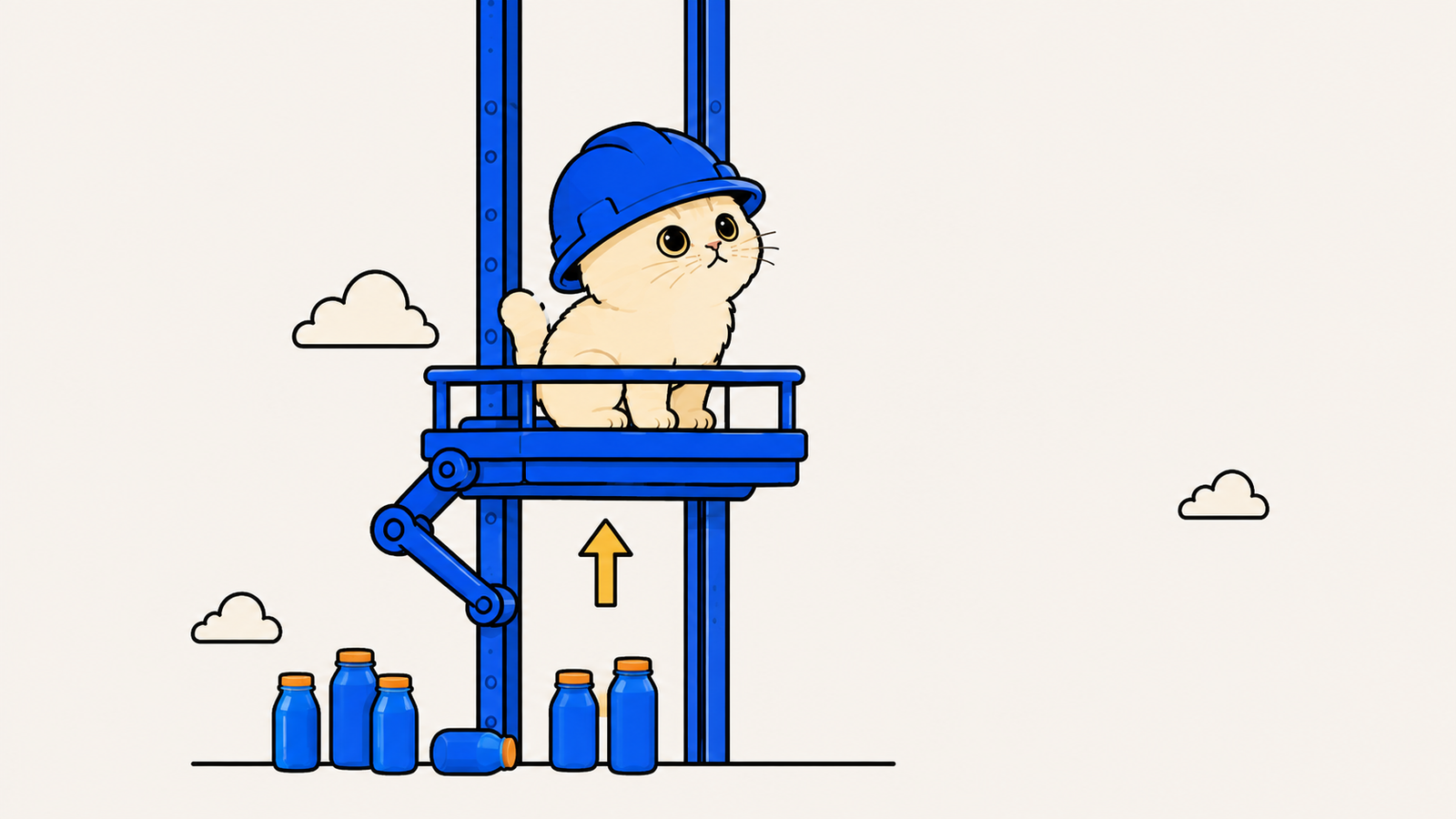
A cream cat in a blue hardhat became Base's unofficial mascot. Six days after someone minted it, Coinbase said it had decided to list the token.

- 15 August: a cat in a blue hardhat launches on Base
- 16 August: a community claims the token and declares a takeover
- 17 August: the first centralised exchange market opens
- 21 August: Coinbase says it has decided to list it
On 21 August, Coinbase Markets added four assets to its listing roadmap. One of them, $BASECAT, had existed for six days.
That is the part everyone repeated, and it is the least interesting thing about the token. The roadmap is a door. What matters is what walked through it: a cream-coloured cat in a tiny blue construction helmet, a crowd that gave itself numbers and called itself an army, and a claim about Base's own culture that the project has been making for longer than the coin has existed.
So before the exchange, the cat.
The mascot Base never had
Every chain that developed a personality developed animals first. Solana accumulated a zoo. Ethereum has been drawing frogs and unicorns for a decade. Base, which is Coinbase's chain and behaves like it, arrived with a wordmark, a shade of blue and a slogan about building. It had an aesthetic. It did not have a face.
BASECAT is an attempt to supply one, and the design is unusually economical about it.
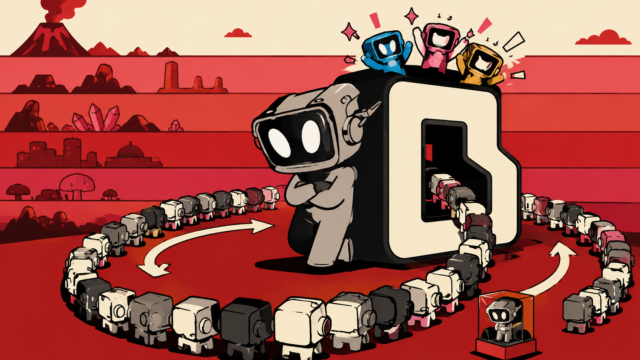
The blue is Base's blue. The construction helmet turns the network's endless builder vocabulary into a costume. The cat itself needs no explanation in any language or on any timeline. Three elements, no backstory required, and the whole thing legible at the size of a profile picture.
What makes it work is that it is barely a character at all.
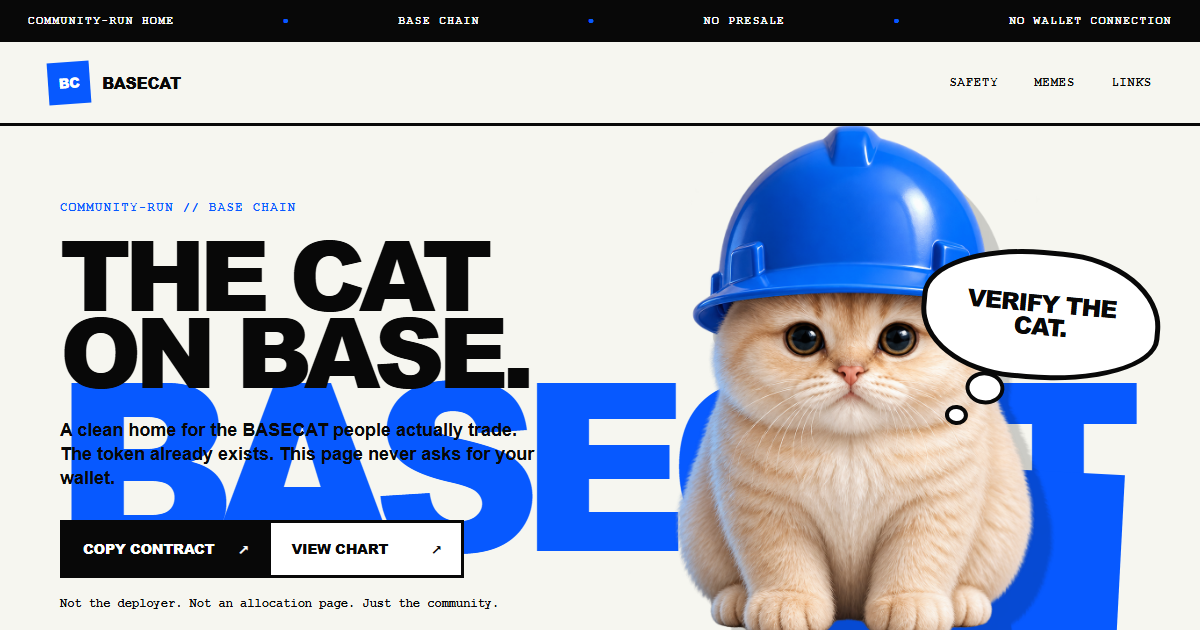
A detailed mascot has a personality you either adopt or reject. A cat in a hardhat is closer to a uniform: something any account on Base can put on without agreeing to anything except that it is here and it is building. That is a lower bar than liking a character, and lower bars are how memes actually spread. The project's own framing gets at this, in a line it repeats: "Every chain needs its native characters. On Base, one cat has already put on a hardhat and gone to work."

"Put your helmet on"
The lore arrived with the same compression as the artwork.
The line the community organises itself around is four short sentences: "you posted the cat. the timeline built the army. now you're asking if it's real. put your helmet on." It is a good piece of writing for what it needs to do. It skips the origin story entirely, treats the crowd as the thing that already happened, and converts scepticism into a joke about not yet being dressed for work.
Where it came from is less settled than the project's telling suggests.
The community-takeover release attributes that wording to the official Base App account, and dates it to 8 April 2025, which would put the cat in Base's culture well over a year before anybody minted a token from it. The accessible post carrying that exact wording, though, is the project's own. A repost, a quote or a deleted original may exist and I could not confirm one.
The same release lists follows from Base-linked figures, including the head of the Base app and Coinbase's chief business officer, as validation. Follows are attention. They are not partnerships, licences or endorsements, and no Base entity has said otherwise.
None of which stops the line from working. It is worth being precise about what is claimed here, because the claim is the interesting part: this is a project arguing that it did not invent Base's cat so much as notice one that Base had already adopted. Whether the archive supports that or not, it is a much better story than "we made a mascot", and the crowd has treated it as settled.
The lore does not ask you to believe in a cat. It asks whether you are dressed for work yet.
What the crew actually built
Most memecoin communities produce a Telegram, a chart channel and a lot of rocket emojis. This one produced something slightly more structural, and it is the reason the token reads as a culture rather than a ticker.
The centrepiece is the crew wall. A browser-based generator puts the blue hardhat on whatever picture you feed it, assigns you a crew number, and posts the result to a shared public grid. That is a small piece of software with a disproportionate effect, because it does three things at once: it makes the uniform literal, it gives every participant a serialised place in a visible group, and it produces an artefact that is useful outside the community, since a hardhatted profile picture works as a badge anywhere on the timeline.
The rest is smaller but points the same way. A safety portal went up after unofficial allocation pages started appearing, which is a community solving a problem for itself rather than waiting for a team. There is a Telegram, a Discord and an X account, and the participation is visibly in the artwork and the wall rather than only in price talk.
It is worth keeping the scale honest. This is a crowd measured in dozens of wall entries, not thousands, assembled inside a week. What it demonstrates is a shape, not a size: people showing up to make things and mark themselves as part of something, which is the raw material a mascot needs and the thing a chart cannot manufacture.
A token that could only exist on Base
The contract is worth thirty seconds, because it is not an ordinary one and its address says so on its face.
BASECAT is a B20, the native token standard Base introduced with its Beryl upgrade in June. A B20 is not a contract deployed the usual way. It is a precompile running inside the Base node, with supply rules and transfer policies built into the chain rather than written in Solidity, and tokens come from a factory whose address begins 0xB20f. They inherit deterministic addresses carrying a 0xB200 prefix, which is why this token's address reads 0xb2000000000000000000004c27f6523082f41d01.
So the cat that claims to be Base's native character is also, quite literally, a native Base asset. It could not have been minted this way on any other chain, and it could not have been minted this way two months earlier. For a project whose entire pitch is chain-nativeness, that is a better piece of evidence than any of the follows.
Supply. A fixed one billion, issued through the o1 launchpad, with no presale and no team allocation. The project's line is blunt: "There is nothing to unlock here. No allocation claim."
Control. An unaffiliated analytics site that publishes its methodology reconstructs the launch as having no administrator, no mint authority and no pause authority, with the whole supply placed into the launch pool. If that is right, the community takeover on 16 August took over the accounts and the identity, because there were no contract keys to take.
Money. No allocation does not mean nobody earns. The o1 model routes a share of swap fees to a creator recipient, and who receives it here is not public.
Then Coinbase called
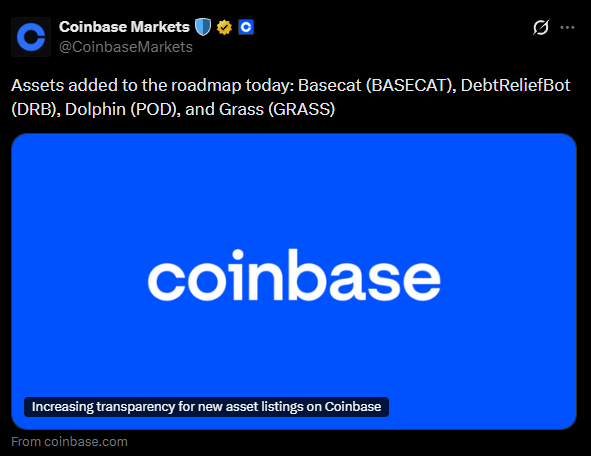
Six days in, the exchange said it had decided to list it, naming that exact contract.
What Coinbase has said. It has affirmatively decided to list this contract, which is a stronger signal than "under consideration".
What it has not said. A trading date, the regions, the pairs or the market maker. Its listings page states that transfers and trading stay unsupported until a separate announcement, and that trading opens only once market-making support and technical infrastructure are in place.
The part worth repeating. Coinbase warns that depositing a roadmap asset before that announcement can mean permanent loss of funds. A roadmap place is not a deposit address.
The market answered before any of those details existed.
Those are DEX Screener pair figures at 21:10 UTC on 21 August 2026, across the thirty pairs where $BASECAT is the base asset. The gap between the last two is the thing to hold on to. A day's trading ran larger than every pool combined, and the deepest single pool held under $800,000. Market cap is price multiplied by supply, not the cash sitting underneath the market, which is how an announcement reprices a small token this hard without tens of millions of new dollars turning up.
The roadmap is a real event and a genuine milestone for a six-day-old meme. It is not a verdict on the cat.
The part that has not happened yet
A mascot is not something a chain announces. It is something that either sticks or quietly stops being drawn, and that verdict takes longer than a week.
What would count as sticking is fairly specific. The hardhat keeps showing up on profile pictures belonging to people who are not holders. The generator gets used by accounts who never bought anything. Base people reach for the cat when they want to say "I build here", the way Solana people reach for their animals, without anyone checking a chart first. That is the difference between a mascot and a ticker with good art, and none of it is visible yet.
The things most likely to decide it are unglamorous. Whether the crew wall is still filling on 20 September, once Coinbase has stopped being news. Whether the safety portal is still maintained. Whether the people running the accounts, the domain and the launchpad metadata turn out to be the community or three people with a press release. And whether anyone at Base ever says anything on the record, rather than following an account.
The cat has the best possible start: a design that costs nothing to adopt, a chain with a hole exactly its shape, and an exchange announcement that put it in front of everyone at once.
The announcement was the easy part. Base has had a face for six days. The question is whether it still has one in six months.
Arc Chain Explained: Circle Wants to Build the Rails, Not Just the Dollar
Circle already supplies USDC. Arc is its bid to build more of the infrastructure around those dollars, with open applications, selected validators, and a token proposal that needs careful reading.

From 400 UNI to Endless Points: How Airdrops Changed Crypto
Airdrops once surprised early users. Then came the roles, the snapshots, the seasons and the points. The history is a fight over who deserves the tokens.
The $65 Million Blokyz NFT Raffle That Took Over X
More than 25,000 ETH queued for 7,500 Blokyz NFTs worth 225 ETH. Most of it was refundable, and the queue itself became the product everyone could see.