Arc Chain Explained: Circle Wants to Build the Rails, Not Just the Dollar
Circle already supplies USDC. Arc is its bid to build more of the infrastructure around those dollars, with open applications, selected validators, and a token proposal that needs careful reading.


- A wallet holds USDC on Ethereum
- The network fee is payable only in ETH
- The dollars wait while their owner shops for gas
- On Arc, the fee is USDC too
A crypto wallet can hold money and still be unable to send it.
Take USDC, Circle's dollar stablecoin. On Ethereum, a wallet full of it can hit a strange wall: the dollars are there, but the ETH needed to pay the network fee is not. Payment tools can hide that step. Circle's own Paymaster already lets apps take the fee in USDC on other networks. But that awkwardness is where Arc starts.
Arc makes USDC the network's own fee currency. The money you send and the money that pays for the sending are the same thing. A small change that decides how an app feels to use.
The bigger change is who is building it. Circle introduced Arc in August 2025 as a Layer 1 built for stablecoin finance. The company behind USDC no longer just supplies dollars that travel across other people's blockchains. Now it is building the venue too.
That is the story worth understanding before launch day: not another chain promising to be fast, but a dollar issuer trying to own more of the infrastructure around its dollar.
First: an L1, not an L2
Arc is an independent Layer 1: its own network, its own operators, its own rules for agreeing what happened. It is EVM-compatible, so developers keep most of the familiar Ethereum toolkit rather than starting over.
Compatibility is not inheritance. An Ethereum rollup, the common kind of Layer 2, leans on Ethereum for its security. Arc does not. It runs its own consensus, and its own validators are the only thing standing behind it.
The road here has been dated and public:
- 12 August 2025. Circle announces Arc.
- 28 October 2025. The public testnet opens. A testnet is a rehearsal: activity there is not customers moving real money.
- 11 May 2026. Circle publishes the ARC token whitepaper and, in its first-quarter results, discloses a $222 million token presale.
- 5 August 2026. Circle names the date: public mainnet on 16 September. The same day it announces the founding validator cohort and says Arc is already running in private mainnet with more than 100 institutional and ecosystem builders.
- 17 August 2026. Arc describes a Uniswap v4 deployment planned for the September mainnet.
- 26 August 2026. Chainlink's Data Feeds, Data Streams, CCIP and Proof of Reserve go live on the testnet.
- 16 September 2026. Scheduled public mainnet. Scheduled, not shipped.
One thing that timeline does not say: 16 September is a network date. It is not automatically the launch date of an ARC token. Those are separate questions, and the token gets its own section below.
What changes when the fee is also a dollar
The immediate difference: USDC pays Arc's transaction fees. Nobody needs a separate, volatile gas asset just to move money.
Imagine a community commissioning an illustration. The artist quotes dollars, the group pays in USDC, and the network fee comes out in the same unit. Not every wallet problem disappears, but one asset leaves the conversation entirely.
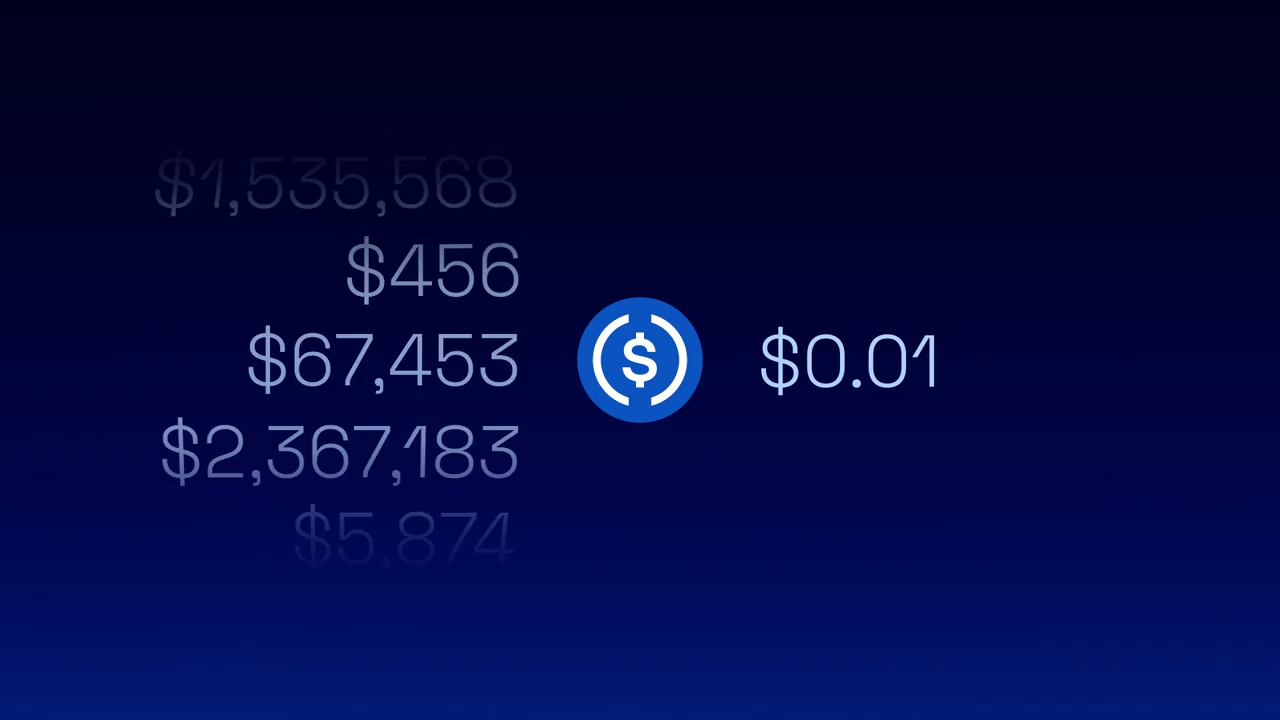
The fee itself is designed to sit around $0.01 per transaction under normal load, and it follows average demand rather than jumping with every burst of traffic. Those numbers are testnet settings, and they can still change before launch. A one-cent target is not a promise that every transaction will always cost one cent.
The circulation figure comes from Circle's USDC page, dated 3 September 2026, and it counts USDC everywhere it exists. It is not money on Arc. It only becomes Arc liquidity if people move it there.
Speed is the other headline. Arc settles a payment in under a second, and a settled payment cannot be reversed. An app never has to guess whether the money moved. That is still not the same as money landing in a bank account: currency conversion, account checks and the banks themselves keep their own clocks. Arc speeds up one leg of the journey, not the whole trip.
What would people actually do there?
Circle's pitch covers payments, foreign exchange, lending and tokenised assets. The common thread is money that software can act on: a payment that fires when work is approved, or an asset and its payment changing hands in one step. These are intended uses, not products running at scale.
For launch, Circle's second-quarter results promise "a full product suite that includes privacy capabilities, an agent stack for programmable finance, and support for tokenized real-world assets." The agents are the interesting audience: software that pays other software, with no person approving each routine charge. Circle says its Agent Stack already hosts more than 900 paid services settling in USDC. Those are company figures, and an ambition. They are not evidence that Arc hosts an autonomous economy today.
Getting dollars in is the quieter question. Circle's Cross-Chain Transfer Protocol moves real USDC between chains: burned on one side, minted on the other, with Circle vouching for the move. No wrapped copies from a third party. Arc's Unified Balance Kit goes further, using Circle's Gateway service to let an app treat a user's USDC across several chains as one balance. A payment app stops feeling like a drawer of separate accounts.
All of it still depends on Circle's infrastructure working as described, and on people choosing to use it. Distribution is an advantage, not a teleporter for other chains' users.
The moat is distribution, not a stopwatch
Paying fees in stablecoins is not, by itself, a moat. Tempo describes a native stablecoin-fee model too, and Circle's own Paymaster already delivers the user-facing half of the trick on other networks. Arc builds the choice into the protocol. It did not invent the benefit.
The stronger argument is the combination. One company issues the dollar, runs the cross-chain plumbing, supplies the wallet tooling, and now operates a network designed around all of it, with financial institutions signed up to run the machinery. That is an interpretation of Circle's strategy, not proof that nobody can match it.
Who each piece is for:
- For a developer, fewer separate systems to assemble before a payments product works.
- For a financial institution, a network built around requirements it already recognises: named operators, service levels, enforceable controls.
- For Circle, a seat at more points in the journey than issuing and redeeming the dollar token.
The counterargument is just as simple. Everyone already has somewhere to operate. Being convenient for Circle's customers does not make Arc the best destination for anyone else.
Open applications, selected validators
Anyone can build on Arc. Running it is a different job. The network launches with a selected set of roughly 20 known, vetted validators, each under audit, uptime and compliance obligations.
The founding cohort announcement names 11 institutions joining Circle: BlackRock, DTCC, Galaxy, Global Payments, ICE, Mastercard, MoneyGram, SBI Group, Standard Chartered, Sumitomo Corporation and Visa. That is an announced list, not a verified count of live nodes.
The roadmap allows a later move to proof of stake, where validators also lock up collateral. Even that future model is described as permissioned. Staking would add money at risk. It would not remove the selection process.
USDC as the native asset brings the issuer's controls with it. Circle keeps a blocklist, and Arc enforces it at the protocol level: a transfer to or from a blocked address simply fails, and the failed attempt still costs gas. Paying fees in dollars does not mean freedom from the issuer's rules.
For institutions, known operators and enforceable restrictions are part of the appeal. For anyone who prizes resistance to intervention, they are the trade-off. Neither audience is served by pretending the choice is not there.
One boundary worth drawing before launch week blurs it: a name on the validator list is not an endorsement of anything built on top. Running the infrastructure is not an approval stamp on what crosses it.
Will there be an ARC token?
There is a serious proposal and a large disclosed cheque. The official language around both is more careful than the posts you will see about them.
In its first-quarter results, Circle disclosed a $222 million ARC presale at a $3 billion fully diluted network valuation, with a16z crypto, Apollo Funds, ARK Invest, BlackRock and others named among the buyers. At the same time, the official token page says no ARC token has launched, calls the whole discussion "merely exploratory," and says "no decision has been made" on whether one will exist at all.
Both things are true at once. The presale happened. The token remains officially unconfirmed.
The split of jobs matters more than the ticker. USDC is the money. ARC would be the machinery token: validators stake it, holders vote with it, and the network converts its fees into it to pay rewards and fund burns. The whitepaper sketches an initial supply of 10 billion:
- 60% ecosystem, which explicitly includes token sales, developer grants and growth programmes. Ecosystem does not mean airdrop.
- 25% Circle, for its role as builder and operator.
- 15% long-term reserve, for stabilisation and stress.
Two details deserve more attention than the percentages. First, the supply grows. New ARC would be issued to pay validators, on a schedule that shrinks over time, and the stated goal is for burns to eventually cancel out that new supply. The whitepaper says plainly that the outcome is not guaranteed. So 10 billion is a starting figure, not a permanent cap. Second, the power is split. Token holders would vote on fees, inflation and burn rules. Protocol upgrades stay with Circle. Unlock schedules are promised for the coming months and have not been published.
"Circle raised $222M at a $3B market cap." The $3 billion figure is a presale's fully diluted valuation. There is no live public market, so there is no market capitalisation.
"The token launches September 16." That is the announced network date. No official token launch date or airdrop eligibility rules were verified for this piece, and testnet activity is not a documented entitlement.
"ARC is on exchanges already." A ticker with the same three letters proves nothing. The whitepaper calls everything in it preliminary, subject to change, and possibly never happening. And ARC would not be Circle equity or a claim on Circle's profits.
The promise side of the ledger
Several of Arc's most quotable features have not shipped yet. The honest way to show them is as a delivery schedule, not a feature list.
| Feature | The pitch | Where it stands in the record |
|---|---|---|
| Uniswap v4 | A deep swap venue from day one | Described by Arc as deploying for September mainnet |
| Chainlink services | Price data, cross-chain messaging, reserve proofs | Live on testnet as of 26 August |
| Privacy (Arc Privacy Sector) | Confidential contract state for payroll and treasury use | On the roadmap, not yet available |
| Post-quantum security | Quantum-resistant signatures, phased in | Wallet-signature beta planned at mainnet; the rest comes later |
| BlackRock BUIDL | An institutional fund operating onchain | "Expected to deploy," no date in the record |
| DTCC tokenisation | DTC-custodied assets tokenised on Arc | Described as beginning in the second half of 2027 |
The tension inside that table is the point. Circle's quarterly results say the launch "will unveil" privacy capabilities. Arc's own privacy page, checked on 5 September, says they are not available yet. Post-quantum protection arrives in phases over years, so nobody should call the network quantum-proof at launch. For every feature on the list, the question is not whether it appears in marketing. It is whether you can actually use it, and under what restrictions.
Everything here was checked against primary sources on 5 September 2026.
Claims by Circle, Arc and their partners are attributed to the announcements that made them. Figures carry their dates: the $74.3 billion circulation number is Circle's own, from 3 September.
Nobody was interviewed for this piece, and nothing in it audits the private mainnet or its performance.
Where the ordinary crypto crowd fits
There is a smaller, more relatable example than the validator roster.
In June, Arc showed off XyloNet, a stablecoin DeFi project on its testnet, and a companion tool called PayX. PayX lets someone tip USDC to an X handle before the recipient has ever touched a wallet. The money waits in escrow on Arc until they prove the account is theirs and claim it. A testnet demo from an interested party, not a live creator economy.
But it shows the shape of the opening. The same rails built for clearing houses can turn a payment into a reply-button gesture. A creator should not need to understand a consensus algorithm to receive a tip. Circle designed Arc for financial institutions. Independent developers do not have to care. Creator payments, community tools and stranger experiments can grow next to the compliance-grade plumbing, and that collision of crowds is the genuinely new thing here. A possibility, to be clear, not a forecast of an Arc memecoin boom.
So judge the launch on two levels. Does the network deliver what was described? And do people come back to what gets built there because it is useful, not because showing up might someday be rewarded? Payments, liquidity, repeat users and clear governance will say more than any partner page.
Circle already supplies the dollar. Arc is the question of whether it can build a place people choose to spend it.
$TRUMP 2 Years Later: Who Won, Who Paid, and What Remains
The chart collapsed. The project did not. Official Trump evolved from a launch spectacle into a holder-ranked access club, while affiliated entities remained central to supply, royalties, trading revenue and the token's next phase.


From 400 UNI to Endless Points: How Airdrops Changed Crypto
Airdrops once surprised early users. Then came the roles, the snapshots, the seasons and the points. The history is a fight over who deserves the tokens.

Before the GTA 6 Leak, $CYBERLEEK Was Already Trading
The Solana token traded for nearly three quiet days before QR-coded GTA 6 footage handed it an audience. The bots got there before the crowd did.
