The $65 Million Blokyz NFT Raffle That Took Over X
More than 25,000 ETH queued for 7,500 Blokyz NFTs worth 225 ETH. Most of it was refundable, and the queue itself became the product everyone could see.

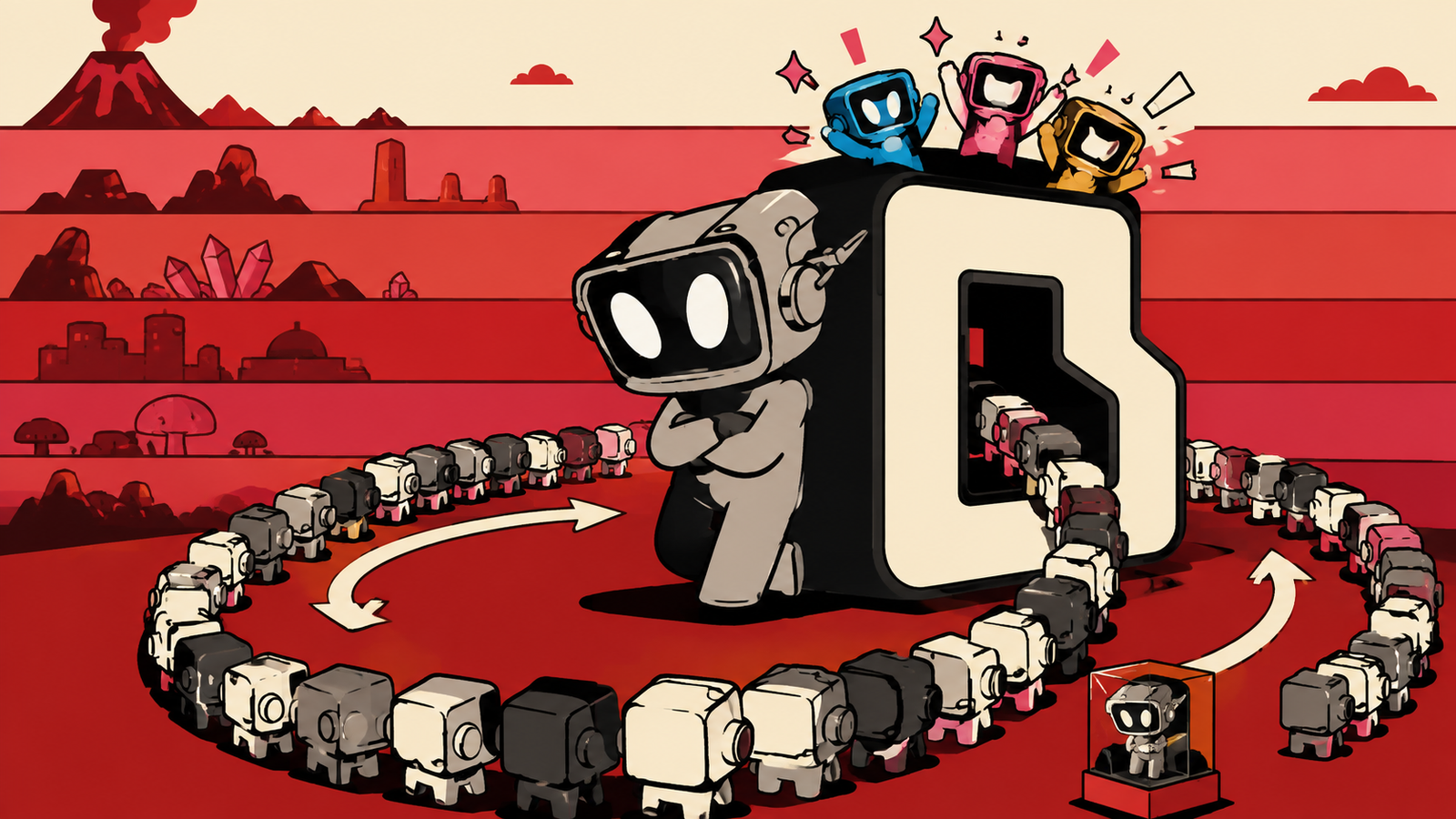
- 7,500 NFTs are offered at 0.03 ETH each
- The allocation subscribes in under a minute
- The entry window stays open another 24 hours
- Every unsuccessful entry is refundable
- The counter climbs past 25,000 ETH
The 7,500 NFTs Blokyz offered the public were worth 225 ETH at the price Blokyz charged for them.
More than 25,000 ETH turned up to queue for them.
That gap is not a footnote to the story. It is the story.
According to the project's official closing post, participants committed more than 25,000 ETH, roughly $65 million at the time, to the public raffle for Original Blokyz.
The terms were plain and the project never hid them: "7,500 supply, 0.03 ETH per entry, no cap. Winners mint, everyone else is refunded in full."
So Blokyz did not raise $65 million. At the stated entry price the entire public allocation came to 225 ETH, and almost everything above that figure was attached to losing entries and due back. The money was real, it was visible, and most of it was always going home.
What that capital bought, while it sat there, was a number that would not stop moving.
The queue was full after one minute. The money kept arriving for another day.
Blokyz says the first 7,500 entries landed in under a minute. The entry window stayed open for a further 24 hours anyway, which the project framed as fairness: nobody in the wrong time zone would lose an NFT to a faster connection.
Both things are true, and together they produce the number everyone screenshotted.
After that first minute, every additional entry went into an allocation its owner could already see was full. The odds only worsened with each deposit, and they were visible in real time. Roughly 24,775 ETH of the eventual total arrived under those conditions: not to secure an NFT that was still available, but to buy a lottery ticket in a draw that was already heavily oversubscribed and getting worse by the hour.
Figures from the project's closing post of 28 August 2026. The dollar conversion is Blokyz's own, taken at the time of that post.
Divide the total by the entry price and you get more than 833,000 entry-equivalents chasing 7,500 NFTs, better than 110 times the public supply. That ratio is the headline everyone reached for, and it is where the reading starts to go wrong.
An entry-equivalent is not a collector. It is not even reliably a wallet. There was no cap, so a single participant could hold hundreds of entries, and the arithmetic cannot tell you whether 833,000 entries came from 200,000 people or from a few thousand. The launch produced an extraordinary capital signal and almost no information about how many humans stood behind it.
That distinction matters more than it sounds, and there is a recent case that proves why. We will come to it.
The business is memecoin communities, cast in resin
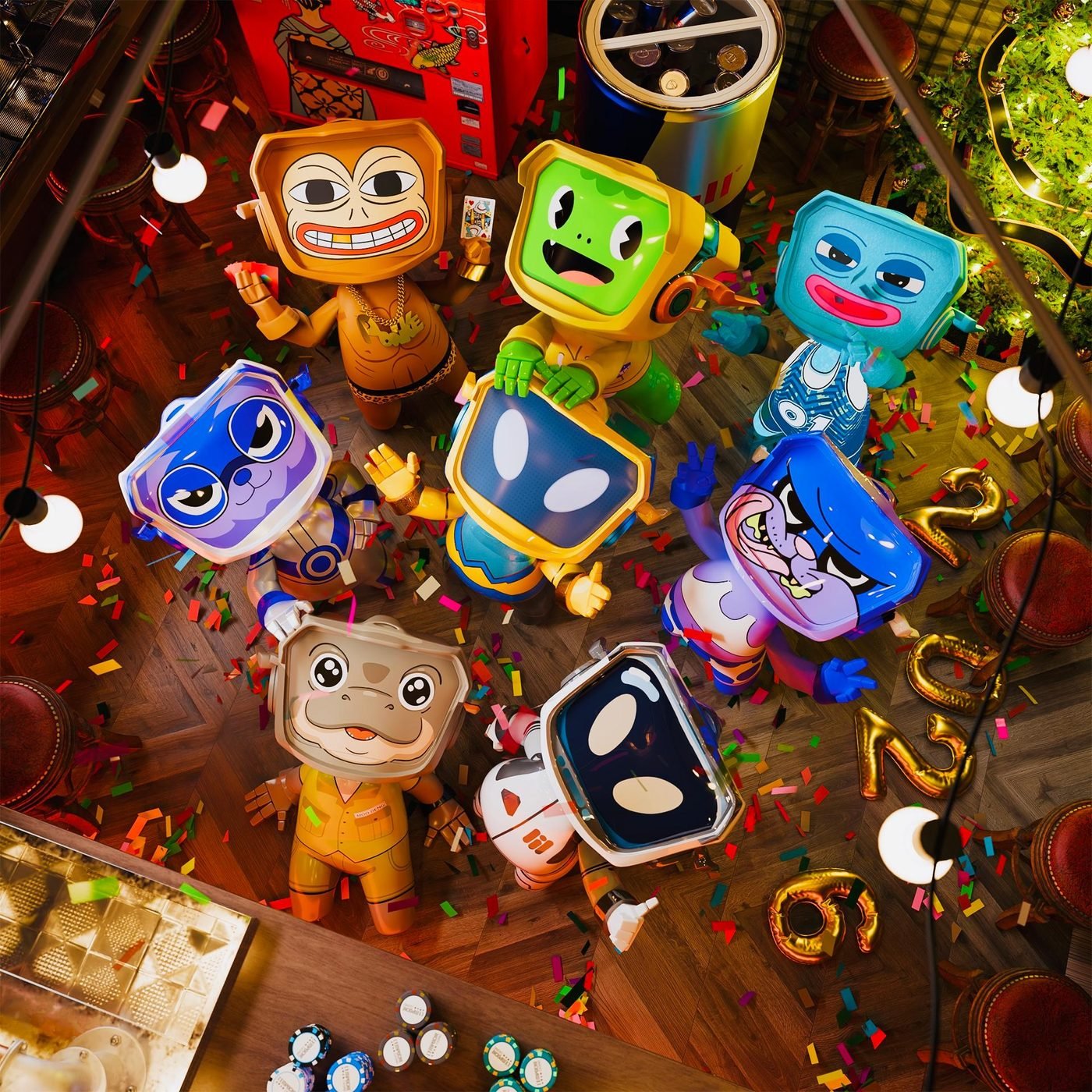
Blokyz is trying to build a designer collectibles house, and its central object is a block-headed figure with a fixed silhouette that can be repainted as almost anything: a protocol, an exchange, a chain, a cartoon frog with a market cap.
The project's stated principle is borrowed openly from Bearbrick, the Japanese format where an unchanging body becomes a canvas for endless identities. "An empty shape holds more than a full one," the documentation says, before claiming the thing Bearbrick does not have: a world of its own.
The reason this launch belongs in Center Ring rather than the toy pages is the partner catalogue, which reads like a memecoin roll call. Turbo. Ponke. Moodeng. Based Brett. Alphakek. Alongside them sit CoinGecko, Arbitrum, KuCoin, Kaspa and Saros, with CyberKongz, Claynosaurz and Normies listed as in production. Each partner edition is a run of exactly one hundred pieces.
Blokyz's argument for all this is that crypto forgets at speed. Communities form in weeks and leave behind "screenshots, dead links, and a Discord nobody opens." A physical object, the pitch goes, outlives the cycle that produced it.
It is a more specific promise than the usual vow to build global intellectual property, and it is considerably harder. Memecoin communities are temporary, territorial, and rarely agree on who speaks for them. Compressing one into a single resin figure means deciding what it is actually about, which is the sort of decision a community can reject.
The distribution model is the part worth studying. Blokyz says partner announcements "come from the partner's own account rather than ours," and describes the arrangement in its own company copy as turning "aligned communities into native distribution channels." Each collaboration introduces the silhouette to a crowd that already trusts the account posting it.
By the time the Originals arrived, Blokyz was not introducing an unfamiliar object to strangers. It was calling in a dozen separately assembled audiences at once.
The project existed long before the mint
Blokyz's strongest asset at launch was not its lore or its raffle contract. It was proof the team could actually make things.
Before the Originals opened, Blokyz had designed, manufactured, packaged and shipped physical collectibles. The flagship format is a resin body with detachable ABS ears, a magnetic base, and an NFC chip from the US vendor Qliktag. Each figure weighs just under 500 grams and stands about 4.5 inches before its base. The team says it inspected six factories in Shenzhen in person before choosing one, and that design, 3D modelling and animation are handled in house.
None of that guarantees future delivery. It does supply something most NFT launches cannot: a production history that predates the hype.
CoinGecko ran a campaign covering the final 30 figures of a 100-piece Gecko Bloky edition.
Selected collectors received a digital token through DYLI which could be redeemed for the physical object, held on the platform, or transferred to someone else.
That is independent evidence that at least one partner system moved past a rendering and through manufacturing, fulfilment, a digital ownership record and a physical redemption.
It is not evidence that the Original collection carries the same redemption right. Nothing in the reviewed material attaches a one-for-one physical figure to an Original NFT, and readers should not assume a partner mechanism transfers.
The project is also unusually candid about the limits of its own technology. On the NFC chip, the documentation states that it "proves the object is authentic. It does not prove the chip is still attached to the object it was attached to at the factory." Security, it says, comes from tamper-evident mounting rather than the chip alone.
That is a small piece of restraint, and it is rarer than it should be. The physical collectibles industry is full of authentication claims that stop being impressive the moment someone mentions glue and a resale market.
Ten thousand characters, 540 drawings, and one piece of software
The Original collection is built across six eras: the Forgotten Years, Prehistoric, Medieval, Modern, Future and Far Future. Each carries five geographically distinct tribes and a set of recurring archetypes, so a Tinkerer in one age has a descendant in the next.
Two faiths run through the whole world. The Temple of the Blok holds that the Blokyz were once wholly machine and something woke in them, so "feeling is the miracle." The Order of the Cog holds the reverse: they were once wholly alive and took the mechanism in to survive. Allegiance shows up in clothing and objects rather than as a filterable trait, which means rarity hunters cannot simply sort for it.
NFT projects have never been short of ancient orders and hidden symbols. The more interesting decision is structural: Blokyz built the setting as "a cast, not a plot," with a permanent foundational layer that never moves and an episodic layer where creators can work. No single protagonist has to appear in every future story, which is what would let other artists build without renegotiating the foundations each time.
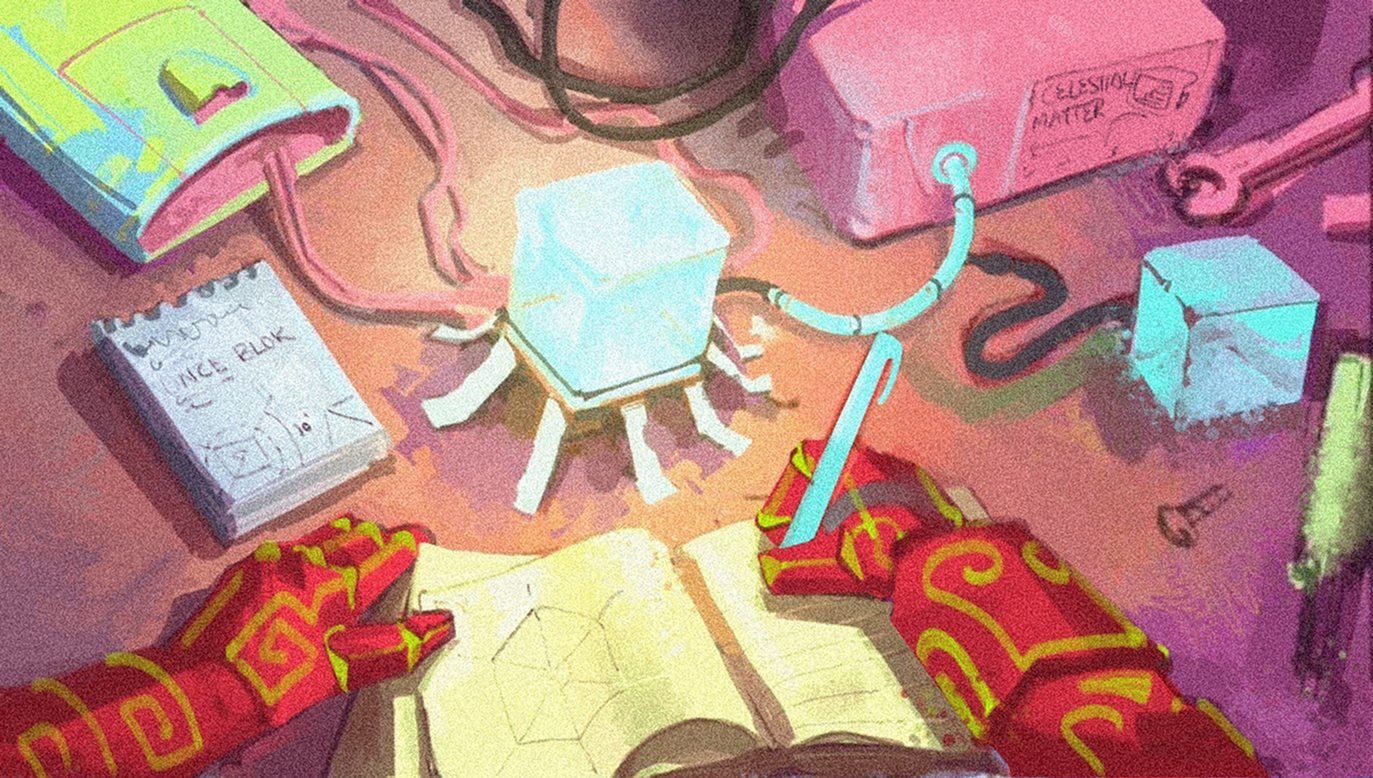
The 10,000 characters are assembled from roughly 540 hand-drawn components across six layers, with palette swapping.
Blokyz built an internal tool, Blokyz Studio, that composites those layers, tracks how often each piece is used, ranks the set by rarity, and lets the art team throw out combinations that look broken or contradict the world's rules.
So human artists made the components, the rules, the environments and the character system. Software assembled and helped curate the results.
That is a substantial creative undertaking. It is not 10,000 portraits painted individually from an empty canvas, and the project's "nothing generated is published under the Blokyz name" framing is easier to assess once the difference is stated plainly.
Open to everyone, weighted by wallet
Whether the raffle was fair depends entirely on which fairness is being asked about.
Measured against a first-come mint, it was a real improvement. The window stayed open across time zones. Nobody had to win a gas auction. Arriving in the opening seconds conferred no advantage, which removes most of the machinery that normally decides who gets an NFT: bots, priority fees, and proximity to the announcement.
Measured as economic access, it was not equal at all. With no wallet cap, more ETH bought more entries and more entries bought more exposure. Two participants could touch the same contract while expressing wildly different financial weight.
Blokyz then added a second contest on top of the first. The project announced that the 100 largest bidders on the leaderboard would be able to claim a limited physical Original Bloky, of which only 100 were planned. The NFT allocation stayed random, but the physical reward was awarded strictly by size, and it gave the largest participants a reason to keep depositing long after the odds on the NFTs themselves had collapsed.
Both statements hold at once. It was open. It was not economically equal.
After the first minute, the raffle stopped being a way to distribute 7,500 NFTs and became a way to display demand for them.
The last raffle this size had a cap. That changes what the number means.
More than 25,000 ETH into a 24-hour NFT lottery is rare, but it is not unprecedented, and the precedent is instructive.
In January 2024 the Chinese NFT project TinFun ran a public sale lottery that also drew around 25,000 ETH, and closed ahead of schedule once it hit that target. Same headline number, similar duration, comparable oversubscription drama.
The mechanics were not the same at all. TinFun let each wallet deposit a minimum of 0.1 ETH and a maximum of 0.2 ETH, once per wallet. Blokyz charged 0.03 ETH per entry and set no cap whatsoever.
That single design difference decides what each total is capable of proving.
| TinFun, January 2024 | Blokyz, August 2026 | |
|---|---|---|
| Collection size | 10,000 | 10,000 |
| Public allocation | 4,200 | 7,500 |
| Entry price | 0.1 ETH | 0.03 ETH |
| Per-wallet limit | 0.2 ETH, one entry per wallet | None |
| Total committed | About 25,000 ETH | More than 25,000 ETH |
| Wallets that total needed, at minimum | About 125,000 | One |
That last row is arithmetic, not an accusation. Because TinFun capped every wallet at 0.2 ETH, its 25,000 ETH could not have come from fewer than roughly 125,000 separate addresses. The cap converted the total into a headcount, and the headcount was the achievement.
Blokyz set no ceiling, so the identical figure carries no floor. Arithmetically a single wallet could have produced all of it. Nobody thinks that happened, and the leaderboard plainly had many participants on it, but the point stands: the number tells you how much capital showed up and refuses to tell you how many people did.
There is one further wrinkle. The unofficial community dashboard tracking the raffle warned users that its displayed odds were only estimates, because the Blokyz team runs a sybil-detection algorithm that can remove entries before the draw. That is a third-party description of the project's process rather than a documented procedure, and the dashboard says plainly that it is not affiliated with the team. But if entries can be filtered by discretion before allocation, then the fairest-sounding part of the mechanism has an unpublished human step in front of it, and the criteria for that step have not been made public.
The multisig moved the risk. It did not remove it.
As the deposits mounted, so did questions about how much control the project retained over a contract now holding tens of millions of dollars.
Blokyz responded during the raffle by transferring contract ownership to a two-of-three multisignature wallet. The announced signers were UJ from Blokyz, the smart-contract auditor 0xQuit, and OxSimpleFarmer. Sensitive actions, including setting the raffle root and the refund total, would need at least two approvals.
That is a genuine improvement over one person holding the keys, and changing the structure mid-event rather than dismissing the concern was the right instinct.
It is not the same as removing trust. 0xQuit said so directly, warning that the arrangement did not make the launch "rug-proof" and that an audit should not be read as an endorsement of the project, the art, the team or the market. A multisig distributes authority. It cannot prove the allocation was computed correctly, that every refund completed, or that signers will never coordinate.
What settles those questions is evidence, and all of it arrives after the announcement: the final allocation record, the transactions approving it, the refund total actually designated, the refunds actually completed, and any gap between what was announced and what executed.
The credibility of this raffle rests on what happened to the ETH, not on how recognisable the names on the signer list were.
Where it actually stands
At the time of writing the public allocation had not visibly landed.
At 17:44 UTC on 28 August 2026, OpenSea listed the Original Blokyz collection at 2,500 items held by 884 owners, with no floor price and no volume displayed.
That item count matches the 1,750 community presale and 750 treasury allocations exactly, which suggests the 7,500 public NFTs had not yet been distributed at that moment.
It is a marketplace's indexing at one instant, not a contract read. Indexing lags, owner counts treat wallets as people, and this figure will be stale quickly.
It is included because it establishes the obvious thing: at this cut-off, the part of the launch everyone argued about had not yet produced a single public holder.
Which means the loudest NFT launch of the month is currently unresolved in every way that will end up mattering.
Six things are still open:
- The refunds. With more than 24,000 ETH due back, returning it cleanly is not administrative tidying. It is the central promise of the mechanism.
- The allocation record. A verifiable draw, published in a form outsiders can check against the contract.
- The holder count. Unique wallets and concentration among the largest of them, which is the only thing that converts 25,000 ETH into a statement about people.
- The sybil filter. How many entries were removed before the draw, and on what published criteria.
- The rights. Which commercial rights, physical entitlements and platform access actually attach to an Original NFT, stated as terms rather than as collector-access language.
- The reveal. Whether 540 components across six layers produce 10,000 characters that read as composed rather than shuffled.
The roadmap will not help anyone judge the pace. Blokyz deliberately attaches no dates to its four phases, on the stated grounds that "dates are promises made by people who do not control the variables." That is defensible, and it is also unfalsifiable: a roadmap without dates cannot miss one. Progress will have to be judged on shipped work.
What the roadmap does describe is genuinely interesting. The planned collector platform centres on an illustrated map where ownership "reveals part of the world, and it places a character who can build in it," with territory staying charted even after a piece is sold. The physical onboarding is the sharper idea: buy a figure, tap the chip, log in with an email, and skip extensions and seed phrases entirely.
What the counter proved, and what it did not
Blokyz has now demonstrated three things beyond argument.
It can command an enormous amount of temporary capital. Its silhouette travels across crypto communities that agree on very little else. And a refundable raffle can convert a one-minute sellout into a full day of escalating public spectacle, which is a distribution insight other projects will copy long before they copy the manufacturing.
That third one is the transferable lesson, and it is worth being precise about who it serves. A refundable queue costs a participant nothing but time and opportunity cost, which is exactly what makes it such an efficient attention instrument: the barrier to joining the crowd is a deposit you expect to get back. The project gets a public counter that only moves in one direction, for 24 hours, at no cash cost to anyone.
What none of that establishes is the thing the project is actually trying to build. A crowd assembled around a rising number has a reason to watch. It does not yet have a reason to stay once the number stops moving and the ETH goes home.
The physical evidence is real, the world is more carefully structured than most, and the partner network is a genuine acquisition loop rather than a slide. The Originals are the test of whether any of that belongs to Blokyz itself, or only to the crypto names painted on its earlier figures.
Blokyz won the counter comfortably.
Now it has to build the thing that remains when nobody is watching it move.
Ansem.io Is Not Just a Launchpad. It Is a Market for Ansem's Attention
Ansem's new Solana platform borrows pump.fun for the launch, then sells the thing it actually owns: his audience, priced in burns, airdrops and a leaderboard.

What Are Quotrons? Inside $QUOTRON's Stock-Reward NFTs
Quotrons turns retro stock terminals into collectible, fee-linked NFTs. Its next test is whether the rewards can outgrow trading in Quotrons itself.
Almost Five Years After $SQUID: The Fake Game Token Crypto Still Remembers
The unauthorised Squid Game token did not spread because its warnings were hidden. It spread because a famous name and a one-way market made them secondary.