Almost Five Years After $SQUID: The Fake Game Token Crypto Still Remembers
The unauthorised Squid Game token did not spread because its warnings were hidden. It spread because a famous name and a one-way market made them secondary.
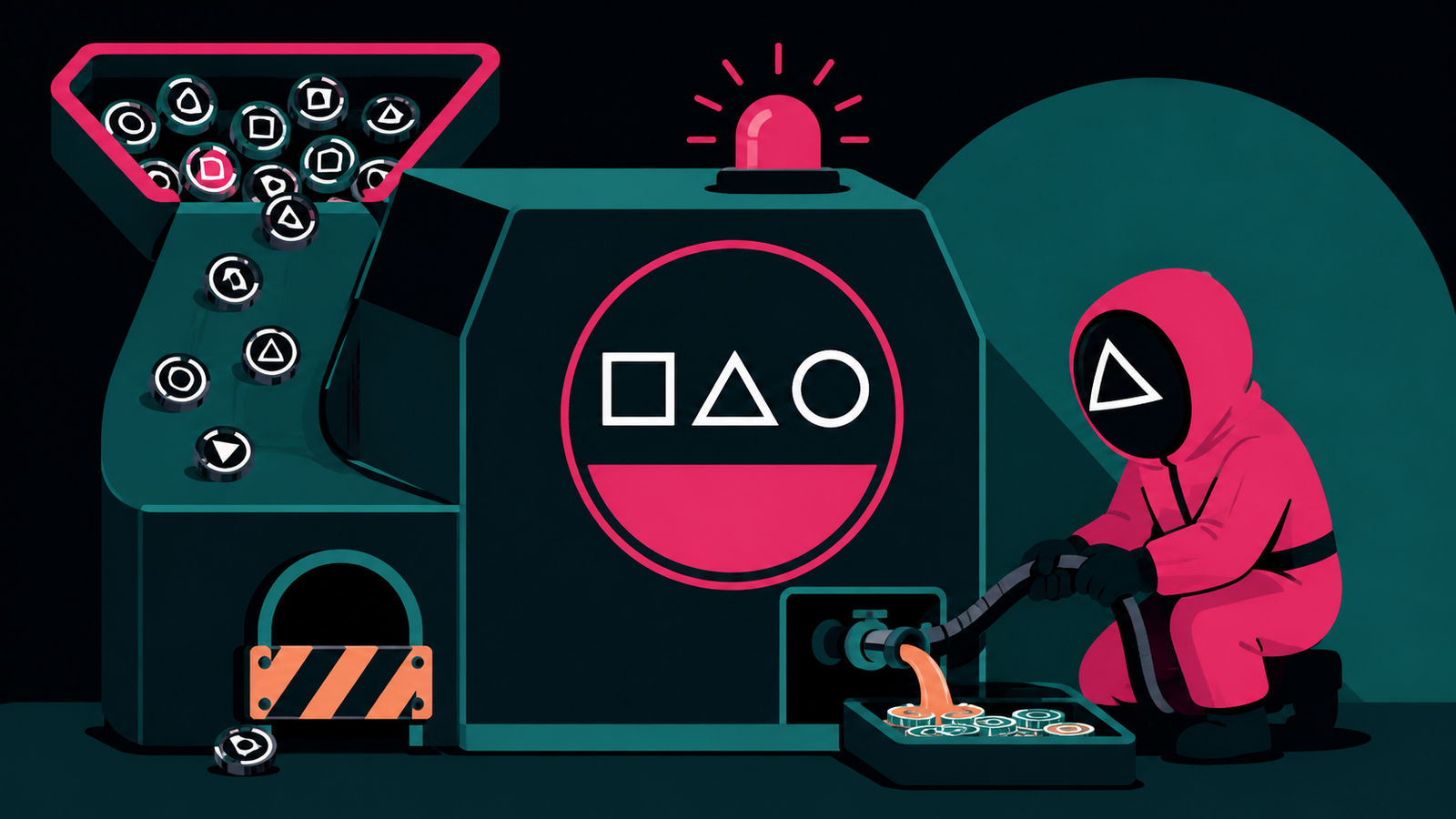
- A famous name supplies recognition
- Entry is trivial
- Exit needs a second token
- The quoted price climbs unopposed
- Coverage supplies reach
- The liquidity leaves
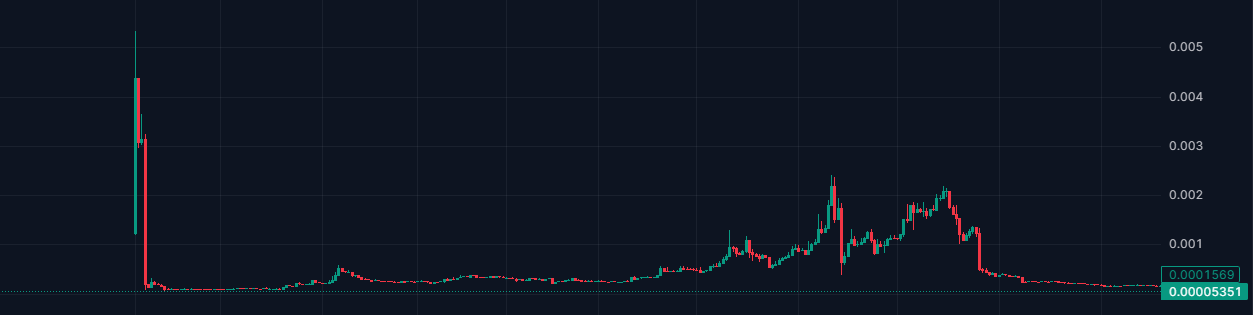
Shortly after 13:38 UTC on 1 November 2021, roughly $3.36 million left the liquidity behind the Squid Game token. Within ten minutes a token that had briefly quoted at $2,861 was worth almost nothing. The website went down. The social accounts stopped working. The people behind it were never identified.
That gets told as a rise and a crash, which is the wrong shape for it.
Buyers could put real BNB into it. Many holders could not get it back out. The price kept climbing partly because the ordinary flow of sellers had been obstructed, so the famous peak was not the market discovering extraordinary value. It was the arithmetic of a system where entry was trivial and exit was reserved.
The chart was real. The fortune it appeared to show never existed.
Nearly five years later, that distinction is still the whole reason this one gets remembered.
The show arrived first, and did the vetting
Netflix released Squid Game on 17 September 2021, and it reached 111 million accounts inside its first 28 days. Green tracksuits and geometric symbols became instant internet furniture.
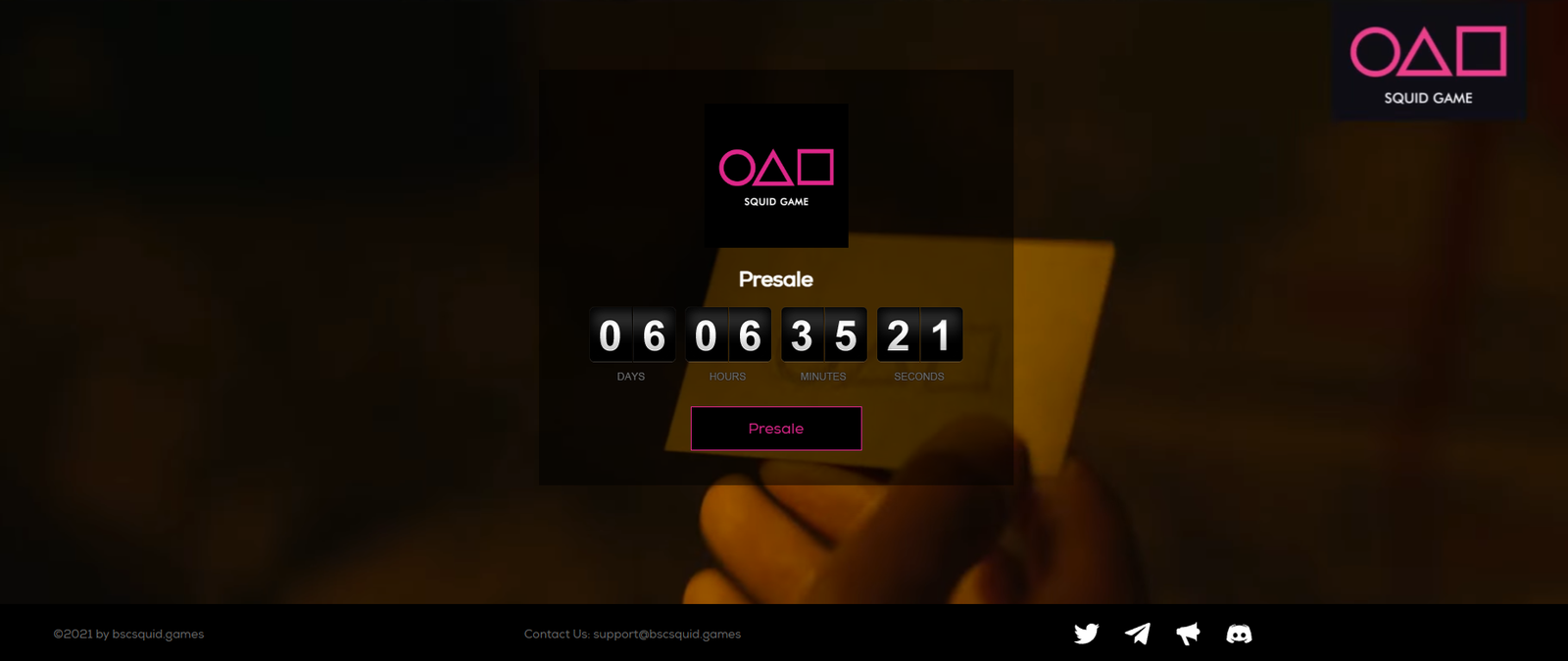
The token followed almost immediately. The domain was registered on 12 October, the promoters claimed a presale that sold out in one second on 20 October, and the original BNB Chain contract dates to 21 October, though some contemporary reports treated 26 October as the public launch. Contract creation, pair creation and public availability were three different events, and collapsing them into one date is how a project with days of history acquires the appearance of a track record.
The pitch was a play-to-earn tournament built on the structure of the series. Entry fees in the token, ninety per cent into a prize pool, ten per cent to the developers, and the first games in November. The tournament never happened.
There was never any authorisation. Netflix said it was not involved, and nothing in the public record established a connection to the show's creators or rights holders. But the token borrowed the title, imagery and premise closely enough that "Squid Game token" read to a casual eye as an official product.
That was the first mechanism it exploited, and it is the one worth naming plainly: recognition doing the work of verification. The project never had to build a visual identity, explain a character or earn a community joke. It rented a global obsession and let familiarity handle the first round of due diligence.

The missing exit was sold as game design
The project called its sell restriction an anti-dump mechanism.
Per the white paper, holders needed a second token called MARBLES to sell $SQUID, and those MARBLES would be burned on sale. Buying would release selling credits. The whole arrangement was framed as protecting the market from sudden dumps.
The framing worked because it fitted the source material. A convoluted rulebook, a scarce object called a marble, and a structure where only some participants reach the next round all sounded thematically correct for a Squid Game product. A restriction was dressed as tokenomics, and the costume was supplied by the show.
In practice it produced a market with two classes of permission. Ordinary participants could buy. They could not necessarily sell.
A trader who spoke to Wired had been in crypto since 2017 and bought about $300 of it on 28 October. By the next day he was reading posts from people who could not sell, and he bought MARBLES to test whether an exit existed. At the quoted peak his position appeared to be worth almost $1 million. It was a number on a screen.
That detail matters because it breaks the comfortable version of this story, the one where only newcomers ignored obvious signs. Experience did not confer immunity to urgency, social proof, or a line going up.
How the price is made. A decentralised exchange quote is the output of swaps against a liquidity pool. Buyers and sellers push against each other, and the balance in the pool moves the number.
What a blocked exit does to it. Remove the sellers and the counterpressure disappears. New purchases keep lifting the quote while holders cannot execute the opposite trade, which is what makes a one-way market so persuasive to look at.
Why the headline figure was fiction. A last-traded price is not what every holder could receive, and multiplying it by total supply does not produce a cashable sum. The pool held a small fraction of the wealth the valuation implied.
So the billions were never there. Post-collapse reports describing billions erased were describing a number that could never have been paid out to anyone.
The warnings were public before the money left
By 29 October the project already looked indefensible. The founders could not be verified and their claimed backgrounds did not resolve into real profiles. The website carried broken links, unfinished sections and conspicuous spelling errors. The social accounts limited replies, which kept outside warnings from appearing under promotional posts. Unrelated Elon Musk commentary about the television show was repurposed to imply attention for the token.
And buyers were already saying publicly that they could not sell.
CoinMarketCap put a warning on the token's page before the collapse, in plain language: "We have received multiple reports that users are not able to sell this token in PancakeSwap". It added that the project was unlikely to be affiliated with the official intellectual property. Gizmodo called it an obvious scam on 29 October, leading with the only fact that really mattered: money could go in, and there was little evidence it could come out. Forbes reported the absent Netflix affiliation, the anonymous team and the tracker warning, also before the liquidity vanished.
The internet was not short of warnings. It was short of a hierarchy that ranked them above the chart.
The media failure was ordering, not ignorance
It is too easy to say the press was fooled. Much of it was not. Fortune's 29 October piece led on a gain of more than 86,000 per cent, and it also carried CoinMarketCap's warning that users could not sell, and noted an official link to the series was unlikely.
The problem was the running order.
A headline about an 86,000 per cent rise with "buyers may be unable to sell" several paragraphs down still makes the chart the story. The warning becomes a complication inside a gains piece rather than the fact that invalidates the gains piece. And every article that repeated the name, the price and the game claims also supplied distribution, carrying the token out of crypto feeds and into general attention. Wired later reported criticism that mainstream coverage lent the unauthorised project a veneer of legitimacy, particularly where the missing Netflix connection was not made prominent.
When a token cannot be sold, the inability to sell is the headline.
Which generalises into something more useful than "do more research". Ten things worth settling before anyone publishes a viral token's price:
- Verify authorisation. Check statements from the company, creator or rights holder whose identity is being used.
- Test sellability. Confirm an ordinary wallet can execute a small sell. A tracker chart is not evidence of an exit.
- Read the mechanism. Secondary-token requirements, transfer restrictions, blacklists, owner privileges, upgrade controls, external contracts.
- Verify liquidity. How much counter-asset is actually in the pool, who controls the position, and whether any claimed lock can be independently confirmed.
- Check concentration. Record deployer and major holder positions without asserting who those wallets belong to.
- Separate the dates. Contract creation, pair creation, presale, announcement, tracker listing and exchange listing are six different events.
- Label the number. Circulating market cap, fully diluted value, self-reported supply and price times supply are not interchangeable.
- Put the decisive warning first. If holders cannot sell, that belongs in the headline, not below a percentage.
- Archive everything. Site, white paper, posts and account names, before the operators can edit or delete them.
- Do not mistake a disclaimer for a neutraliser. A gain-first headline amplifies a project even when the caveat is present lower down.
How the two weeks actually ran
- 17 September 2021. Netflix releases Squid Game, and it becomes the platform's biggest launch to that point.
- 12 October. The token's domain is reportedly registered, giving the project days of visible history.
- 20 October. The promoters claim a presale sold out in one second. A project claim, never independently verified.
- 21 October. The original BNB Chain contract and trading history begin. Some later reports use 26 October as the public launch.
- 29 October. Buyers report they cannot sell. CoinMarketCap adds a warning. Gizmodo calls it a scam. Other outlets keep leading with the percentage.
- 31 October. The quote accelerates. Some holders buy MARBLES trying to unlock an exit.
- 1 November, just after 13:38 UTC. Roughly $3.36 million leaves the pool. Ten minutes later the token is worthless and the project's infrastructure is gone.
- 3 November. Binance says it is investigating, blacklisting related addresses and preparing to hand findings to law enforcement.
- April 2024. A later community promotes a V2 contract and a cross-chain migration, describing itself as volunteer-run and unrelated to the original team.
- 8 April 2024. An attacker exploits faulty logic in the migration's swap contract with a flash loan, taking an estimated $87,000.
The removal itself was not invisible. Wired reported that eight of the 43,455 addresses then associated with the token held more than one per cent of supply, and that an address holding around five per cent moved approximately $3.36 million onward, through Tornado Cash. The final Telegram message blamed hackers, scammers and developer stress, announced the team no longer wanted to run the project, and suggested $SQUID would enter a phase of community autonomy.
Contemporary estimates of the amount taken ranged from about $2.1 million to $3.38 million depending on method and timing. This piece uses Wired's onchain figure while noting that reputable outlets published different numbers, because the spread is itself part of the record.
As of late August 2026 there is no verified announcement identifying the original promoters, and no arrest, charge, conviction, civil judgment or settlement tied to the original operation appears in the public record. Journalists have pursued the identification independently. That is a reporting result, not proof that nothing is unresolved elsewhere.
The creators disappeared more successfully than the contract did.

What remains: the ticker outlived everyone who made it
$SQUID did not die. It split.
There are more addresses holding the original contract now than there were when the scam was running. Addresses are not people, and that figure is provider-dependent and easily inflated by dust, but the direction is the point: the thing that collapsed accumulated more holders afterwards than it had at its peak.
| Original contract | Squid Game V2 | |
|---|---|---|
| Created | October 2021 | 2024 |
| Chains | BNB Chain | Omnichain via LayerZero, on BNB Chain and Base |
| Holder addresses | About 102,000 | More than 111,000 |
| Liquidity | About $359,000 | Very little |
| Built by the 2021 team | No, community-continued | No, separate community |
| Own security incident | The 2021 liquidity removal | The April 2024 swap exploit |
Market figures are provider-dependent and move quickly. The structural facts do not: the original scarred contract is still trading, a second contract presented as V2 is also onchain, and the pages describing the relationship between them do not agree with each other.
Neither is the original team returning. Both trade on the cultural memory of the collapse while trying to hold the people who caused it at arm's length, and a project created partly to escape the original contract's vulnerabilities immediately acquired one of its own.
The project failed in 2021. The ticker became an inheritance dispute.
Why it is still the one everybody cites
$SQUID was not the biggest fraud of its era, nor the most technically sophisticated, and it invented none of the techniques it used. It is remembered because it compressed an entire attention economy into under two weeks, with every component visible.
A television phenomenon supplied the brand. Anonymous promoters supplied the token. A game-themed restriction supplied the missing exit. A thin pool supplied the impossible number. Social media supplied urgency, news coverage supplied reach, and then the chain supplied a public record of the money leaving.
The story is almost too neat. A token based on a series about desperate people entering a competition they did not fully understand became a market where buyers discovered the rules did not apply equally. That is a good enough joke to have carried it for five years, and it should not obscure that the people who lost money were exposed to a contract, a pool and an information environment controlled by people they could not name.
Squid Game-themed scam tokens returned when the show's second season did, on chains that did not exist in 2021. Cultural memory does not confer immunity, because a recognisable name can be recycled every time the franchise comes back.
So the lesson was never "avoid tokens named after television shows".
Visibility is not verification. A tracker listing is not approval. A famous name is not authorisation. A quoted price is not liquidity. And a market that cannot process an ordinary sell is not giving you a price at all.
In 2021 everybody watched $SQUID go up. The information that mattered was the exit that did not work.
How $microduck Turned a $399 Robot Into an NVIDIA Narrative
A real robot supplied the character. Reports of an NVIDIA deal supplied the storyline. An unofficial token on Robinhood Chain brought the two together.
From Dog Wif Hat to Ape on Fone: The Story Behind $FONE
The account was six days old. The post, the token and a fully migrated market arrived in 111 seconds. Then the crowd began using the meme to describe itself.
What Are Quotrons? Inside $QUOTRON's Stock-Reward NFTs
Quotrons turns retro stock terminals into collectible, fee-linked NFTs. Its next test is whether the rewards can outgrow trading in Quotrons itself.