What Is a Memecoin, Really?
A memecoin is not just a joke with a contract. It is a cultural symbol, a tradable asset, and a crowd still arguing over what either one is worth.

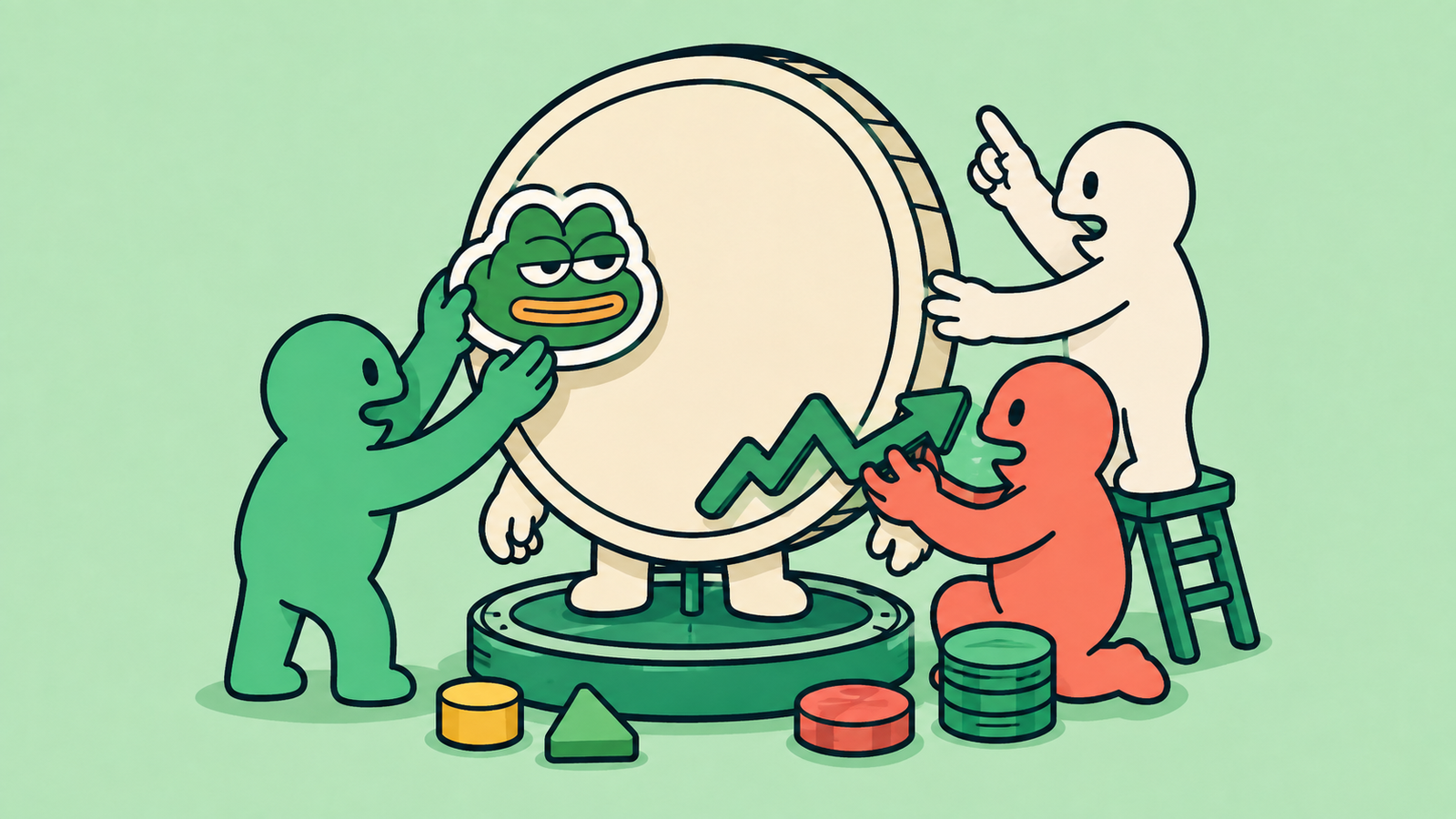
- A symbol people recognise
- A crowd that copies and argues about it
- A token that turns joining in into a position
- Market events that become new lore
A memecoin is a transferable crypto asset whose identity and demand rest on a shared cultural symbol and on the crowd circulating it.
The meme supplies recognition and a story. The token supplies units, scarcity and a price. The crowd supplies distribution, interpretation, belief, conflict and everything that eventually gets called culture.
Utility can arrive later. The label on its own guarantees none of it: not fairness, not safety, not creator approval, not liquidity, not decentralisation, and not a community that still exists next month.
The object arrived before the word
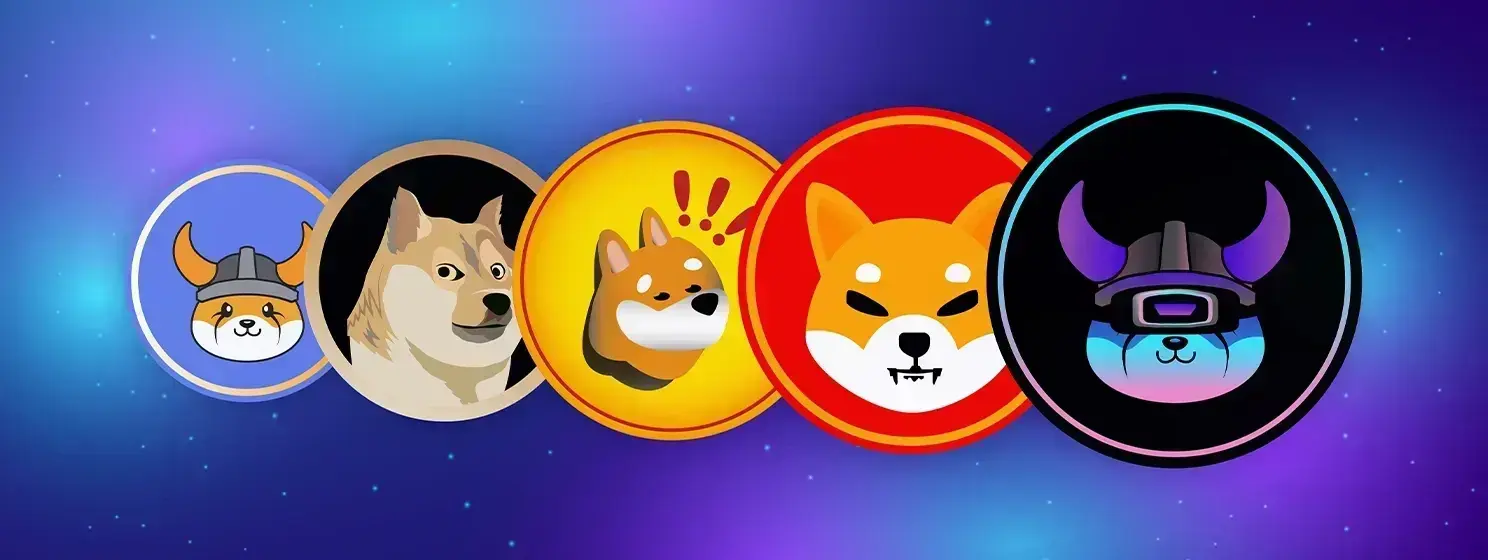
On 6 December 2013, Billy Markus and Jackson Palmer launched a cryptocurrency built on Doge, the Shiba Inu image language that had been circulating for three years. Within two days its announcement thread was already written in the meme's broken grammar: very scrypt, many coin, wow.
The word for what they had made took longer. Merriam-Webster dates the first known use of "meme coin" to 2014, and still defines it as an altcoin created "typically as a humorous tribute" to something or someone, "and that typically has no real utility."
$DOGE was built as a joke about an industry its founders thought was taking itself too seriously. It did not stay one. Its early crowd used it for tipping, public fundraising and community campaigns, including a push behind the Jamaican bobsled team and wells in Kenya.
That is the whole machinery in miniature. A recognisable cultural object. A transferable asset. Then a crowd deciding what the combination was allowed to mean.
Most dictionaries and exchange glossaries say a memecoin is a cryptocurrency based on a joke or an internet meme. That is accurate and almost useless.
It explains where the branding came from. It does not explain why people gather, why markets form around some symbols and not others, why a few produce institutions that outlive their founders, or why most evaporate the moment attention moves.
The definition below is an editorial model, not a legal test or a quality score. It tells you what kind of object you are looking at. It says nothing about whether that object is fair, safe or likely to survive.
A symbol, a market, and a crowd
Three parts have to be present at once.
- The symbol. A character, phrase, image, event, personality or joke that people can recognise and repeat.
- The market. An asset that can be held, transferred, distributed, priced and traded.
- The crowd. The people, promoters, artists, moderators, developers, holders, critics, bots and spectators who circulate the symbol and negotiate what it means.
None is sufficient alone. A funny image with no token is just a meme. A tradable token with no identity is a utility asset or a speculative instrument. A large group with no shared symbol and nothing transferable is an audience.
A memecoin is what appears where all three overlap.
The meme is a format, not a logo
The word predates crypto by decades. Richard Dawkins coined it in 1976 for cultural material transmitted by imitation. Internet scholars later adapted it, and Limor Shifman's formulation is the useful one: internet memes are not single viral images but groups of related items, created and copied and transformed by people who are aware of each other's versions.
That distinction does real work here. A meme is not a picture sitting on a token page. It is a format people know how to continue.
The Doge origin makes the point better than any theory. On 13 February 2010, a Japanese kindergarten teacher named Atsuko Sato posted photographs of her rescued Shiba Inu, Kabosu, to her personal blog, including one of the dog glancing sideways at the camera with raised eyebrows. Sato did not invent the meme. Anonymous users on a Tumblr blog did, by overlaying her photograph with Comic Sans captions in a broken inner monologue that anybody could imitate.
The photographer supplied the image. The crowd supplied the grammar. That division shows up again and again in this category, and it is why "who made this" is usually the wrong question and "who can continue it" is usually the right one.

The strongest symbols make participation cheap. Nobody needs a technical briefing before posting a dog in a hat, changing an avatar, translating a catchphrase or drawing another version of a familiar frog. $PEPE inherited an enormous archive of faces and moods and contradictory readings. Others launch a character and a token together and hope the crowd will do the memetic work afterwards.
The token is not the meme
Many things called memecoins are not coins at all, which is a distinction worth keeping straight even though the culture ignores it.
Dogecoin is a native cryptocurrency with its own blockchain. Most later arrivals are fungible tokens issued on somebody else's network: Ethereum's ERC-20 standard defines interchangeable tokens, while Solana uses mint accounts to define an asset, its supply and its authorities, and separate token accounts to record who holds what. The word memecoin flattens all of that, because it describes a cultural and market role rather than a technical standard.
What tokenisation adds is a set of things a meme cannot do by itself: identifiable units, wallet ownership, transfer rules, a recorded supply, a distribution among participants, venues to exchange them, and a visible price.
That turns attention into positions. Someone can own a quantity, send it, sell it, pay contributors with it, pool it, or gate a room with it.
What it does not do is convey the joke. Holding units recorded by a token contract is not ownership of the character, the photograph, the catchphrase or the copyright. The PEPE project site is unusually direct about this, stating that the token has no association with Matt Furie or his creation and describing itself as paying homage to the meme.
So "official" always needs a second question: official according to whom? A token may be made by the original artist, licensed by a rights holder, endorsed after the fact, unofficial but tolerated, publicly disowned, competing with three other versions of the same character, or operating while the creator has said nothing at all. Those are six different factual situations, and marketing copy treats them as one.
The chart does not merely measure the story. In memecoin culture it becomes part of the story.
The crowd is not the holder count
A deployer can create a token and a designer can draw a mascot. Neither can create a culture, because culture requires other people to repeat things without being asked.
"Community" gets used as a synonym for holders, and it should not be. A holder count records addresses holding a balance. It does not establish that those addresses are separate people, that those people share an identity, or that any of them contribute anything beyond a trade.
Weak evidence: holder count, follower count, message volume, a group chat that only discusses price.
Stronger evidence: recurring contributors who are named and known, original art and remixes, moderation and visible conflict resolution, shared language, translations and regional groups, rituals or anniversaries, and collective projects.
The hardest test: does any of it continue while the chart is quiet, and does it survive the departure of whoever currently leads it?
Dogecoin's tipping and fundraising years are the standard example. The crowd was not only speculating on what the token might be worth. It was using the token to perform a particular version of itself, publicly and repeatedly, which is what an institution looks like before anyone calls it one.
What is actually primary
These labels overlap and none of them is a clean legal or technical category. The useful question is not which box a token belongs in but what it is mainly for, and there is a quick way to find out: mentally delete the meme and see what survives.
| Label | What is usually primary | Delete the meme and |
|---|---|---|
| Memecoin | A shared symbol and the crowd circulating it | there is nothing left to gather around |
| Utility token | Access to, or payment inside, a product or protocol | the product still works the same way |
| Community token | Membership, governance, rewards, shared resources | the membership still means something |
| Fan token | A recognised relationship with a club, artist or brand | the affiliation is still the reason to hold it |
| Branded token | The issuing company, platform or personality | the brand carries it regardless |
| Celebrity or political token | Identity, affiliation, opposition, spectacle | the public figure is still the whole point |
A community token can use memes heavily without being a memecoin. A protocol token can develop a ferociously memetic identity and remain a protocol token. A celebrity token can behave exactly like a memecoin while using entirely official branding. The categories describe emphasis, not purity.
Utility can arrive afterwards
It can, and that does not revoke anything. $BONK describes itself as a community meme coin while presenting integrations across decentralised finance, consumer apps, art and sport. Its identity did not have to be dismantled first for people to build things around it.
The regulators now say something similar in their own vocabulary, and it is the sequence rather than the origin that they treat as decisive.
| Where a memecoin sits | What puts it there | Consequence |
|---|---|---|
| Digital collectible | Demand comes from artistic, entertainment, social or cultural significance and from supply and demand, rather than from the essential managerial efforts of its creators | Not a security under the interpretation |
| Digital commodity | It later becomes functional inside an associated crypto system | It leaves the collectible category |
| Potentially a security | The collectible is fractionalised and buyers reasonably expect profits from the managerial efforts of others | Securities law can attach after all |
That framework comes from a joint SEC and CFTC interpretation issued on 17 March 2026, which sorted crypto assets into five categories and placed NFTs and meme coins together as digital collectibles. It is a United States regulatory description rather than a universal cultural definition, and it turns on economic substance and what was actually promised, not on what a website calls itself.
The existence of utility, meanwhile, proves nothing about its quality. Plenty of advertised utility is a chatroom, a roadmap and a feature nobody opens. The reverse holds too: a token with no application can still do real social work, as entertainment, identity, coordination, gifting or status. Social purpose is genuine purpose. It is simply not the same thing as contractual rights, cash flow, or protection from loss.
What the label does not promise
Calling something a memecoin establishes none of the following, and each one is a separate thing to check.
- That the original creator approves, or has ever been asked.
- That anyone involved controls the rights to the imagery.
- That the launch was fair, or that supply is widely held.
- That risky contract authorities have been removed.
- That the project is community-controlled in any sense that survives inspection.
- That the social activity around it is organic.
- That liquidity will still be there when you want to leave.
- That there is one universally accepted official contract address.
It also does not make fraud impossible. Regulators have repeatedly warned that tokens can be spun up around popular culture, promoted hard on social media, and sold into the attention they generate. Wrapping that in a joke does not change what it is, and the humour is frequently the mechanism: it lowers the reader's guard at precisely the moment it should be going up.
A short history of the word and the thing
- 1976. Richard Dawkins introduces "meme" for cultural material spread by imitation.
- 13 February 2010. Atsuko Sato posts photographs of Kabosu to her blog. The meme does not exist yet.
- 2010 to 2013. Anonymous remixers add the Comic Sans inner monologue, and Doge becomes a format rather than a picture.
- 6 December 2013. Markus and Palmer launch Dogecoin, and the announcement is already written in the meme's grammar.
- 2014. Merriam-Webster's first recorded use of "meme coin". Dogecoin's crowd is meanwhile tipping and fundraising, proving the asset can coordinate something other than speculation.
- Late 2022. BONK launches around Solana community identity and accumulates integrations later, the meme-first-then-utility path in a single token.
- 2023. PEPE becomes the prominent case of a token built on an older character while explicitly disclaiming its creator.
- 17 March 2026. The SEC and CFTC place meme coins among digital collectibles, and concede they can become functional later.
So what is a memecoin?
A shared symbol with a transferable market attached, and a crowd arguing about both.
The meme gives people something to recognise. The token gives them positions to own and exchange. The crowd gives the pair a life well beyond whatever the deployer intended, and that life can become a community, a product ecosystem, a cultural archive, a political signal, a spectacle, or an extraction machine. Frequently several of those in the same week.
Which is why "a joke cryptocurrency" was never quite enough. The joke opens the story. The market raises the stakes. The crowd decides what happens next.
More in The Degen Almanac
InfoFi Paid Crypto to Talk. Then X Changed the Rules.
InfoFi promised to reward useful crypto voices. Then X revoked the API underneath the whole model, and four businesses had to become something else.
What Is $QENIS? Inside the Solana Meme's First Five Days
Qenis existed as an AI character before the contract. Five days later, $QENIS had thousands of traders, creator-linked economics, and an unfinished control story.
$TRUMP 2 Years Later: Who Won, Who Paid, and What Remains
The chart collapsed. The project did not. Official Trump evolved from a launch spectacle into a holder-ranked access club, while affiliated entities remained central to supply, royalties, trading revenue and the token's next phase.
